Mariology of the Wedding at Cana

The Wedding at Cana, narrated in Jn 2:1-11, is the setting of Jesus’ first sign and of the only command of Mary preserved in the Gospels: “Do whatever He tells you” (Jn 2:5). This episode, seemingly domestic, has an extraordinary theological and Mariological density: it reveals the intercessory role of Mary, inaugurates the public mission of Jesus and anticipates the “hour” of the cross. Practically the whole tradition of the Church, from Saint Cyril of Alexandria to Saint John Paul II, has found in these few lines a synthesis of the relationship between Mary and Christ.
We practically know this passage of Jn 2:1-11 by heart, always studied and cited by the great Tradition of the Church of Christ. However, an in-depth study of this passage never ceases to surprise us as an inexhaustible source of treasures for the understanding of Mary and of Christ.
Before this narrative, in the 1st chapter of John (1-18) we find the prologue, which is a testimony, and then a narrative prologue (19-51) with the testimony about Jesus by John the Baptist and the call of the disciples. In this context the passage of the Wedding appears inserted within this revelation of the mystery of Jesus in the grand realities of salvation. This appears even more clearly if we compare the Wedding at Cana with the Cross (Jn 19:25-27). Placed at the beginning and at the summit of the mystery of Jesus and of the signs that reveal Him, the two verses form an inclusion between them, that is, they open and conclude the entire work of salvation of Jesus, in which His Mother has a prominent place.
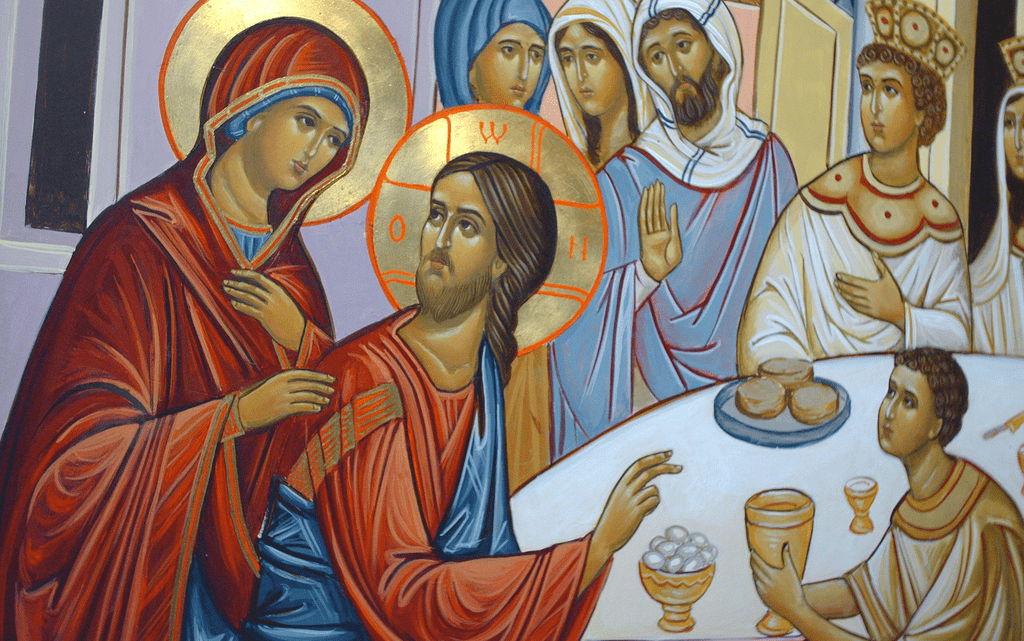
Jn 2:11 and the “beginning of the signs”: the context of the Johannine prologue and the presence of Mary at the wedding at Cana
The wedding at Cana is where the beginning of the signs of Jesus takes place (Jn 2:11). This sign — in the Gospel there are no miracles, but signs — is an action performed by Jesus to reveal His identity as the Son of God, a presence in our midst, Emmanuel, as the Word made flesh.
The Mother of Jesus (v. 2.3.5.12), present at the Wedding, places herself on a completely human level and remarks to Jesus that they have no more wine (v.3). Jesus answers in an initially disconcerting way (v.4), calling Mary not Mother but Woman. This distance of Jesus with regard to family ties, in order to affirm His identity and mission, echoes in the answer Jesus gave to His parents in the temple of Jerusalem (Lk 2:49). Still more in the answers of Jesus about the Mother and the brethren who were looking for Him (Mk 3:31-35. Mt 12:46-50). In reality, flesh and blood (family) must give way to the demands of the will of God the Father in the Christian’s mission.
“Woman, what does that matter to me and to you?” (Jn 2:4): the title “Woman”, the “hour” of Jesus and the intercession of Mary
Far from any suspicion of discrimination against women on Jesus’ part, the term woman does not have a negative connotation. It will be taken up again and made explicit in the verses of the Cross (19:26), at the moment when the new identity and particular role of the Mother of Jesus in the mystery of salvation will be manifested.
At Cana, however, the term seems to take on a positive and new meaning, as can be argued from the words that the Mother, immediately afterwards, addresses to the servants (v. 5). In every circumstance Jesus claims a space of His own in His relationship with the Mother, for His hour had not yet come (v. 4). This hour of Jesus is the time of His passion-death and glorification, in which the Father and the Son will be glorified (Jn 13:31. 17:1). The hour orients the whole existence of Jesus, and it is a tension that embraces the entire Gospel of John, from the initial expression my hour has not yet come (2:4) to Father, my hour has come (17:1), a dramatic existence of Jesus who cannot anticipate the hour.
After this revealing and mysterious answer of Jesus, the response of Mary is transformed into the mission entrusted to her of doing the will of the Son of God: do whatever He tells you (v.5). This simple response already finds its root in the event of Mount Sinai in Ex 24:7, where it is stated: He then took the book of the covenant and read it aloud to the people, who answered: “We will do everything the Lord has spoken and we will obey”. With these words, which reflect the experience of a past event, we again find a sign that will reveal the glory of the Son of God and inaugurate the faith of the disciples.
The sacramental symbolism of the wedding and the Eve-Mary typology: Mary as the “Woman” of the new covenant
If we look at the Wedding as a simple historical description, possibly devoid of meaning, we will never be able to see the depth of this passage, filled with a symbolism that still impresses us. The Wedding is a sign of the final communion of God with His people (multiplied bread and wine), the wedding makes us see Christ as the bridegroom of the Church, and in 3:29 John the Baptist defines himself as the friend of the bridegroom!
In all this sacramental symbolism the Mother of Jesus appears above all as the Woman at the side of Jesus, serving the mission of the Son and the faith of the disciples. As Mother she becomes a disciple of Jesus, passing from they have no more wine to do whatever He tells you, which shows a total adherence of faith, together with a work of mediation similar to that of Moses on Sinai, for fidelity to the New Covenant is salvation for the new community of the faithful.
As Woman, the Mother of Jesus has as her mission to continue the mission of the ancient Daughter of Zion, serving the whole people of God, as we will later find made explicit on Calvary. By her faith Mary is the first of the disciples of the Lord, who, welcoming the words of Jesus, constitute the community of the new covenant. In this sense, together with the disciples who came to believe after seeing the sign of Jesus, she is the true bride of Him who, far beyond all symbolism, is the bridegroom of the Church and of humanity: Jesus, the Word of God made flesh.
And you, reader, what contributions do you have about the event of the “wedding at Cana”? What questions do you have concerning this great moment in the history of salvation?
To deepen the Mariology of the Wedding at Cana, consult the encyclical of John Paul II: Redemptoris Mater, which analyzes the presence and mediation of Mary at Cana.
Deepen your studies: explore Mariology, Marian Theology, Marian apparitions and the Postgraduate Program in Mariology.
Postgraduate Program in Mariology
Would you like to deepen your formation in Mariology? Discover the Postgraduate Program in Mariology of Locus Mariologicus, an academic formation that unites theological rigor, spiritual life and the living tradition of the Church.
Would you like to study Mariology seriously?
This article is born of the works in the library of Locus Mariologicus. The Postgraduate Program in Mariology brings you to the same source, with academic guidance: Scripture, the Fathers of the Church and the Magisterium, from the first dogma to contemporary questions.



Responses