Marian iconography: the apses of churches from the 5th century.

When the image of the Virgin Mother with the Child in her arms, or turned towards the Incarnate Word, placed in a central position under a theophany of the glorious Lord, began to occupy the apse of churches, this was because it perfectly corresponded to the demands of content and, consequently, of form, of the apsidal compositions.
Now, from the beginning, the peculiar content of the apse iconography signifies, through the sense of sight, the presence, believed through faith and celebrated in worship, of the Risen Lord, Priest of the unique eternal liturgy, to which all are united in the earthly liturgies.
In the human experience, sight and presence are inextricably linked. Christian faith is based on the testimony of those who saw and touched the Word of God.
“Annunciation”Beginning with John’s baptism and ending on the day he was taken up into heaven“Mariology, angelology, demonology, josephology” “Short title/phrase – translate without context or additional information”Acts (1,22)
We are witnessing a manifestation of God in the flesh.
However, there are three categories of witnesses in the Church:
- Testimonies of eye-witnesses, historical, among which the Virgin Mary occupies a privileged and unique place.
- How many, through the gift of life to the shedding of blood, are equated with eyewitness witnesses (the very martyrs)?
- and a third category, largely ignored, consisting of Christians who celebrate/worship and thus become, in the present meta-historical of the liturgy, the sacramental witnesses of the Incarnation.
The sensitive vision, mediated by the concrete image of the Reality believed and celebrated, therefore does not clothe the audience with neutral or amorphous concerns, but meets the inner vision, characterized by testimony, of those related to details that are credible. The quality of this encounter can then also become an indication of the quality of the image.
The last statement may seem a bit bold or provocative, but it is based on an objective fact contained in the teaching that guides us from the Christian art of the first millennium.
Who were the madmen who needed to be taken into account?
On one hand, the dogmatic-liturgical purpose re-established in the iconography of the apse aims to express the presence of the Living Lord in His Church. On the other hand, in the human experience, presence is inextricably linked to vision: therefore, apse compositions must attempt the characteristics of vision. To do this, Christian figurative expression adopts the expressive laws of vision rediscovered by Late Antiquity in traditional cultures, rooted in anthropological laws, including, of course, the chromatic aspect: a symmetrical and strongly centered composition, the absence of depth, frontalness, the immobility of main figures, and the serenity of their expressions.
Everything here that is omitted when presenting the unfolding of an action in progress or the manifestation of strong feelings, such as tenderness, pain, would, in a more general sense, weaken the focus on vision, diverting the viewer’s attention from the substance of the encounter, emotionally engaging them or distracting them from the center.
This is the backdrop against which the insertion of the Virgin Mother Mary into apse iconographic programs is delineated: here her testimonial figure refers not only, first and foremost, to the precise historical event of the Incarnation (
epitaphThis figure of the Virgin Mother, however, always speaks of the Epiphany that ventures into time and is sacramentally present in the Church. As we will see, the figurative language allowed the dual temporal reference inherent to the Mother-Son group.The expression with different accents, for instance, suggesting the concreteness of the Incarnation (the gesture of Lactation“or by indicating the interchangeability between the figure of Mary and that of” Churchand also, in the case of compositions with two levels, by direct reference to the quality of the Virgin Mary, as an eyewitness to the divinity of Christ.
The attentive celebrant/contemplative has already grasped the basic harmony between the characteristics of the Marian iconography of the first period and the specific needs of the absidal iconography: a semantic harmony that facilitated, as much as possible, the entrance of the Virgin Mother into the Christian absides, not only from the point of view of content – dogmatic and celebratory – but also from the point of view of form.
As categories
Marian side altars can be divided into three main categories:
- Those who, with different variants, have as core the group Mother-SonBy far the most numerous.
- those in which the The virgin is depicted face-on with her arms outstretched. Symmetrically and raised to heavenPrayerful one“Lumen gentium”
- those in which Mary is depicted in profile, with her arm extended “Gently raised (or both) in a significant posture”Virgin Advocate or of Intercessor“Light of the Nations”
As already mentioned, setting aside topical-artistic analysis, the focus will primarily be on the composition’s structure, the postures of the figures, and generally, on gestures or significant elements for a Marian reading of the works.
- The Virgin Mother with the Child
In the apses, the Virgin Mother and the Child are always depicted full-length. Possible variants They refer to:
“—” compositionThe Mother-Son group can be represented by itself or in relation to a topical-salvific theophany.
“–” to autonomous representationThe Mother-Son group appears alone or accompanied by other characters (angels, apostles, martyrs and/or saints).
“–” combined representationThe Mother-Son group is represented together or below (in scenes with two registers).
“–” A manifestation of God from the Old TestamentIn most cases, the vision of the chariot and the four living creatures of Ezekiel 1:4-28.
“–” A manifestation of the New TestamentAdoration of the Magi, Transfiguration, Ascension.
“—” an eternal manifestation of Christ.
Postures of the two figures:
– The Mother: always facing forward, she may be seated or standing:
– The Child, in relation to the Mother, can be positioned axially or to the side:
– When to the side, the Mother’s left or right arm may be resting on the Child.
– Both the child and the mother can be depicted in a vertical position.
– Or the Child can bring His face close to that of the Mother («face a face»).
Specific actions performed by the Mother regarding the Child:
– When the Child is not on Her knee, the Mother holds up Her free hand in a gesture signifying indication and intercession.
– She may be nursing the baby.
– She may hold a clasp (medal/circle) within which the Child is depicted.
We now begin the presentation of the different Marian iconographic types found in the apses. The analysis of each will be followed by examples constituted by works that can usefully complement their illustration and understanding, even if not all are present in the apses.
Mother of the Virgin with the Child
on thrones
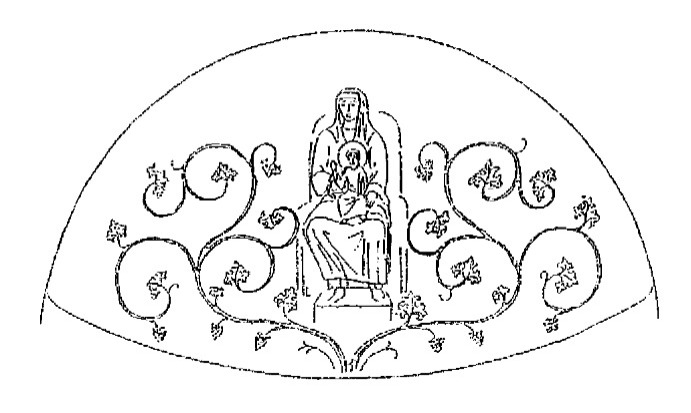
Mother Virgin with the Child, enthroned, apse, S. Maria Capua Vetere, Basilica of the Sulci, 5th century reconstruction.
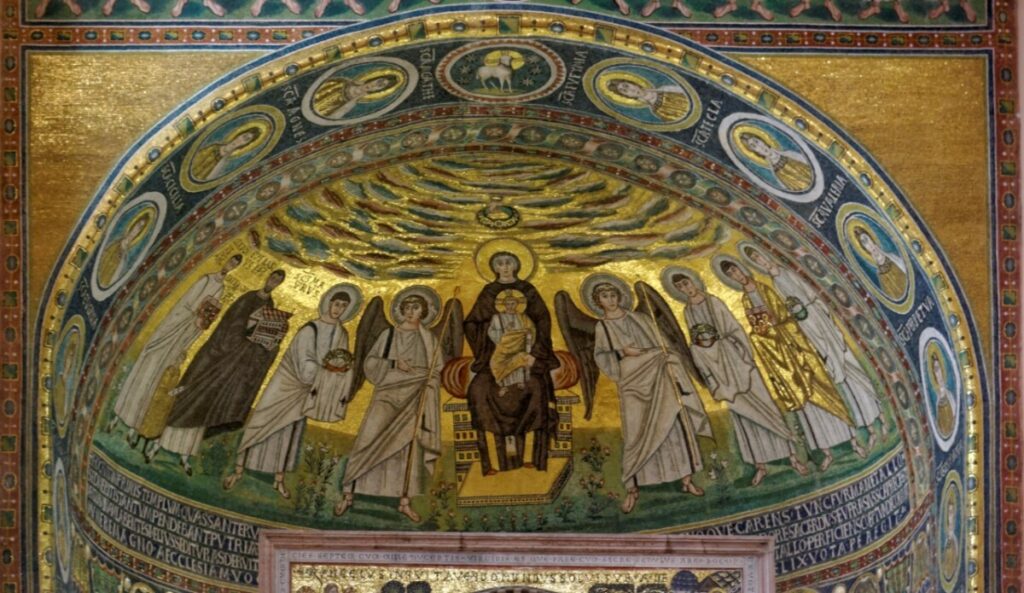
Mother Virgin with the Child, enthroned between two angels, four saints, and donors, apse of the Basilica of St. Eufrasius, 6th century.
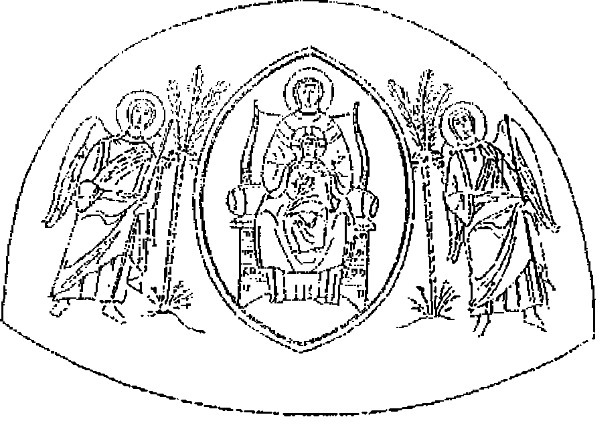
Mother Virgin with the Child, enthroned between two angels, apse, Panagia Kanakaria, Cyprus, 6th-7th century, reconstruction
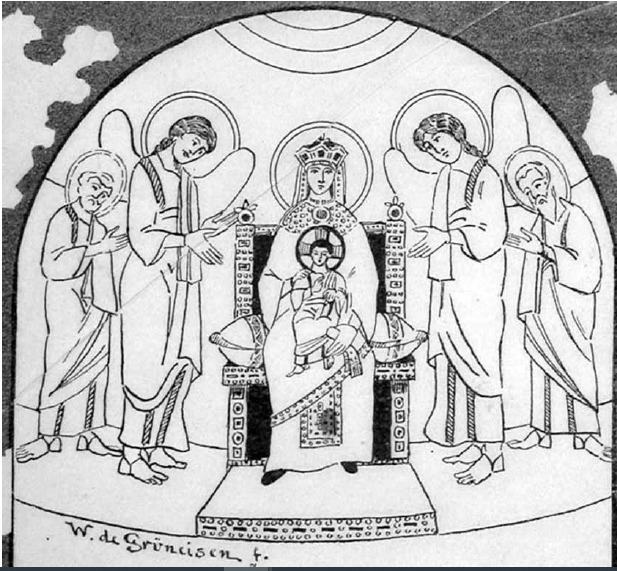
Mother Virgin with the Child, enthroned between angels, Peter and Paul, apse, S. Maria Antiqua, Rome, early 8th century, reconstruction
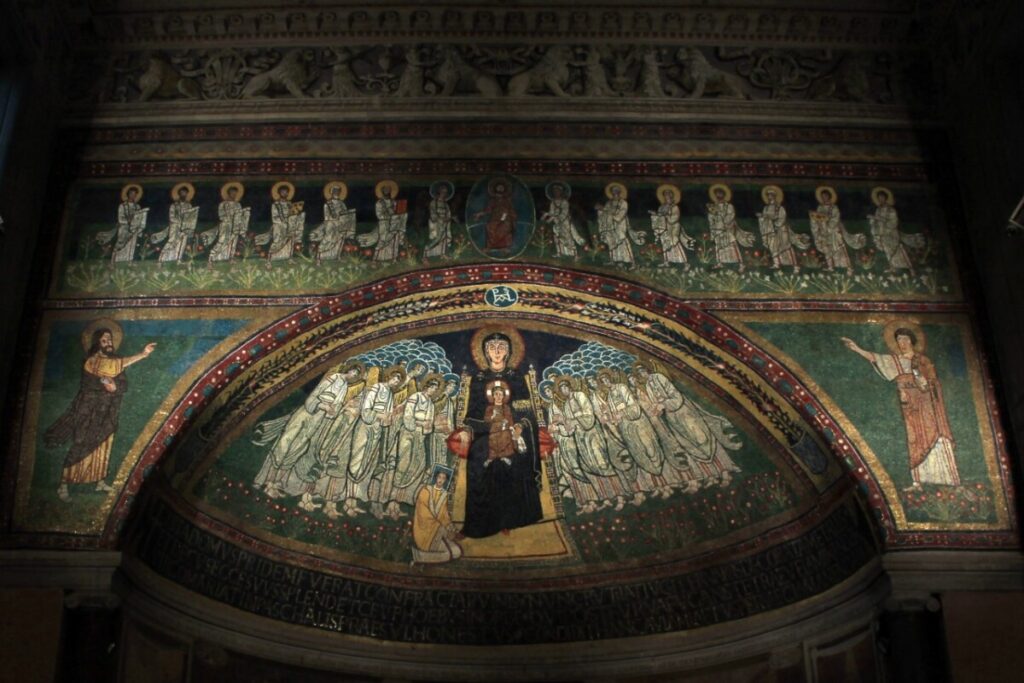
Mother Virgin with the Child, enthroned among angels and bestowing grace, apse, S. Maria in Domênica, Rome. 9th century.
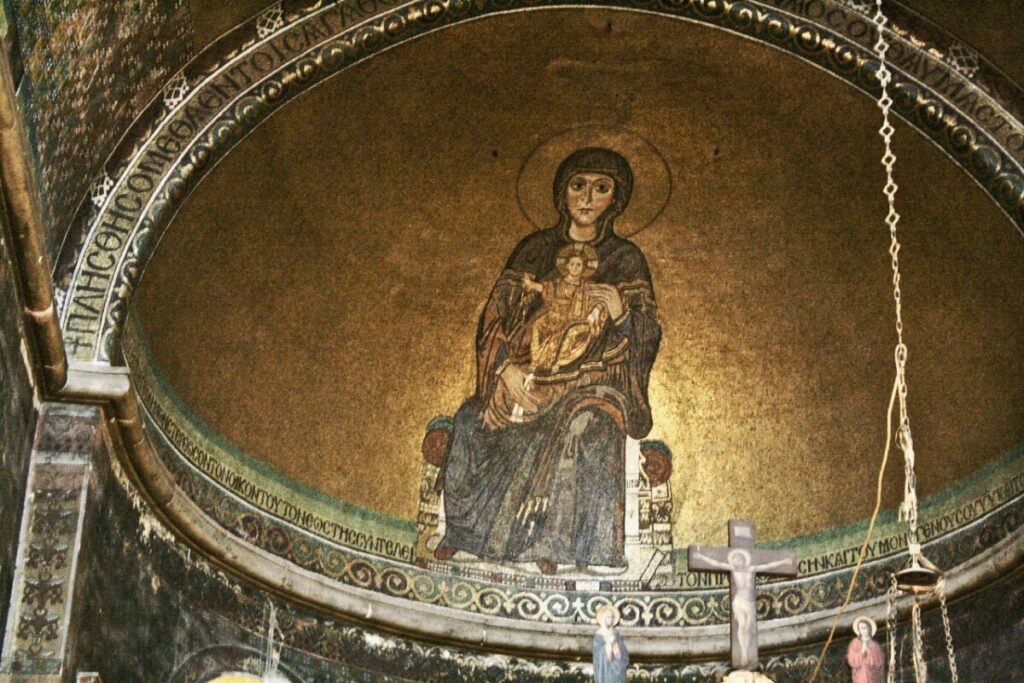
Mother Virgin with the Child on the throne, apse of St. Sophia, Thessaloniki, 9th century.

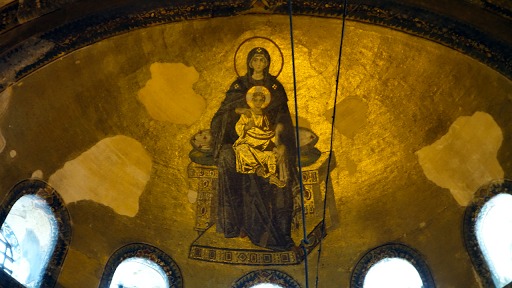
Mother Virgin with the Child on the throne, apse of St. Sophia in Constantinople, 9th century
Concluding…
From the description of Coricius of Gaza (d. 530), we learn that the content of the mosaic in the entirely gold and silver-adorned apse of the church of St. Sergius in Gaza depicted the Virgin Mother with the Child between the saints Sergius and Stephen. In particular, the martyr Sergius made the patronal gesture (hand resting on the shoulder) towards the basileus, the benefactor/restorer of the church, while beside him was the bishop holding a model of the church.
To deepen your reflection on Marian iconography in church apses and its liturgical meaning, consult the Apostolic Exhortation Marialis Cultus by Paul VI, which situates artistic expressions of Mary within the context of worship and the liturgy of the Church.
Further your studies: explore Mariology, Marian theology, Marian apparitions, and the Postgraduate Program in Mariology.
Postgraduate Program in Mariology
Would you like to deepen your formation in Mariology? Get to know the Postgraduate Program in Mariology from Locus Mariologicus, an academic formation that combines theological rigor, spiritual life, and the living tradition of the Church.
Discover the oldest Marian image in the Catacomb of Priscilla.
Would you like to study Mariology seriously?
This article arises from the works in the Locus Mariologicus library. The Postgraduate Program in Mariology takes you to the same sources, with academic guidance: Scripture, the Fathers of the Church, and the Magisterium, from the first dogma to contemporary issues.




Responses