Mary and the Incarnation of the Word
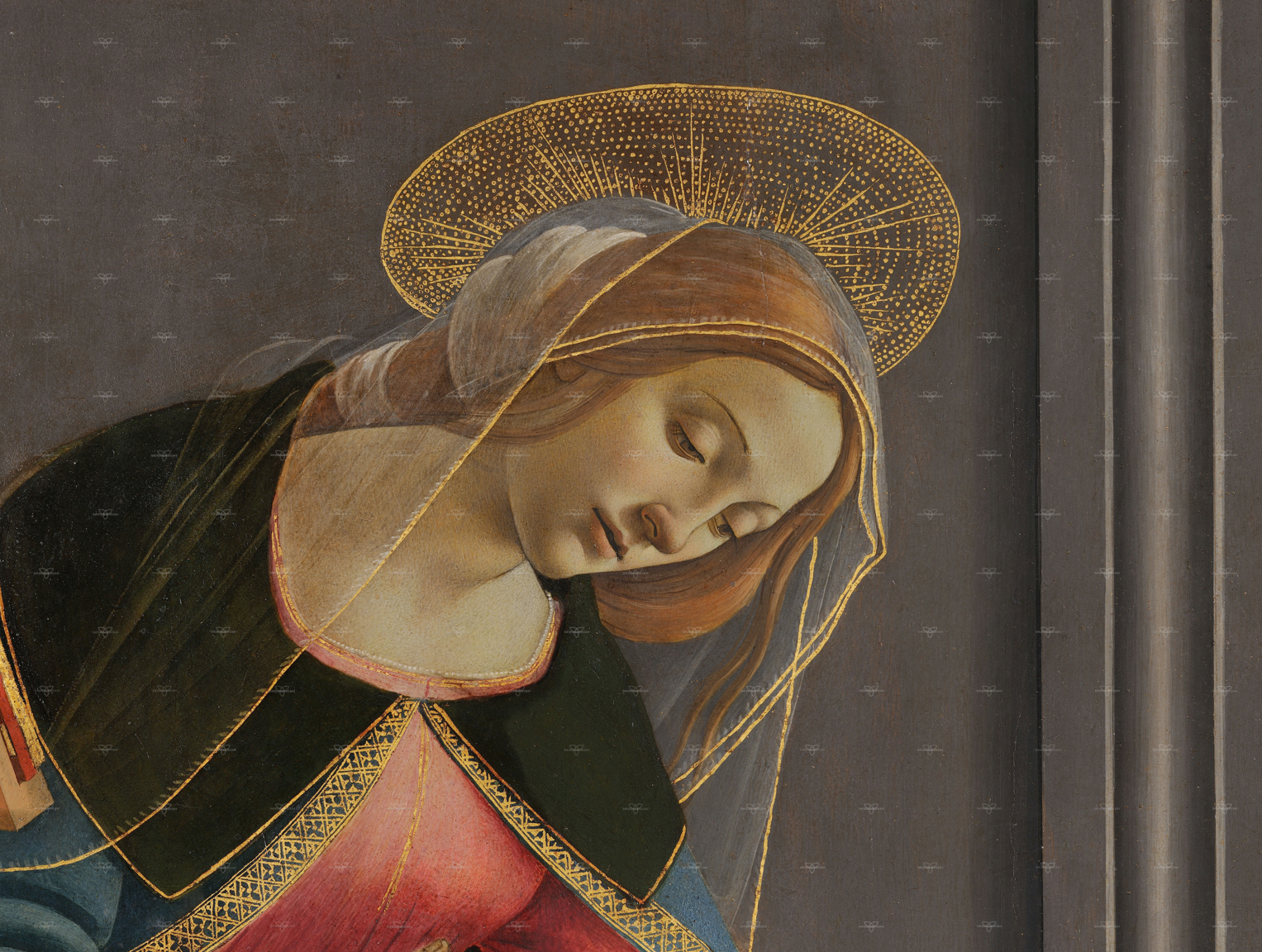
What is the value of the world compared with life?
And what is the value of life, if not to be given away?
And why do we torment ourselves, when it is so simple to obey?
The wise observation, evangelical in flavor, presented in the famous work ‘The Tidings Brought to Mary’, by the French poet and playwright Paul Claudel (1868-1955), captures the crucial point of the incomparable Lucan narrative about the message delivered to the Virgin of Nazareth in Lk 1:26-38. We wish to meditate on the Gospel text that reveals the mystery of Mary’s call and that has the power to prepare our life too for the unexpected things of God.
The formal dimension of the textThe passage of the announcement to Mary of the conception of Jesus is exclusive to the Gospel of Luke. In the narrative of Jesus’ earthly beginnings, this account stands as the second panel, following the announcement to Zechariah in Lk 1:5-25. If we consider what is stated in the prologue (Lk 1:1-4), where the sources of the text are mentioned, we must infer that, among the eyewitnesses from the beginning, the narrator is referring to Mary. Behind this passage, it is legitimate to suppose that her testimony stands. However, Mary’s testimony, according to Lk 2:19 and 2:51, is nothing other than the result of keeping things in her heart. Therefore, in the text we do not find the details of a chronicle, but the fruit of the reflection that Mary carried on throughout her life, in the light of the events of the Son. The text thus presents itself as deeply interwoven with the pure “Marian” testimony, of a contemplative nature.
Moreover, the pericope reflects the literary genre of the annunciations of prodigious births, such as those of Ishmael (Gen 16:11-12), Isaac (Gen 18:1-15), Samson (Judg 13:1-25), Samuel (1 Sam 1:9-18), the Messiah (2 Sam 7:14; Is 7:14-17) and the Baptist (Lk 1:5-25). Nevertheless, the biblical account that comes closest to ours is that of the vocation of Gideon in Judg 6:11-24. The episode begins with the greeting of the messenger, who addresses the one called with an honorific title. Gideon does not understand the greeting and questions its content. The angel then communicates a first message consisting in the assignment of a task: to save Israel from Midian. Gideon, however, is aware of his own weakness and asks a question: How shall I save Israel? The angel answers with a second message in which God guarantees His presence. Gideon, finally, asks for and obtains a sign and expresses his consent by building an altar.
Now, the same scheme is used, with some divergences, in Lk 1:26-38 and allows the author to narrate Mary’s vocation as the call to a great undertaking of liberation, decisive for salvation. Among the features proper to the Lucan passage, the name of the angel stands out first of all: Gabriel. He is a messenger presented in Dan 8:16-19; 9:20-23 to communicate God’s saving intervention. He calls Daniel “man of desires“, that is, desired, favored, especially chosen. Gabriel’s presence reveals to the prophet the end of time and also gives the Lucan account an eschatological nuance.
A second aspect of the text is marked by the scheme of the covenant. As in the Old Testament, so also for Mary God’s proposal is communicated by means of a mediator who addresses an interlocutor. The latter welcomes the proposal and promises to obey. So it happened at Sinai, where the people responded to the Mosaic reading of the law: “All that the Lord has commanded we will do, and we will be obedient” (Ex 24:7).
Furthermore, the focus of interest in the Lucan account is Christological: it seeks to explain who the child about to be born is. Therefore, both the response of the subject involved and the faith with which the message is welcomed are of the utmost importance. Mary is called to collaborate in a grand undertaking: the establishment of an eternal kingdom. She is presented as the model of the disciple, who believes and welcomes God’s call. Finally, the Annunciation to Mary is also a theophany, which takes place upon and in Mary, just as in the times of Moses it took place “upon” and “within” the tent of the covenant. Priority is given to the Word; it is the primal event. Its energy is a bearer of life, as stated in Gen 1 or Is 55:10-11: “So shall my word be that goes forth from my mouth: it shall not return to me empty, without having accomplished what I desire and without having succeeded in that for which I sent it”.
The theological messageFrom the primacy of the divine Word in this passage, the reader is able to grasp the pillars of the narrative that make it possible to focus on the fundamental points. In fact, if it is the divine Word that presides over the account, it enters the text first of all with Gabriel’s greeting in verse 28: “Rejoice, full of grace: the Lord is with you”. This is a greeting used by the ancient Greeks and also present in Mk 15:18; Acts 15:23; 23:26. “Rejoice“, however, conveys the sense better, since more than a greeting it is an announcement of joy, like the one announced to the shepherds in Lk 2:10.
In the same verse 28, the greeting is reinforced by the expression “Full of grace“, which would be better translated as “full of God’s favor, of His blessing“. The term has a meaning difficult to express with a single word. We could translate it as “you who have been and are perpetually in a state of grace“. In courtly language, it is the benevolence shown by the king toward a servant. Royal favor, however, and love sometimes become synonyms (cf. Esth 2:17; 5:8; 7:3; 8:5). Mary is greeted as the one who enjoys the King’s favor, the beloved, the one chosen in a unique and lasting way. Like Abram in Gen 17:5: “No longer shall you be called Abram, but Abraham, for I will make you the father of many nations” (cf. also Gen 32:28), so Mary receives a completely new name that places her definitively within God’s design.
From this arises the conclusive sense of the greeting: “the Lord is with you“. It is a promise of assistance on God’s part. It is found in the vocation accounts, as in Gen 26:3-24; Ex 3:12; Josh 1:5; Judg 6:12; Jer 1:8-19, and it is a promise made when God entrusts an important mission. It indicates the reason for messianic joy: Mary becomes the sign of God’s saving presence in the midst of His People. God is with her, who will be the Mother of “God with us“.
The surprising aspect of this greeting stands out when compared with the Old Testament accounts mentioned. In the “calls” of biblical history, such a greeting is a guarantee offered after the objection of the one called. Moses, Jeremiah, Gideon express their difficulties. For this reason, God declares: “I am/will be with you“. However, to Mary this is said before any possible objection. It is not a guarantee for a frightened soul, but the gratuitous affirmation of God’s overflowing presence upon this creature. It is the proclamation of a fact prior to any response and descriptive of an established situation, always active, unmerited. This kind of greeting, never heard in biblical literature, indicates the entrance of a new divine way into history, which begins in the gaze full of love and blessing directed to this young woman of Galilee. With this greeting, Mary enters sacred history with a note of absolute distinction and singularity: we stand before a unicum.
This singularity also emerges from the fact that God asks all those called for the readiness of the “yes“, which amounts to an act of faith on the part of the one addressed. Only afterwards does God specify the kind of mission. First He asks for an act of faith that must take place in an unlimited way with regard to the whole truth of God, whether the one called understands it or not, whether it is pleasing or displeasing to him. Then, to the objection of the one called, God responds with the promise of assistance. The only exception to this divine strategy is Mary, to whom a “you will give birth” is presented, her precise role in the plan of salvation being shown to her beforehand, before she expresses her consent. This exception is a proof that God, unlike all sinners who always want to impose conditions, can count on a “yes” given a priori to everything imaginable and unimaginable. Here we are at the heart of the pure divine predilection, which makes Mary full of every favor.
The reason for this choice, however, does not lie in Mary, but in God. He is the first to be mentioned in verse 26: He sends Gabriel. To Him must be attributed the initial movement of the grace that fills Mary. If we wished to inquire into the reasons for this prevenient act of grace, we would find an answer in Is 43:4: “Because you are precious in my eyes, you are worthy of esteem and I love you…”
Therefore, God’s choice is the whole life of Mary; God’s unexpected predilection for her is the total horizon of her life. If the Precursor is wholly voice, Mary is wholly called, wholly desired, wholly full of favor. In this way, from what God accomplishes in Mary, it appears that vocation is the word we ought to love most, for it is the sign of how important a creature is in God’s eyes. It is the index of how pleasing our fragile life is before Him. For if He calls us, it means that He loves us.
We are important to Him. In an innumerable multitude of people, one name resounds: mine. No one had thought of me. He did! He wrote “I love you” on rock, not on sand, and He is not ashamed of me. For this reason, Dante in the Vita nova (42,4) calls God “sire de la cortesia“. God is Lord of every delicate goodness.
After the greeting, disquiet arises.
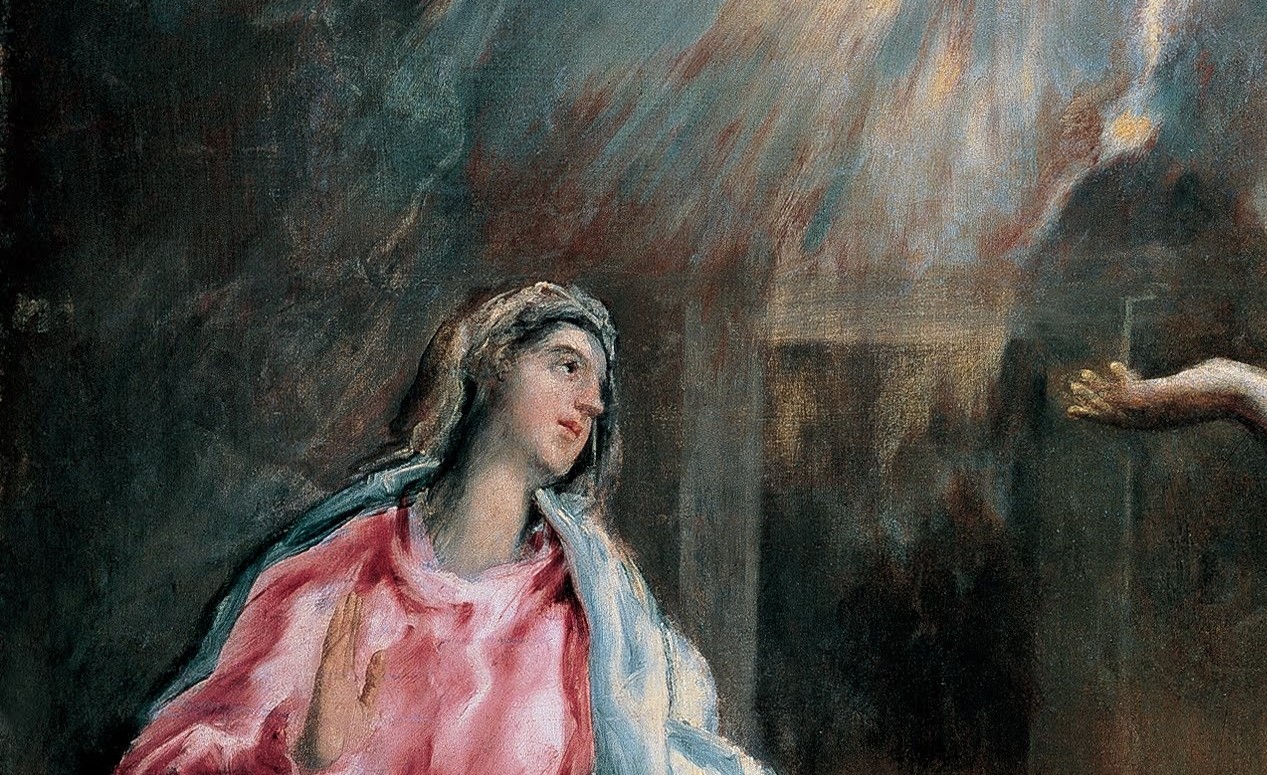
Unlike Zechariah, Mary’s disquiet in verse 29 is not produced by the vision itself, but by the grand words she heard, considered disproportionate to the one who received them. It is the disquiet of a spirit that is humble and aware of its own lowliness (Lk 1:48). Therefore, it is not a question of fear of the vision, since in the face of it we are told that Mary “pondered within herself” (v. 29). Mary neither disputes the message nor, like Zechariah, asks for a sign, but goes on to consider her situation. She is immersed in history, yet she does not forget to seek its meaning. She perceives that something new is happening in her person and wants to understand.
Who will help her in this?
It is the light of Scripture, which in Jn 1:19-28 furnished the Baptist with the elements to define his own identity, that offers Mary the light to clarify God’s plan for her. The reader thus learns to understand that every feature of personal history reveals its full meaning in the light of the scrutiny of the sacred Word. Mary understands that what is happening to her is comprehensible thanks to meditation on the Scriptures.
It is on this level that Mary’s question takes on the contours of a drama. Mary is in the delicate situation of the virgin who, already betrothed according to Jewish custom, still lives in her own home, but with marriage in view. She knows the Scriptures, and comparing them with Gabriel’s words, she feels exposed to one of the most difficult human situations, one for which Deut 22:23-27 prescribes death. Mary’s question does not arise from doubt or inadequacy. It proceeds from the clear presentiment that that message is casting her into a dramatic situation.
We are not far from Jesus’ stay in Gethsemane, where the same Luke presents Jesus consoled by an Angel (Lk 22:39-46). The Mother before and the Son afterwards feel in its fullness the weight of the responsibilities demanded of them and feel themselves crushed: Mary questions, the Son bleeds. If this context is not taken into account in the light of the Scriptures and of the agony of Jesus, one cannot understand the extraordinary greatness of this Daughter of Zion, who risks death but consents to God.
Deepen your studies: explore Mariology, Marian Theology, Marian apparitions and the Postgraduate Program in Mariology.
On Mary’s role in the Incarnation of the Word of God, see the Encyclical Redemptoris Mater of Pope John Paul II.
Postgraduate Program in Mariology
Would you like to deepen your formation in Mariology? Discover the Postgraduate Program in Mariology of Locus Mariologicus – an academic formation that unites theological rigor, spiritual life, and the living tradition of the Church.
Would you like to study Mariology seriously?
This article is born from the works in the library of Locus Mariologicus. The Postgraduate Program in Mariology takes you to the same source, with academic guidance: Scripture, the Fathers of the Church, and the Magisterium, from the first dogma to contemporary questions.



Responses