Sic Deus dilexit mundum: Mary and the Love That Sends the Son
Sic enim Deus dilexit mundum ut Filium suum unigenitum daret.
Jn 3:16
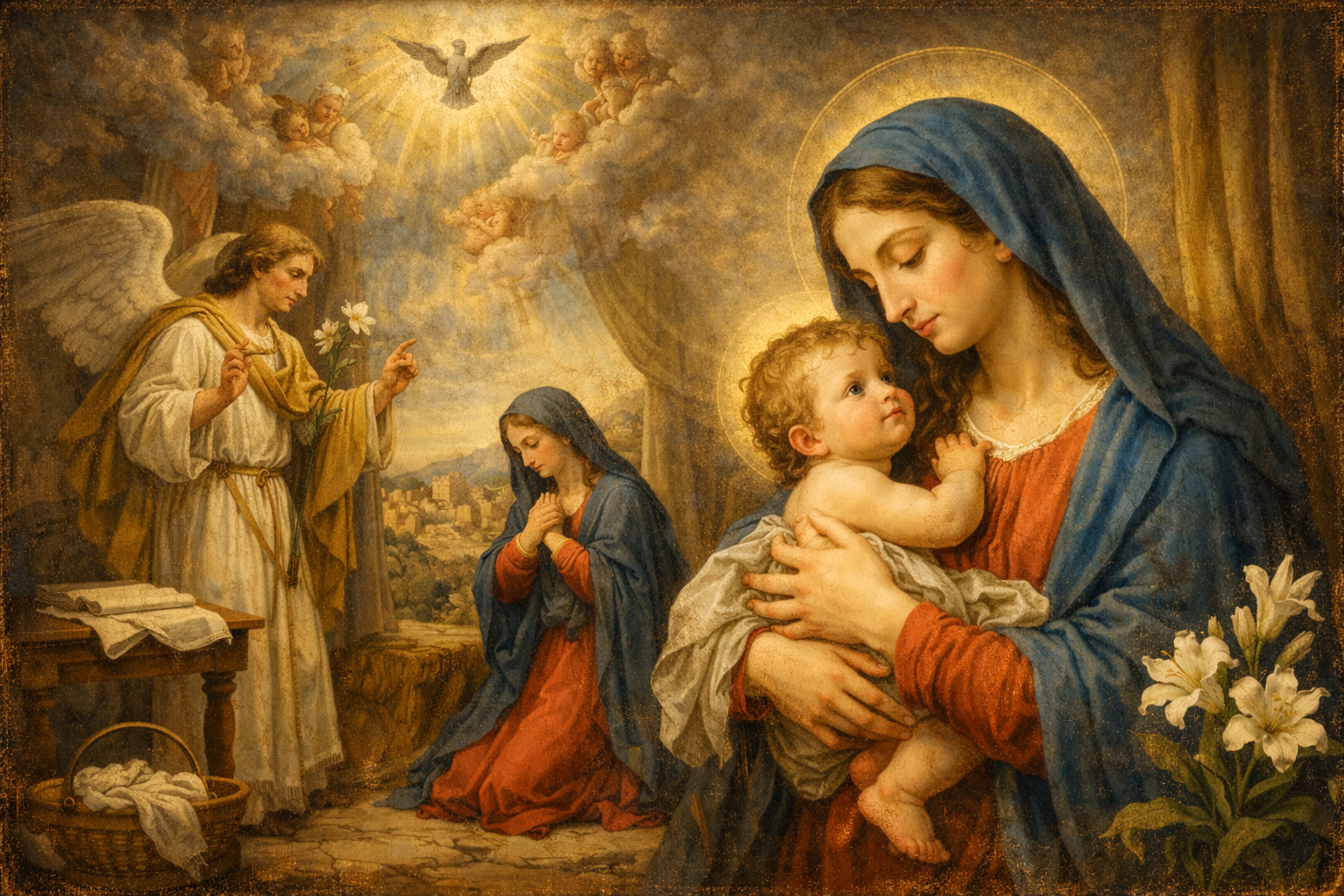
At the heart of the Johannine pericope that the liturgy sets before us on this Wednesday of the Second Week of Easter resounds the most lapidary synthesis of the Christian mystery: God so loved the world that He sent His only Son. This is not an abstract assertion about divine goodness, but a declaration that points to a concrete, historical, and unrepeatable event: the Incarnation of the Word in the womb of Mary of Nazareth. The Trinitarian love that moved the Father to give the Son found in Mary its point of entry into human history. It is impossible to meditate on Jn 3:16 without the figure of Mary emerging as the place where this love became flesh and dwelt among us.
I. The Love That Gives the Son
The Greek construction of Jn 3:16 is technically precise: hōste ton huion ton monogenē edōken, “to the point of giving the only-begotten Son”. The verb didōmi (to give) does not designate a merely abstract mission or a diplomatic sending, but a real, bodily, historical handing over. The Son was given in the flesh, “born of a woman, born under the Law” (Gal 4:4), and the woman of whom He was born was Mary. This Pauline precision confirms what Jn 3:16 implies: the Father’s “giving” has a maternal dimension, because the Son whom the Father gives to the world came through a mother of flesh and blood.
The patristic tradition, above all Origen and Cyril of Alexandria, read Jn 3:16 in close connection with the Annunciation: the “love that sends” (the Father) and the “love that welcomes” (Mary) constitute the two polarities of the same mystery of the Incarnation. Divine love is not imposed. It awaits the free fiat of the creature. Without Mary’s “yes”, the Son of God would not have entered the world in the way He did. Mary’s freedom, which could have refused, as Adam and Eve refused obedience, was the space in which God’s love waited for and obtained its most perfect human response.
It is remarkable that Jn 3:16 should be the most quoted verse in all of Scripture in the history of Christian evangelization. And yet the mariological dimension of this verse is often left in the shadows. Protestant theology insists on the sovereign initiative of the Father. Catholic theology, without denying that initiative, emphasizes that it included the free cooperation of Mary. The two emphases are complementary: the initiative is absolutely the Father’s, but the Father willed that this initiative should meet a free human response, and that response was Mary. The Annunciation is not a secondary episode of Christmas. It is the constitutive moment in which the love of Jn 3:16 found its human correlative.
Thomas Aquinas, in the Summa Theologiae (III, q. 30, a. 1), asked why God announced the Incarnation to Mary beforehand, instead of simply becoming incarnate without prior notice. The answer is lapidary: “so that the Virgin might give her consent in the name of all human nature”. Mary’s fiat is not only her personal consent. It is the consent of all humanity to the initiative of God’s love. This perspective raises the Annunciation to a cosmic event and restores to Mary her precise theological function: she is the door through which the love of Jn 3:16 entered time.
II. Mary as the Living Mediation of the Gift
John Paul II, in Redemptoris Mater (no. 9), emphasized that Mary “belongs indissolubly to the mystery of Christ”. She is not a peripheral figure who can be omitted without loss: she is the concrete place, the locus, in which the eternal love of God took on human form. Twentieth-century mariology, from Matthias Scheeben to Hans Urs von Balthasar, insisted on this “indispensability” of Mary for the concrete realization of the gift of the Son. Not because God could not have acted otherwise, but because He chose to act through Mary, and that choice is irrevocable, full of meaning, and pedagogically necessary for our understanding of the mystery of salvation.
The Son given by the Father to the world was first given to Mary. She received Him in her body, nourished Him with her blood for nine months, accompanied His first steps, taught Him to pray the prayers of the people of Israel, and accompanied Him to the Cross. The itinerary of the gift, from the Father, through Mary, to the world, has a structure that cannot be shortened. Whoever tries to pass directly from the Father to the world, skipping over Mary, abstracts from something from which God did not abstract: the maternal mediation that made the gift concrete, historical, and carnal. This mediation is not accidental. It is constitutive of the Incarnation.
The Christian spiritual tradition has developed this insight in the most varied ways. Bernard of Clairvaux described Mary as the “aqueduct” through which the graces of God reach the world. The metaphor may seem mechanical, but it expresses a real theological truth: God’s love for us passed through Mary’s love for the Son and for the world. A more personalist vision, developed by René Laurentin and Jean Galot, prefers to speak of Mary as a subordinate “Mediatrix”: not a passive channel, but an active person who freely cooperates in the distribution of the graces of Christ. The two images are complementary and express distinct facets of the same reality.
This cooperation has precise biblical roots that go beyond the Annunciation. In Jn 2:1-11, the Wedding at Cana, Mary presents to the Son the need of the guests and obtains the first public sign of His ministry. The sequence “they have no wine → do whatever He tells you → water into wine” is the paradigm of Marian mediation: Mary perceives the human need, turns to the Son, directs others toward Him, and the miracle takes place. This pattern, which theology identifies as “maternal intercession”, recurs in the history of spirituality with a consistency that theology cannot ignore: at Lourdes, at Fatima, at Guadalupe, the same pattern of Cana is repeated in diverse historical forms.
III. Light and Darkness: Judgment by Love
The pericope of Jn 3:16-21 does not end with the affirmation of love. It unfolds in a dialectic of light and darkness that deepens the meaning of the gift. “The light came into the world, but men preferred darkness to the light, because their deeds were evil” (Jn 3:19). The coming of the Light, the Word who is “the true Light that enlightens every man” (Jn 1:9), is not automatically welcomed. The love that gives itself can be refused. The Light that shines can be rejected. It is precisely here that the figure of Mary takes on a particular prominence within the Johannine text as a whole: she represents the luminous exception of the perfect welcome.
Mary is, in patristic and liturgical language, the aurora, the creature who first welcomed the Light, without shadow of sin. The title aurora consurgens, inspired by the Song of Songs (6:10: “Who is she who rises like the dawn”?), designates Mary as the creature who precedes and announces the Sun of Justice. Her Immaculate Conception is not an arbitrary and isolated privilege: it is the condition of possibility for the Light to find a completely transparent receptacle, able to welcome it without distortion. Where Adam and Eve introduced the shadow of sin, Mary offered the total transparency of faith and obedience.
The light/darkness dialectic of Jn 3:19-21 has a precise mariological reading: while sinful humanity “prefers darkness to the Light”, Mary represents the exception, the creature who, by the grace of an anticipated Redemption (Pius IX, Ineffabilis Deus, 1854), never “preferred darkness”. She is the model of what human existence could and should be: total openness to the Light that “comes from above”. Her existence of openness is a permanent challenge to every one of the faithful: what darkness do we still prefer to the Light that has been given? What refusals do we set against the love that handed over the Son?
Jn 3:21 offers the positive conclusion of this dialectic: “whoever does the truth comes to the Light, so that it may be seen that his works were wrought in God”. The “doing of the truth”, poiōn tēn alētheian, is the life that corresponds to the love of Jn 3:16: to receive the Gift, to let oneself be enlightened, to act from the Light received. Mary is the perfect figure of this “doing of the truth”: from the fiat of the Annunciation to the faithful silence of Holy Saturday, her whole life was a doing of the truth that “was seen to have been wrought in God”. Every gesture of Mary, from caring for the Child in Bethlehem to offering the Son on the Cross, is an act of obedience to the Light that she welcomed without reserve.
IV. The Paschal Love That Continues
In the paschal context, the meditation on Jn 3:16 attains its richest and most demanding fullness. The “giving of the Son” is not limited to the Incarnation: it culminates in the Cross and in the Resurrection. The love that sent the Son into the world is the same love that, on the Cross, handed Him over to death, and that, in the Resurrection, restored Him to a life that has no end. Easter reveals that God’s love is not defeated by death, but that death is the point of passage to a new and definitive life. “God did not send the Son into the world to judge the world, but that the world might be saved through Him” (Jn 3:17): salvation is always the horizon of love.
Mary, who stood by the Cross (Jn 19:25), is the privileged witness of the full breadth of that love which “gave the Son”. The Risen One who appears to the disciples is the same Son whom she brought forth in Bethlehem, whom she raised in Nazareth, whom she accompanied throughout His public ministry. The continuity between the Son of the Annunciation and the Risen One of Easter is Mary: she is the human link that unites the two extremes of the mystery. Without Mary, the Resurrection would be a mystery without a human face. With Mary, it is the fulfillment of a history of love that began when the angel said “Hail, full of grace”.
The tradition of the Fathers, taken up by the Catechism of the Catholic Church (no. 975), sees Mary as the first to receive in faith the grace of the Resurrection, even before any appearance recounted by the Gospels. This conviction has no direct biblical foundation, but it has a profound theological coherence: if Mary was the first to welcome the Son in the Incarnation, it is theologically coherent that she was the first to welcome Him in the Resurrection. The faith that never wavered on Holy Saturday, when the apostles scattered and lost hope, was also the faith that first “saw” the Risen One with the eyes of the heart, before meeting Him with the eyes of the body.
Paschal mariology does not separate the mystery of Mary from the paschal mystery, but rather shows us how the two illuminate each other. Mary is, as John Paul II called her in Redemptoris Mater, the “pilgrim of faith”, who traveled the whole itinerary from the Annunciation to Pentecost, without ever losing the thread of the love that Jn 3:16 states so lapidarily. The “sic Deus dilexit mundum” is not merely a verse of the past: it is the eternal law of God’s relationship with humanity, inscribed indelibly in the mystery of Mary, who welcomed it first and continues to transmit it to all her spiritual children.
May the love that moved the Father to give the Son, and that found in Mary its first and most perfect human welcome, continue to transform our hearts in this paschal season.
Postgraduate Program in Mariology
Would you like to deepen your formation in Mariology? Discover the Postgraduate Program in Mariology of Locus Mariologicus – an academic formation that unites theological rigor, spiritual life, and the living tradition of the Church.
Would you like to study Mariology seriously?
This article is born of the works in the library of Locus Mariologicus. The Postgraduate Program in Mariology takes you to that same source, with academic guidance: Scripture, the Fathers of the Church, and the Magisterium, from the first dogma to contemporary questions.





Responses