Ego sum ostium: Mary and the Gate That Opens to Life
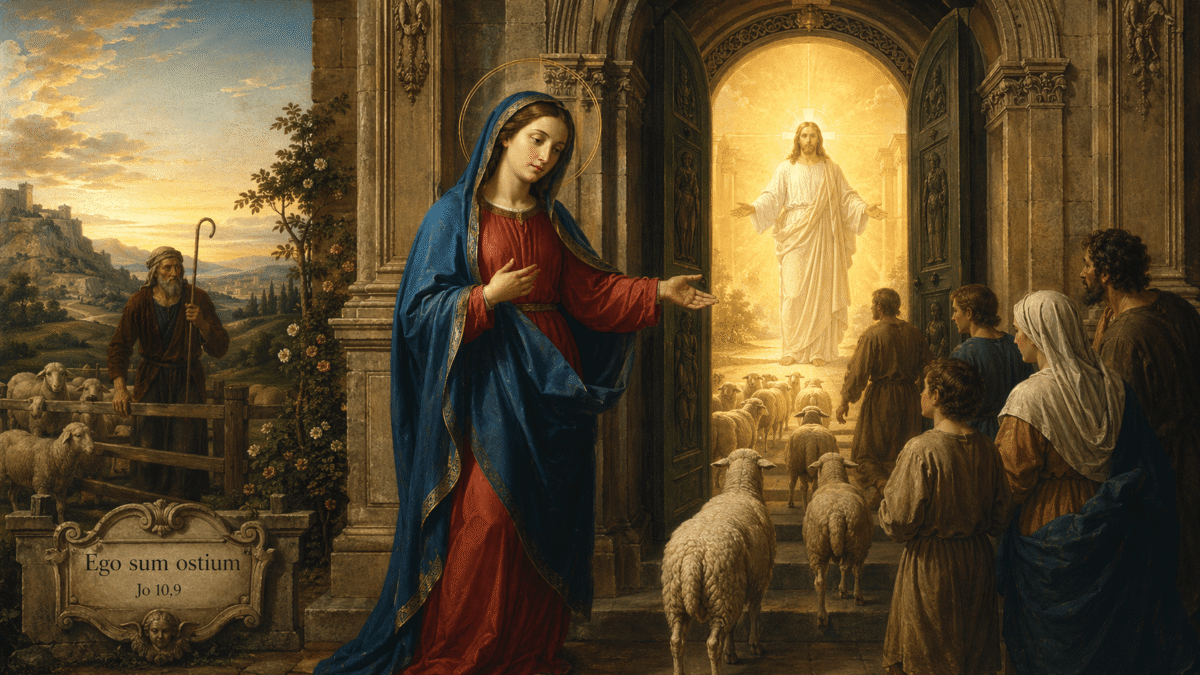
Ego sum ostium: per me si quis introierit, salvabitur.
Jn 10:9
“I am the Gate: if anyone enters through me, he will be saved.” The image of the Gate in Jn 10 precedes that of the Good Shepherd and has a theological density of its own: the Gate is the only legitimate access to the fold, the only way to security and to life. Mariology finds in this image a fruitful analogy: Mary is, in the tradition, the “Gate of Heaven” (Ianua Caeli), the one who opened for the world access to the Savior, the one who made possible the “entering” of God into human history and the “entering” of human beings into the history of God.
I. The gate as theological metaphor in John
Jn 10:7-9 presents Jesus as “the gate of the sheep” and as “the gate” without further qualification. The image, strangely mixed (how can someone be at once the Shepherd and the Gate?), is deliberately ambivalent: it points to the multivalence of the salvific function of Jesus. He is not only the guide; He is the access. He does not only lead to the destination; He is the condition of possibility of the way itself.
The immediate context is polemical: those “who came before” are characterized as “thieves and robbers” (Jn 10:8), in contrast with the Shepherd who enters through the legitimate gate (Jn 10:1-2). The legitimate Gate is controlled by the “gatekeeper” (thyroros) who opens to the true shepherd (Jn 10:3). The image points to the legitimacy of the mission of Jesus in contrast with the religious leaders who do not “enter through the gate,” that is, who do not receive their authority from the Father.
Verse 10:9 specifies three effects of “entering” through the Gate who is Jesus: salvation (sothesetai), freedom of movement (eiseleusetai kai exeleusetai), and the finding of pasture (nomen heuresei). Salvation is not an enclosure; it is an opening: whoever enters through the Gate has the freedom to “go in and go out,” to inhabit the world with the security of one who knows where the Gate of return is. And the “pasture,” an image of abundance and of the fullness of life, is what the Good Shepherd offers to His sheep who enter through the legitimate Gate.
The structure of “entering through the gate” has a sacramental dimension that the tradition has explored: the sacraments are the “gates” that Jesus opens in the life of His disciples so that they may “enter” progressively into the Trinitarian life. Baptism, the Eucharist, Penance: each sacrament is an “entering” into the life that Jesus promises. Mary, who was “full of grace” from the beginning, lived her whole existence “inside the Gate,” in a permanent state of communion with the divine life.
II. “Ianua caeli”: Mary as the gate of heaven in the tradition
The Litany of Loreto includes the title Ianua Caeli, Gate of Heaven, which has deep patristic roots. The title derives from a typological transposition: just as Jacob called the place of his vision “the Gate of Heaven” (porta caeli, Gen 28:17), the tradition applied the title to Mary, through whom Heaven entered the world in the Incarnation and through whom humanity has access to Heaven.
St. Ephrem the Syrian (4th century), in one of his most beautiful homilies, celebrates Mary as “the Gate through which the Light entered the world.” Here the image of the Gate is active: Mary is not merely the passive channel through which the Savior passes; she is the one who actively opened the Gate through which God entered history. Her “fiat” was the act by which the Gate was opened: without it, the Son of God could not have “entered” into humanity as a man among men.
The typology of the Gate has a complex biblical articulation. The “gate” of the Temple of Ezekiel, through which the Lord passes and which afterward remains shut (Ezek 44:2-3), was interpreted by the Fathers as a figure of the perpetual virginity of Mary: she through whom the Lord passed remains shut, virgin before, during, and after the birth. The “gate” of the Song of Songs (“open to me, my sister, my love,” Song 5:2) was interpreted as the voice of Christ who calls at the gate of the human heart, and Mary as the one who answered that “open to me” with her “fiat.”
The medieval Gothic cathedral expresses this theology architecturally: the entrance portal of the cathedral was frequently dedicated to Mary and decorated with scenes from her life. To enter the cathedral, “domus Dei,” house of God, was to pass through the “Gate of Mary,” through which the visitor became a sharer in the divine life. Sacred architecture made visible what theology formulated: Mary is the human portal through which one gains access to the divine.
III. The Incarnation as “the opening of the gate”: theology of the Annunciation
The scene of the Annunciation (Lk 1:26-38) can be read as the moment in which Mary “opens the Gate.” The angel Gabriel brings a proposal: God wills to enter history in a radically new way, and the entrance depends on the consent of a woman. Mary’s “fiat” is the opening of the Gate: without it, the Incarnation does not take place. With it, the Son of God “enters” into humanity and humanity has access to the divine life.
This theology has profound implications for the understanding of human freedom in the economy of salvation. God does not impose the Incarnation; He proposes it and awaits the free response of Mary. Divine omnipotence, paradoxically, willed to limit itself by the freedom of the creature: the eternal Son awaits the “yes” of a woman in order to be born in time. This is the supreme expression of God’s respect for human freedom, and of the dignity that God conferred on humanity by making it an active participant in His work of salvation.
St. Bernard of Clairvaux, in a famous Advent sermon, dramatizes this moment with an eloquence that has crossed the centuries: “The angel awaits the answer (…) we too await, Lord, the word of mercy by which You can descend from Your majesty (…) Answer quickly, O Virgin. Say the word and receive the Word.” The divine Word awaits the human word. The eternal Word awaits the temporal “fiat.” The Gate was shut. Mary opens it.
The pneumatological dimension of the Annunciation is inseparable from this opening. “The Holy Spirit will come upon you and the power of the Most High will cover you with His shadow” (Lk 1:35): the Incarnation is the work of the Holy Spirit, who acts through the free consent of Mary. The “shadow” (episkiasei) refers back to the cloud that covered the Tent of Meeting in the desert (Ex 40:35): Mary is the new “place of the presence” of God, the new Temple where the “Shekinah” dwells. The Gate of the Temple is open.
IV. Mary, gate of the temple: Revelation and eschatology
Revelation 12 presents a “woman clothed with the sun” who gives birth to a son who “will rule all the nations with a rod of iron” (Rev 12:5). Patristic and medieval exegesis identified this woman as Mary, and the tradition continues to recognize in her a Mariological figure of great eschatological scope. The woman of Revelation is not only a historical figure; she is the image of the Church in eschatological tension, whose icon is Mary.
In the context of the “Gate,” Rev 3:20 places in the words of Christ the image of the Gate being knocked upon: “I stand at the door and knock.” This Gate is not the Gate through which divine life enters humanity: it is the Gate of the human heart that Christ wills to be opened. Mary, who “opened the Gate” at the Annunciation, is the model of every heart that opens at Christ’s knock: that says “fiat,” that welcomes, that consents.
The Marian title Porta Orientalis, Gate of the East, refers back to the tradition that the Resurrection happened at dawn, in the direction of the east, and that Mary was the first to experience the dawn of the Resurrection. The “Gate of the East” is the Gate through which the Light enters, the risen Christ. Mary, who was the first to receive the Light of the world in the Incarnation, is also the first to be illumined by the Light of the Resurrection.
Marian eschatology culminates in the Assumption: Mary, who was the Gate through which Christ entered the world, is now the Gate through which humanity glimpses its final destiny. She, who is glorified in body and soul, prefigures what redeemed humanity will be. The Gate does not close after having been opened at the Annunciation: it remains open, inviting all to enter, promising to all the life that Jesus came to bring “in abundance” (Jn 10:10).
Mary, the “Gate of Heaven” who opened for the world access to the Savior with her “fiat,” remains forever the open Gate through which humanity enters into the life that Christ promises “in abundance.”
References
- St. Bernard of Clairvaux, Homilia in laudibus Virginis Matris, IV.
- St. Ephrem the Syrian, Hymns to the Virgin Mary.
- Second Vatican Council, Lumen Gentium, nos. 55-59 (1964).
- R. Brown, The Gospel According to John, vol. I (1966).
- A. Feuillet, L’Apocalypse: état de la question (1963).
Postgraduate Program in Mariology
Would you like to deepen your formation in Mariology? Discover the Postgraduate Program in Mariology of Locus Mariologicus – an academic program that unites theological rigor, spiritual life, and the living tradition of the Church.
Would you like to study Mariology seriously?
This article grows out of the works in the Locus Mariologicus library. The Postgraduate Program in Mariology takes you to the same source, with academic guidance: Scripture, the Fathers of the Church, and the Magisterium, from the first dogma to contemporary questions.

Responses