Qui credit in me: Mary and the Faith That Illumines the World
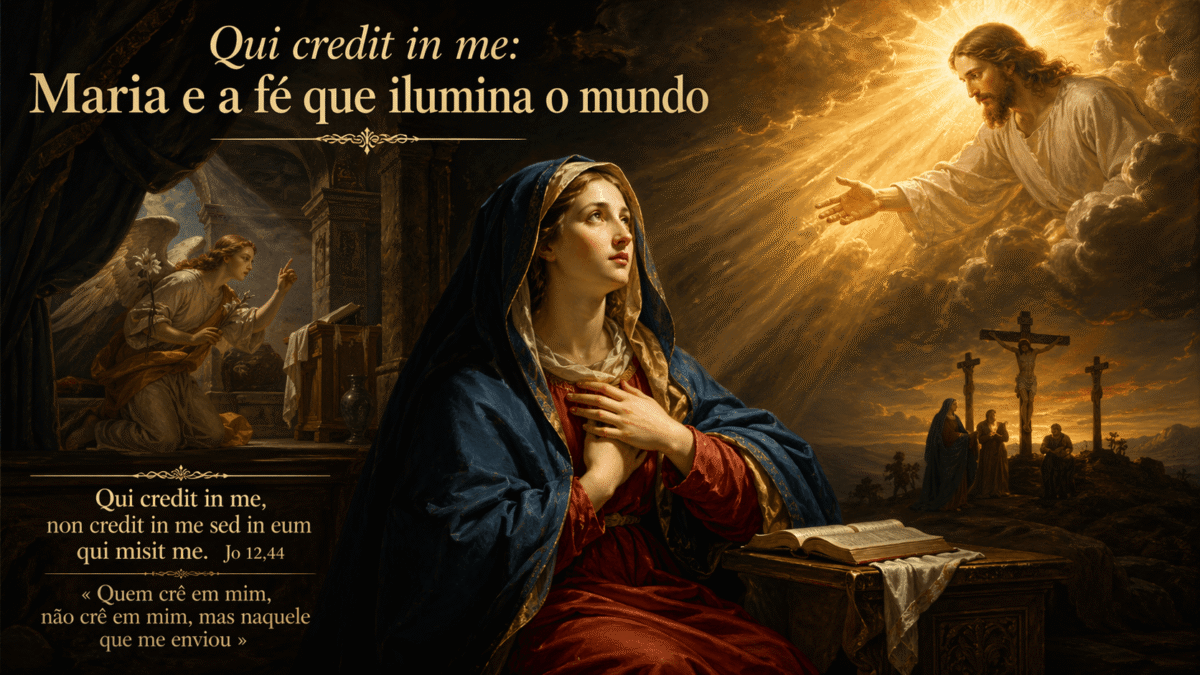
Qui credit in me, non credit in me sed in eum qui misit me.
Jn 12:44
“Whoever believes in me believes not in me but in Him who sent me”. This statement from Jn 12:44 places faith in Jesus in a radically theocentric perspective: to believe in the Son is, in the final analysis, to believe in the Father who sent Him. Christian faith is not a devotion to Jesus as a historical figure, however singular He may be; it is adherence to the God who reveals Himself in Jesus and who sent Jesus into the world to lead humanity back to Himself. Mariology finds in this perspective one of its fundamental axes: Mary’s faith was paradigmatically theocentric, she believed in the God of Israel who was fulfilling His promise in the Son whom she conceived.
I. Faith as Relationship: Believing “in” and Not Merely Believing “that”
The Johannine Greek for “to believe in” is pisteuein eis, literally “to believe into”, a construction that goes beyond simple intellectual assent to a proposition. Johannine faith is a movement of self-surrender of the person to the other, an “entrance” into the relationship with Christ that engages the whole of existence. This use of eis, “into”, is distinctive of John and points to the mystical dimension of faith: not merely “to believe that Jesus is the Son of God”, but “to live within” the relationship with Jesus.
Jn 12:44-46 situates this faith in a luminous context: “I have come as light into the world, so that whoever believes in me may not remain in darkness” (Jn 12:46). Faith in Jesus is a passage from darkness to light, a cosmological metaphor that John uses to describe the existential transformation brought about by adherence to the Son. Whoever believes does not merely “know” more, he “is” different: he is illumined from within, guided by a light that does not come from himself but from Christ.
This dimension of faith as illumination has a profound resonance in the Christian contemplative tradition. The “dark night” of which St. John of the Cross speaks is not the absence of faith, but the purification of faith from everything that is superficial adherence, sentimentality, or comfort. Purified faith is precisely the faith that “believes into” Jesus, even when He seems absent, even when the light has become obscurity and consolation has become aridity.
In this tradition, Mary is the model of purified faith. She who said “fiat” at the Annunciation and remained beside the Cross in the apparent absence of God lived what the mystics describe as “naked faith”, adherence to the Son not for the comfort He brings, but for the divine identity He possesses. Her believing “into” Jesus passed through the obscurity of the Cross without wavering. For this reason tradition calls her “Virgin of Faith”, not of easy faith, but of proven faith.
II. “You Do Not Believe in Me but in Him Who Sent Me”: The Trinitarian Dimension of Faith
Jn 12:44 states that to believe in Jesus is to believe in the Father: faith in the Son is inseparable from faith in Him who sent Him. This statement has a clear Trinitarian structure: Christian faith is not directed to Jesus as to an autonomous divinity separate from the Father, it is directed to the Son precisely as Son, that is, in His constitutive relationship with the Father. The mission (“who sent me”) is the key to this relationship: Jesus comes from the Father, reveals the Father, leads to the Father.
Trinitarian theology formulated this point with the principle of circumincession or perichoresis: the three divine Persons live one “within” the other, in an interpenetration of being and of love that is the intra-Trinitarian life. Whoever “enters” into relationship with the Son enters at the same time into relationship with the Father and with the Spirit. Christian faith is structurally Trinitarian: it begins with adherence to Jesus, but progressively unveils the Father and culminates in the indwelling of the Spirit.
The Mariological tradition explored Mary’s relationship with the Trinity on the basis of this logic. Mary is “daughter of the Father”, “mother of the Son” and “temple of the Holy Spirit”, titles that the Franciscan tradition and later modern Marian spirituality developed with great fruitfulness. This threefold relationship is not an artificial construction, it follows from the logic of Trinitarian faith: whoever is in relationship with the Son is in relationship with the whole Trinity.
St. Louis Marie de Montfort, in the Treatise on True Devotion, developed the idea that devotion to Mary is the surest and quickest way to reach the Trinitarian life. Not because Mary is a substitute for the divine Persons, but because she, as the creature who most fully realized Johannine faith, believing “into” Jesus, believing in the Father who sent Him, is the surest guide along that same way. To follow Mary is to follow the creature who most perfectly walked “into” the Trinitarian life.
III. Mary as Reflected “Light of the World”
Jn 8:12: “I am the Light of the world”. The only one who is Light in Himself is Jesus. But Marian iconography and hymnography celebrate Mary with metaphors of light: “Stella Maris” (Star of the Sea), “Aurora” (which precedes the Sun), “Moon” which reflects the light of the Sun. All these titles indicate a derived, reflected light that comes from the Son. Mary is not the Light, she is the one who, receiving the Light fully, reflects it without distortion to the world.
This distinction is theologically crucial: Mary is not the source of salvation nor the source of grace in the originating sense. But she is the most perfect mirror of the Light of Christ: the creature who received it most completely and who, for that reason, reflects it most perfectly to humanity. Her intercession, her spiritual motherhood, her presence in the Church are not parallel to the mediation of Christ, they are participations in His mediation, reflections of His Light.
The dawn is a biblical image of hope: “the dawn” (shachar in Hebrew) is the moment when darkness yields to light, when the new day begins. The Office of Lauds, prayed at daybreak, asks precisely for this passage: that the Light of Christ may illumine the new day. Mary is, in the liturgical tradition, the “Aurora” that precedes and announces the Sun of Justice, Christ. Before Christ appeared, Mary “appeared”. Before the full Light, the dawn shone.
Authentic Marian devotion always has this structure: it is a devotion oriented toward the Light, not one that halts at the dawn. Whoever says “Hail, Star of the Sea” points to the harbor to which the star leads. Whoever says “Stella Maris” recognizes that the star is not the destination but the guide. A healthy Mariology is one that never loses sight of the Son, that contemplates Mary as “she who believed” (Lk 1:45) and who, for that reason, is the best guide to the faith that leads to the Father.
IV. Mary’s Faith and the “Now” of Salvation
Jn 12:46-47: “I have come as light into the world (…) and if anyone hears my words and does not keep them, it is not I who judge him: for I did not come to judge the world, but to save the world”. Jesus’ mission is one of salvation, not of condemnation. This “I did not come to judge” is one of the most luminous texts on divine mercy: the Son sent by the Father came to save, not to condemn. To illumine, not to punish.
Mary, in the tradition, is associated with this merciful dimension of the Son’s mission. The title Mater Misericordiae, Mother of Mercy, reflects the intuition that the Mother of the Savior shares in His merciful mission. She who intercedes for sinners before the Son is not “twisting the arm” of a severe judge, she is sharing in the mission of a Son who came, above all, to save.
Medieval devotion to the Stabat Mater and to the Salve Regina expressed this intuition with an emotional force that set a pattern: Mary beside the Cross suffers with the Son, intercedes with the Son, saves with the Son. The Salve Regina calls her “our life, our sweetness and our hope”, expressions that, correctly understood, are not devotional exaggerations but expressions of faith in Mary as a participant in the salvific work of the Son.
The illumination of faith, which Jn 12:44-46 associates with believing in Jesus, has in Mary its fullest expression in the order of creatures. She who was illumined by the Spirit at the Annunciation (“the Holy Spirit will come upon you”, Lk 1:35), who lived her whole life guided by this Light, and who now shares in the glory of the risen Son, is the most fully illumined of creatures. The faith that the Church asks for in prayer, “illumine our darkness”, finds in Mary the promise that it is possible: a human creature can be fully illumined by the Son whom the Father sent.
Mary, who believed “into” the Son with her whole existence, is the model of the illumined faith that leads to the Father through the Son and lives in the brightness of the Spirit.
References
- St. Louis Marie de Montfort, Treatise on True Devotion, n. 45-50.
- John Paul II, Redemptoris Mater, n. 12-19 (1987).
- R. Schnackenburg, The Gospel According to St John, vol. II (1980).
- A. Serra, Sapiência e Contemplação de Maria [Wisdom and Contemplation of Mary] (1990).
- H. U. von Balthasar, Maria für heute (1987).
Postgraduate Program in Mariology
Would you like to deepen your formation in Mariology? Discover the Postgraduate Program in Mariology at Locus Mariologicus – an academic formation that unites theological rigor, spiritual life and the living tradition of the Church.
Would you like to study Mariology seriously?
This article is born of the works in the Locus Mariologicus library. The Postgraduate Program in Mariology brings you to that same source, with academic guidance: Scripture, the Fathers of the Church and the Magisterium, from the first dogma to contemporary questions.




Responses