Ipse spiritus postulat pro nobis: Mary in the Vigil of the Spirit
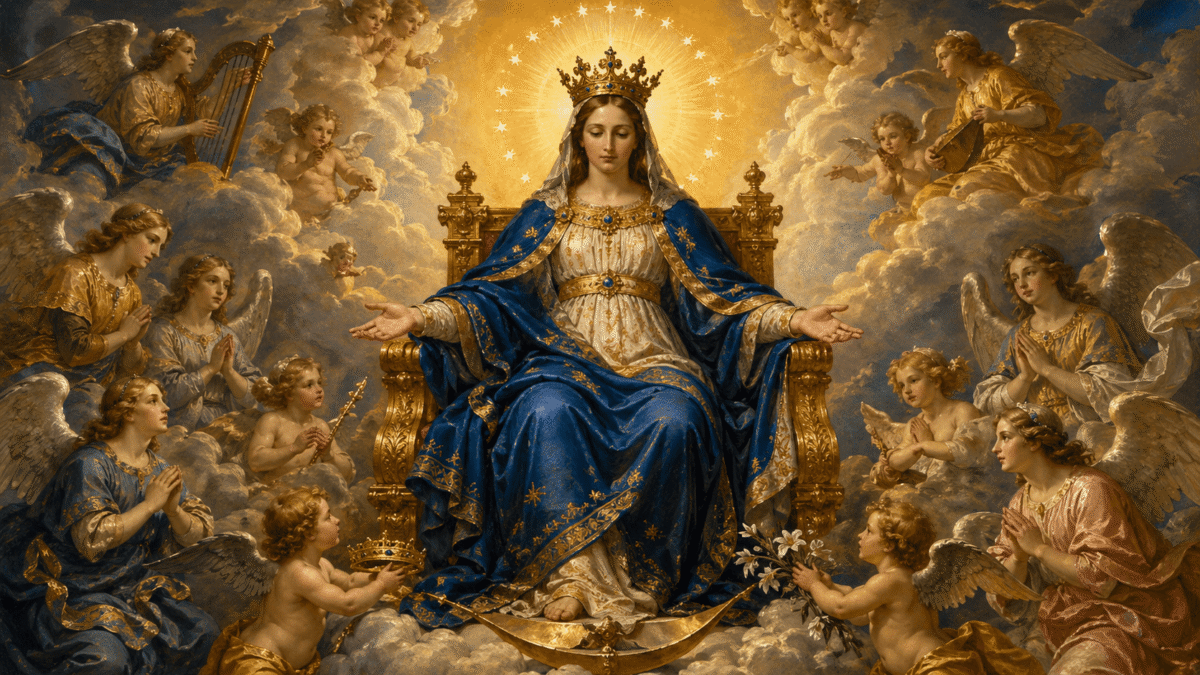
Ipse Spiritus postulat pro nobis gemitibus inenarrabilibus.
Rom 8:26
“The Spirit himself intercedes for us with inexpressible groanings.” The Vigil of Pentecost, the last Saturday of the Easter Season, is the moment of greatest tension in the waiting: the Spirit has been promised, he has not yet been fully given. The Church waits in prayer, as the Upper Room waited. Rom 8:26, which Paul writes in the context of eschatological expectation, captures this tension: when “we do not know how to pray as we ought,” the Spirit himself intercedes. And Mary, who was in the Upper Room awaiting the Spirit, is the model of the human creature who knows how to wait, who knows how to pray even without knowing “as we ought.”
I. “Inexpressible groanings”: the prayer that goes beyond words
Rom 8:26: “we do not know how to pray as we ought” (to gar ti proseuxômetha katho dei ouk oidamen). This confession of Paul’s is surprising in one of the greatest theologians in history: he who taught so much about prayer (1 Tim 2:1-8; Phil 4:6-7; Col 4:2) admits that he does not know how to ask “as he ought.” Not the ignorance of the beginner, but the humility of the experienced man who recognizes that the deepest prayer goes beyond what words can formulate.
The Spirit who “intercedes with inexpressible groanings,” stenagmois alaletois, literally “groanings without words,” is the Spirit who prays within the believer what the believer cannot articulate. This “sub-linguistic” prayer of the Spirit is the deepest form of prayer: not the formulation of specific petitions, but the expression of the fundamental desire of the human heart for full communio with God, which only the Spirit knows and only the Spirit can adequately articulate.
The Christian contemplative tradition has always recognized this prayer “beyond words” as the highest form of the life of prayer. Saint John Climacus described “monologic” prayer, the repetition of a single word or formula, as the way to attain “pure” prayer, without words, in which the believer rests in God beyond any formulation. The Eastern hesychasts called this state hesychia, stillness. Western contemplatives called it “infused contemplation.” In every case, the agent is not the believer, it is the Spirit who prays within the believer.
Mary, who “kept and pondered these things in her heart” (Lk 2:19, 51) and who “persevered with one accord in prayer” (Acts 1:14), is the model of this prayer beyond words. She who prayed for decades — the daily prayer of the Temple, the Psalms of the people of Israel, personal prayer — came, in the contemplation of the Son and in the awaiting of the Spirit in the Upper Room, to the form of prayer of which Rom 8:26 speaks: that of the Spirit who prays within those who have let themselves become transparent to him.
II. Mary in the Upper Room: the vigil that gave rise to the Church
The Ipse Spiritus postulat of Rom 8:26 has in Mary its most perfect witness. Acts 1:12-14: after the Ascension, the Apostles “returned to Jerusalem (…) and, when they had entered the city, they went up to the Upper Room (…) All these persevered with one accord in prayer, together with some women and Mary, the Mother of Jesus, and with his brothers.” Ten days of prayerful vigil: ten days in which Mary and the Apostles awaited the fulfillment of Jesus’ promise. Ten days of “inexpressible groanings,” of waiting that goes beyond words, of desire for the Spirit who has not yet come.
The tradition has seen in this vigil of the Upper Room the model of all the Church’s prayer of waiting: the novena (from the Latin novena, “nine days”) has its origin in these ten days of prayer that preceded Pentecost. The Church that waits — Advent, Lent, Holy Week, the Easter Vigil — always repeats this gesture: to gather in prayer with Mary before the gift of the Spirit is renewed.
Mary’s role in the Upper Room is not described by Acts as institutional or charismatic leadership. She does not preside over the assembly, she does not deliver discourses, she does not work signs. Her presence is that of prayer: she who “persevered in prayer” with the others was at once the model and the support of the Apostles’ prayer. Like the hesychast who prays in silence at the center of the community, her prayer “sustained” the prayer of the others without imposing itself upon it.
The spirituality of the vigil, which the Church practices at the Easter Vigil, but which contemplatives, monks, and cloistered nuns practice daily, has in Mary its most perfect model. She who “remained” in prayer in the Upper Room while she awaited the Spirit is the model of every contemplative life: not flight from the world, but the prayerful vigil that sustains the world from within, that “groans” with the Spirit for those who do not know how to groan, that intercedes with the Spirit for those who do not know how to ask.
III. “He intercedes for us according to God”: Mary and rightly oriented prayer
Rom 8:27: “the one who searches hearts knows what is the mind of the Spirit, because the Spirit intercedes for the saints according to God” (kata theon). The prayer of the Spirit is rightly oriented prayer, not according to what seems good to the believer, but according to what is good “according to God.” This distinction, between what seems good to us and what is good for God, is the fundamental distinction of spirituality: learning to want what God wants, even when it does not coincide with what we want.
The Ipse Spiritus postulat reorients human desire: Mary is the model of this prayer “according to God.” Her “fiat” (Lk 1:38) is precisely the formulation of rightly oriented prayer: not “let what I want be done,” but “let what you want be done.” This alignment of the human will with the divine will, which spiritual theology describes as “conformity to the will of God,” is the mature fruit of a life of prayer that has let itself be progressively oriented by the Spirit who intercedes “according to God.”
The “prayer of abandonment,” which the spiritual tradition presents as the summit of the life of prayer, has in Mary its most eloquent model. Charles de Foucauld formulated this prayer with a beauty that spanned the twentieth century: “My Father, I abandon myself to you. Do with me what you will (…).” This abandonment is the echo of Mary’s “fiat,” what Rom 8:26-27 describes as the Spirit praying within the believer “according to God.” The Mary of the Upper Room who awaited the Spirit was already praying with the Spirit, “according to God,” without knowing exactly what the Spirit would bring.
Marian spirituality has, in this dimension, a particular relevance for those who pass through situations of “arid” prayer, in which words do not come, in which sensible devotion has vanished, in which they do not know how to “pray as they ought.” Mary, who lived these “aridities” throughout her life (the incomprehension of the Son, the silence of God on Calvary) and who remained “persevering in prayer” in spite of them, is the most qualified intercessor for those who do not know how to pray. She asks the Spirit to pray within them, “with inexpressible groanings,” what they cannot articulate.
IV. The Vigil of Pentecost: waiting and preparation
The ecclesial vigil is the time par excellence of the Ipse Spiritus postulat. The Vigil of Pentecost, which the Roman liturgy celebrates with particular solemnity, is the last great vigil of the Easter Season. As the Easter Vigil anticipates the Resurrection, the Vigil of Pentecost anticipates the gift of the Spirit. The Church gathers in prayer, as the Upper Room gathered, awaiting the “breath” that will transform the fearful into the courageous, the scattered into a community, those who “do not know how to pray” into eloquent witnesses.
Mary, in the Upper Room, teaches the Church how to keep vigil: with “unanimity” (homothumadon, Acts 1:14), with “perseverance” (proskarterountes), with prayer. “Unanimity” is not uniformity, it is the convergence of many different people toward the same center: the promised Spirit. “Perseverance” is not obstinacy, it is fidelity to a waiting that does not give up even when the gift is delayed. Prayer is not the recitation of formulas, it is the total opening of the heart to the Spirit who wishes to enter.
The connection between the Vigil of Pentecost and the life of the Church has a practical reach: every time the Church celebrates the sacraments, she is receiving the gift of the Spirit that Pentecost inaugurated. Every Baptism is an individual Pentecost. Every Confirmation is the fulfillment of the promise of the Upper Room. Every Eucharist is the renewal of the gift of the Spirit who unites the community in the Body of Christ. And Mary, who was present at the inaugural Pentecost, is present in each of these “sacramental Pentecosts,” as intercessor, as model, and as “Mother of the Church” that the Spirit continues to bring forth.
Tomorrow’s vigil, Pentecost, is the culmination of the whole Easter Season: fifty days of contemplation of the Risen One that conclude with the gift of the Spirit who “will make all things new” (Rev 21:5). Mary, who traveled this entire road, from Easter to the Upper Room, from the sorrow of Calvary to the joy of the Resurrection, from the experience of the Risen One to the awaiting of the Spirit, is the most qualified guide for this last stretch of the road. With her, we “groan” as we await the full revelation of what we are in Christ. With her, we “persevere in prayer” awaiting the Spirit who will make this revelation definitive.
Mary, who persevered in prayer in the Upper Room “with inexpressible groanings” awaiting the Spirit, is the model of the ecclesial vigil that each Pentecost renews: the prayerful waiting that knows how to let the Spirit pray within.
References
- John Paul II, Redemptoris Mater, no. 26 (1987).
- Second Vatican Council, Lumen Gentium, no. 59 (1964).
- Saint John Climacus, The Ladder of Divine Ascent, step 28.
- H. Mühlen, Una Mystica Persona (1964).
- R. Laurentin, L’Esprit Saint et Marie (1975).
Postgraduate Program in Mariology
Would you like to deepen your formation in Mariology? Discover the Postgraduate Program in Mariology at Locus Mariologicus – an academic formation that unites theological rigor, spiritual life, and the living tradition of the Church.
Would you like to study Mariology seriously?
This article is born of the works in the Locus Mariologicus library. The Postgraduate Program in Mariology takes you to that same source, with academic guidance: Scripture, the Fathers of the Church, and the Magisterium, from the first dogma to contemporary questions.




Responses