“And as Moses lifted up the serpent: the exalted cross, the kenosis, and Mary at the foot of the cross”
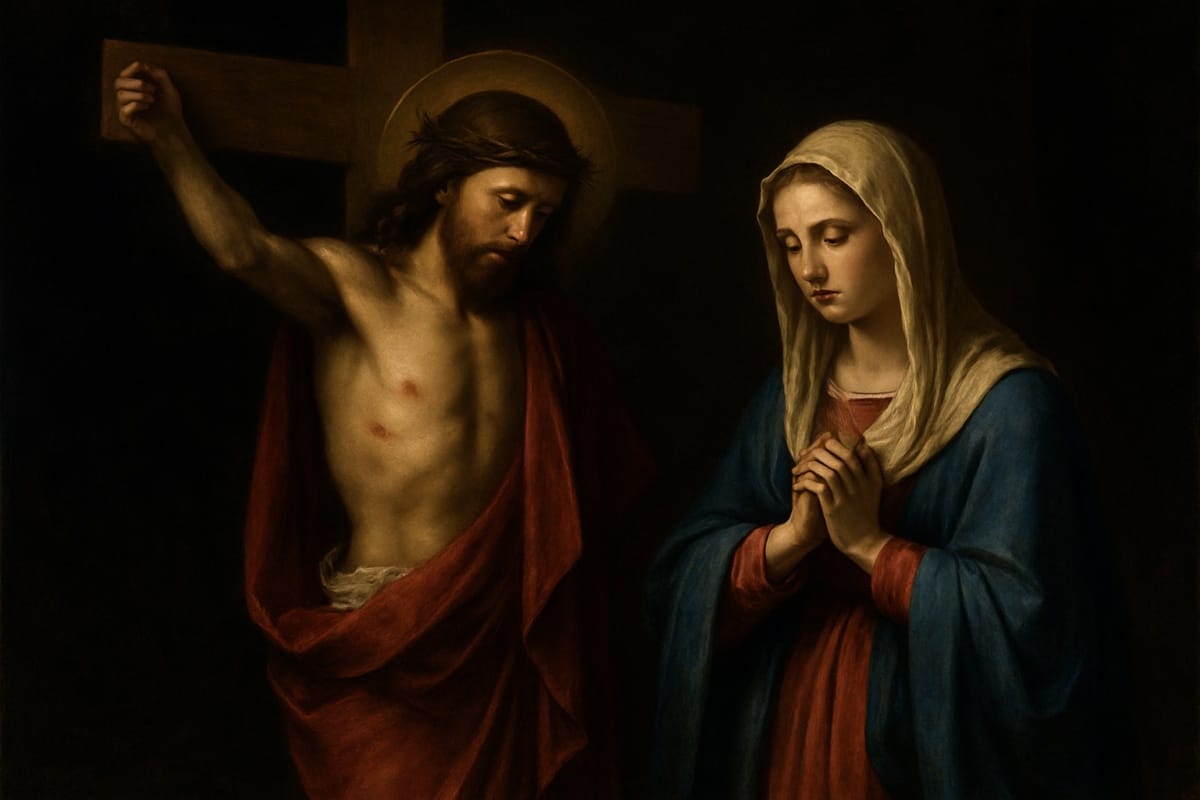
> “And just as Moses lifted up the serpent in the wilderness, so the Son of Man must be lifted up.” John 3:14The feast of the Exaltation of the Holy Cross presents three texts that converge on the paradox of glory through suffering: Numbers 21 offers the bronze serpent that Moses lifted up in the desert as a cure for those bitten, Philippians 2 sings of the Son’s kenosis, who “humbled himself to the point of death on a cross” and thus was exalted above every name, and John 3 reveals that the Son of Man must be exalted “as Moses lifted up the serpent.” Mary, who stood by the cross (John 19:25), is the privileged witness to this exaltation that passes through suffering.
I. The First Reading: Numbers 21:4b-9 and Philippians 2:6-11
The bronze serpent in Numbers 21 is one of the oldest typologies of the Cross in Christian tradition: the people bitten by serpents look to the bronze serpent lifted up by Moses and are saved. The gaze at the symbol of death that kills is healed by the same symbol raised by God who commanded it. Jesus in John 3:14 applies this typology to his own exaltation: just as Moses lifted up the serpent, so the Son of Man will be lifted up, so that everyone who believes in him may have eternal life.The Christological hymn in Philippians 2:6-11 articulates the same paradox in more theologically dense language: the one who existed in divine form did not cling to that status as a privilege, but “emptied himself” (v.7) to the point of obedience to the cross. God’s response to this kenosis is the supreme exaltation: “for this reason God exalted him above all” (v.9). The logic of the Cross is the logic of the bronze serpent: the descent to the lowest is the path to exaltation that no other path allows.II. The Gospel: John 3:13-17
John 3:13-17 is the theological core of the feast: the Son of Man who descended from heaven is the only one who can ascend to heaven, and his “ascend” is the exaltation of the Cross. “Just as Moses lifted up the serpent in the wilderness” (v.14): the comparison is bold because the serpent was the symbol of the curse. Paul in Galatians 3:13 says that Christ “became a curse for us”: the Cross is the exaltation of one who carried the curse of all so that all may be healed by faith’s gaze.“For God so loved the world that he gave his only Son, so that everyone who believes in him may not perish but have eternal life” (v.16) is the key that transforms the paradox into love: the exaltation of the Cross is not a logic of power but a logic of love that goes to the extreme. The Son was not sent to condemn but to save (v.17). The feast of the Exaltation of the Holy Cross celebrates not the instrument of torture but the love that transformed it into a throne of mercy and a symbol of life that overcomes death.III. The Logic of Exaltation: Kenosis and Glorification
The cross-theology proposed by the three texts shares a common structure: descent precedes and makes possible the ascent. In Num 21, the symbol of death is raised as a cure. Phil 2 describes the humiliation that precedes exaltation. John 3 identifies the Cross with the “ascension” of the Son of Man. This is not a logic of resignation but of transformation: the suffering embraced in obedience to the Father is not the end of the journey but the condition for glorification that surpasses all that creation can imagine.The feast of the Exaltation of the Holy Cross invites Christian prayer to consider a paradox that reason cannot resolve but faith embraces: the symbol of the most infamously cruel death became the symbol of the fullest life. As Paul says in 1 Cor 1:18, “The word of the cross is foolishness to those who are perishing, but to us who are being saved, it is the power of God.” The exalted Cross is not God’s defeat; it is the defeat of everything that opposes love that goes to the end.IV. Mary at the Cross: Witness to Exaltation
John 19:25 describes Mary “standing near the cross of Jesus”: the same scene anticipated in John 3:14 as the exaltation of the Son of Man. Mary did not witness to the Cross as a passive observer; she stood while the Son was exalted. John’s “stabat” (she stood) expresses the faith that recognizes in death the exaltation sung in Phil 2: the one who “emptied” the Son is the same who exalted him above every name.The feast of the Exaltation of the Holy Cross invites us to contemplate Mary as a model for one who looks at the Cross with Phil 2’s eyes: she sees the kenosis, recognizes the exaltation. The one who said “Let it be” to the Angel also said “Let it be” to the Cross, because the same logic runs through both moments: God who descends so that creation ascends. Mary who stood near the Cross is the good soil where the seed of absolute love fell and bore the fruit of faith that the Church continues to celebrate.Graduate Studies in Mariology
Do you want to deepen your formation in Mariology? Get to know the Graduate Program in Mariology from Locus Mariologicus – an academic formation that combines theological rigor, spiritual life, and the living tradition of the Church.



Responses