Mary Mediatrix: Mary’s maternal function in the history of salvation
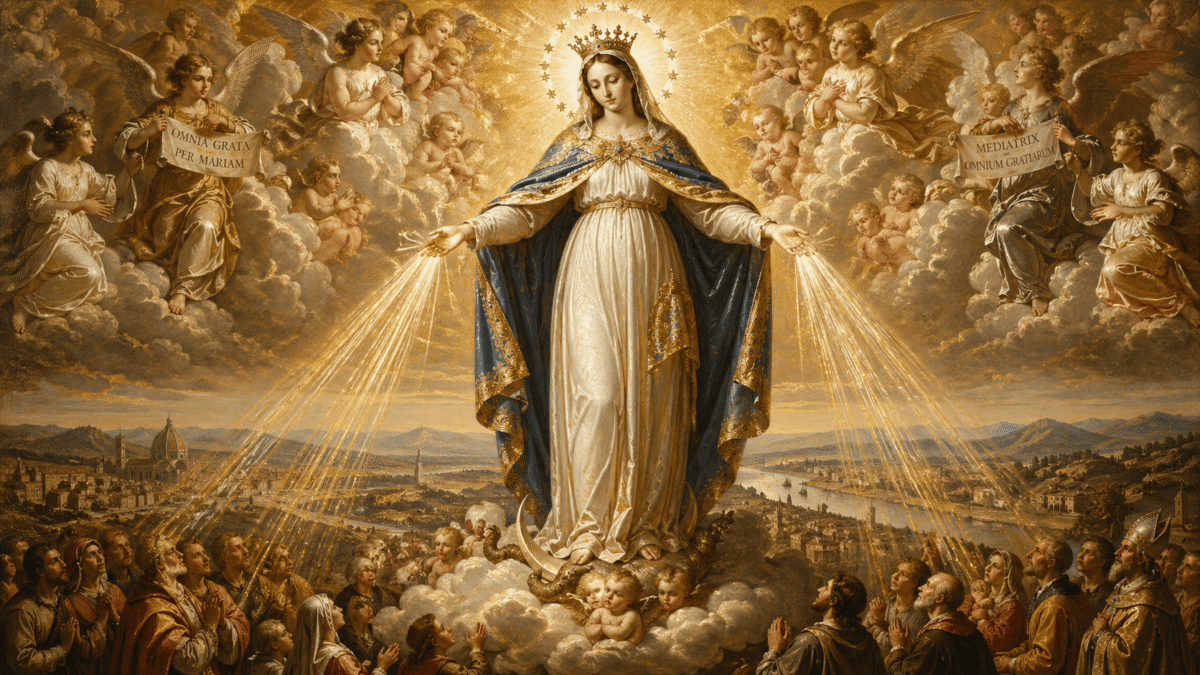
Mary Mediatrix, Mary’s maternal function in the history of salvation
Mary’s universal mediation — her maternal function in cooperating with the work of redemption and in the impetration and distribution of graces — is one of the most discussed and most current aspects of all Mariology. Since the beginning of the twentieth century, this theme has mobilized theological research and the attention of the papal and conciliar Magisterium, has attracted the confidence of popular piety, and has constituted the most salient point of ecumenical dialogue. For the full article: Mary Mediatrix.
Historical development
Supplicant invocation of Mary, expressed in confidence in her protection, is of very ancient origin in the Church. The Marian troparion Sub tuum praesidium, which qualified critics trace back to the third-fourth century, expresses a precise belief in the intercession of Mary Mother of God. The title “Mediatrix” begins to be used with increasingly precise meanings from the sixth century onward and becomes increasingly frequent from the twelfth century. Only in the seventeenth century does it begin to express a true doctrinal thesis, systematized over the course of the twentieth century.
From 1921 onward, within the framework of the Belgian Church’s project for a dogmatic definition of the mediation, a vast theological production developed. Cardinal Mercier, archbishop of Malines, with the scholarly support of the University of Louvain and of the entire Belgian episcopate, requested the approval of a proper Mass and Office in honor of Mary Mediatrix and presented the petition for the dogmatic definition of Mary’s universal mediation. Benedict XV granted the liturgical celebration, but took no position regarding the definition. In the preparatory phase of the Second Vatican Council, three hundred of the responses that reached the Holy See called for the solemn definition of Mary’s universal mediation.
Pre-conciliar terminology and doctrine
Pre-conciliar theology, drawing on Saint Thomas, applied to Mary the title of Mediatrix in analogy with the title of mediator given by Paul to Christ. It distinguished two functions: cooperation in the objective work of redemption (historical co-redemption, from the Annunciation to Calvary) and the present application of the fruits of redemption through intercession and the distribution of graces.
On the nature of the mediation of graces, three interpretations were proposed: moral causality (Mary’s merits and intercession move God to grant grace), dispositive physical-instrumental causality (Mary predisposes human beings to grace), productive physical-instrumental causality (Mary is an instrument in God’s hands for the outpouring of grace). The third interpretation was the most influential in the popular piety of the twentieth century, although theologians recognized its shortcomings.
Theologians nevertheless recognized certain shortcomings in this approach: the hypertrophied development of Mariology, almost on the margins of Christology, Ecclesiology, and Pneumatology, created a disproportionate “Marian verticalism,” without adequate ecclesiological framing and with a poverty of references to the Holy Spirit.
The doctrine of the Second Vatican Council
The question of Mary’s mediation was widely debated by the council fathers and was certainly the most discussed point of the whole of chapter VIII of Lumen Gentium. Vatican II could not accept the request for a dogmatic definition, but it formulated a clear and sure doctrine on Mary’s maternal function. At the same time, it deliberately omitted the customary titles of “Mediatrix” and “Co-Redemptrix,” preferring expressions such as “handmaid of the Lord,” “daughter of Zion,” “associate of the Redeemer,” and “the maternal function of Mary toward men” (LG 53-62).
The Council solemnly proclaimed that Mary cooperated, with charity, in the birth of the faithful in the Church, and that her spiritual motherhood extends without interruption from her historical cooperation to her present intercession in heaven (LG 61-62). At the same time, it established precise interpretive criteria: Christ is the one mediator between God and men (1 Tim 2:5-6), and Mary’s maternal function neither replaces nor completes that unique mediation; it is not an intermediate step between Christ and the faithful, but an empowerment so that they may enter more easily into communion with the one Mediator. No salvific influence of Mary is absolutely necessary; rather, it arises from God’s spontaneous good pleasure, springs from the merits of Christ, and is subordinate to it (LG 60-62).
New theological-pastoral perspectives
Following the indications of Vatican II and of Paul VI’s Marialis Cultus, post-conciliar theology proposed new perspectives for understanding Mary’s maternal function. These perspectives do not replace traditional Mariology, but integrate and update it.
The ecclesiological perspective reads Mary’s maternal function in an ecclesial key. Mary is the initial and perfect member of the Church, figure and model of the historical Church (LG 63-65), and image of the eschatological Church. As assumed and glorified, Mary represents the realized and perfect image of the Church that is yet to be consummated. For this reason Paul VI proclaimed Mary “Mother of the Church” on the very day on which he promulgated Lumen Gentium.
The historical-sociological perspective sees Mary as a historical figure who interprets human history as the history of salvation. The Magnificat shows that Mary not only makes history, but also reads and writes it: she announces that God carries out His plan with the poor and the lowly, subverting the expectations of the rich and the powerful. Pentecost reveals Mary as an ecclesial figure: it is with her presence and prayer that, under the influence of the Holy Spirit, the Church is constituted.
The anthropological perspective of the feminine, developed on the basis of Marialis Cultus (nos. 34-37), rereads the figure of Mary as a model of feminine dignity: a balanced and autonomous feminine person who freely places herself at the service of God and of others. Mary, as spouse, mother, and associate, but principally as woman, realizes in the first place the whole paradigm of feminine dignity.
Current synthesis
Contemporary mariological theology is moving toward a broader understanding of Mary’s maternal function: not restricted merely to the impetration and distribution of individual graces, but extended to her continuous influence on the realization of the Church in its historical journey and in its eschatological destiny, her example and her help for the promotion and liberation of every human being from every situation of oppression and subjection. Mary’s maternal function is not expressed only as assistance from on high, but as maternal presence, strength, and guidance within humanity on its historical journey toward its final destiny.
Deepen your studies: explore Mariology, Marian Theology, New Eve, and the Postgraduate Program in Mariology.
Mary Mediatrix, the theology of Marian mediation
The title Mary Mediatrix expresses the theological conviction that Mary has an active role in the distribution of Christ’s graces. Unlike the unique mediation of Christ (1 Tim 2:5), Mary’s mediation is participated, subordinate to and dependent on the mediation of Christ.
The theology of Marian mediation rests on three elements: the divine motherhood (which places Mary in a unique relationship with Christ), co-redemption (Mary’s cooperation in the work of redemption), and the function of intercession (which Mary exercises in Heaven on behalf of the faithful). These three elements are mutually articulated and mutually grounded.
The Second Vatican Council (LG 62) states that Mary “cooperates with maternal love in the regeneration of the faithful,” but stresses that this mediation “in no way obscures or diminishes the unique mediation of Christ.” The title “Mediatrix” is mentioned, but without a dogmatic definition, on account of the Council’s ecumenical prudence.
There exists a movement of theologians and faithful that calls for the dogmatic definition of Mary as “Co-Redemptrix, Mediatrix, and Advocate.” The debate is intense: its proponents argue that this would be the logical making explicit of truths already implicit in the Magisterium; its critics warn of the ecumenical risks and of the need for more careful language.
Deepen your studies: explore Mariology, Mary Co-Redemptrix and Mediatrix, Marian Theology, and the Postgraduate Program in Mariology.
Magisterium of the Church
Hunc autem Mediatorem nequaquam obscurat aut minuit haec in ordine gratiae functio Virginis, sed virtutem eius demonstrat. Nam omnis Virginis Matris de Filio suo influentia et virtus ex eius meritis oritur, eius auctoritati innititur, ex eius mediationis pendet, atque ex ea totam suam efficacitatem haurit, et non impedimento sed fomento est immediatae cum Mediatore unionis fidelium.
Second Vatican Council, Dogm. Const. Lumen Gentium, no. 62 (November 21, 1964)
📚 Literal translation: This function of the Virgin in the order of grace in no way obscures or diminishes this one Mediator, but rather shows forth His power. For all the influence and saving power of the Virgin Mother with regard to her Son originate in His merits, rest upon His authority, depend upon His mediation, and draw from it all their efficacy; and it constitutes no obstacle, but rather fosters the immediate union of the faithful with the Mediator.
Postgraduate Program in Mariology
Would you like to deepen your formation in Mariology? Discover the Postgraduate Program in Mariology of Locus Mariologicus — an academic formation that unites theological rigor, spiritual life, and the living tradition of the Church.
Learn what the Church teaches about Mary, Mediatrix of All Graces.
Would you like to study Mariology seriously?
This article arises from the works in the library of Locus Mariologicus. The Postgraduate Program in Mariology takes you to that same source, with academic guidance: Scripture, the Fathers of the Church, and the Magisterium, from the first dogma to contemporary questions.





Responses