Saint Mary, servant of the Lord
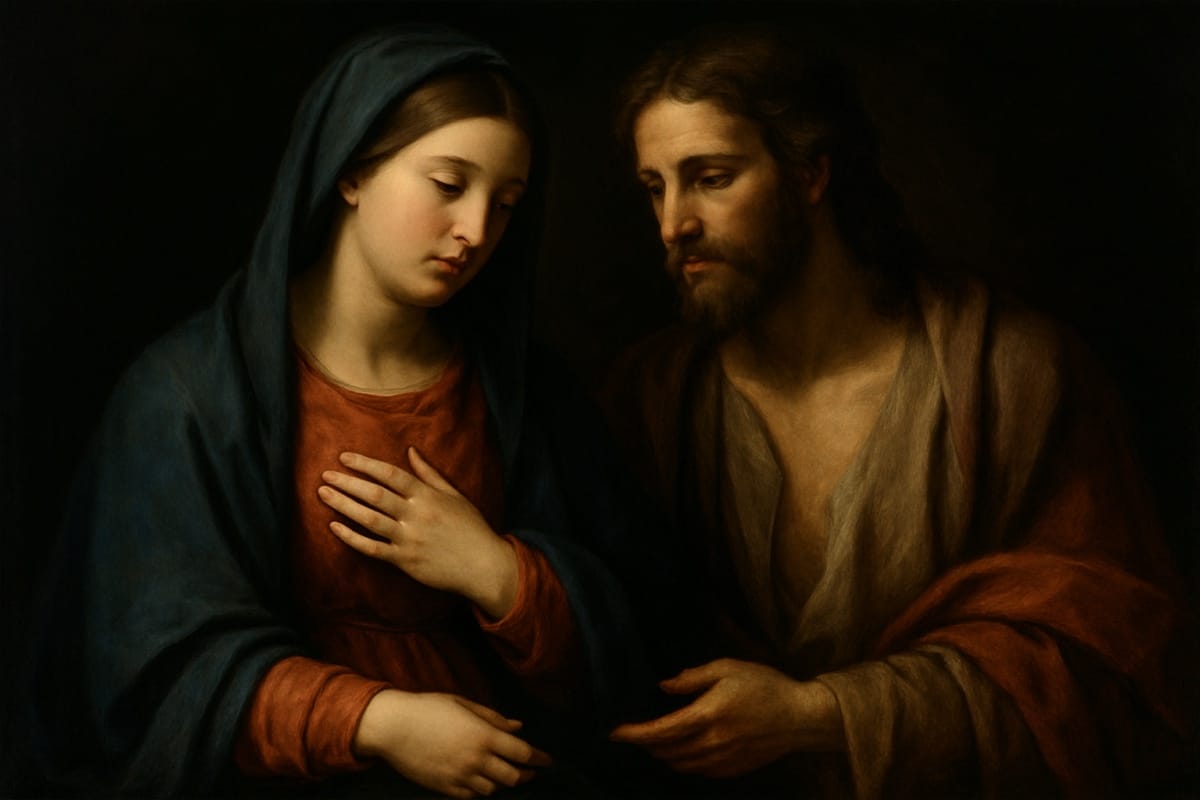
«Ecce ancilla Domini. Fiat mihi secundum verbum tuum. «Behold, I am the servant of the Lord. May it be done to me according to your word.» (Lk 1:38)
I. Ana, the woman who gave her Son to God
The narrative of Ana in the First Book of Samuel is one of the most moving portraits of motherhood and faith in the Old Testament. Ana was sterile, suffering the social humiliation that sterility entailed in her culture, but she prayed in the temple with an intensity that the priest Eli mistook for drunkenness. The Lord heard her prayer, and she conceived and gave birth to Samuel. Then, faithful to the vow she had made, Ana brought the child to the temple and gave him to God: «I have prayed for this child, and the Lord has granted me what I asked. So now I give him to the Lord. He will be dedicated to the Lord for all his life» (1 Sm 1:27-28).
Ana’s act is one of the greatest displays of spiritual magnanimity in the Old Testament: to receive a child as a gift from God and return him to God. This logic of received gift and offered grace prefigures the logic of Mary’s “fiat”: she too received the Son of God as a gift, and throughout her life progressively offered him to the Father, culminating at the extreme moment of the Cross. The song of Ana that follows Samuel’s dedication, «My heart exults in the Lord; my spirit rejoices in God my Savior» (1 Sm 2:1), is the prototype of Mary’s Magnificat: the woman who received the impossible gift and responds with praise that recognizes God’s greatness.
II. From «servant» to «servant»
Ana’s self-designation as «servant of the Lord» (1 Sm 1:11) is the title Mary will adopt for herself at the moment of the Annunciation: «Behold, I am the servant of the Lord» (Lk 1:38). The convergence is not accidental: both women share the same posture of radical availability before God, the same renunciation of any personal agenda that competes with the divine plan, the same surrender that does not calculate costs because God’s love is sufficient to make any sacrifice not only bearable but desirable. The «servant» is not the slave who obeys out of fear; she is the daughter who serves out of love, who gives away what is dearest precisely because she recognizes that the dearest she has is a gift received, not a conquest.
The difference between Ana and Mary lies in the difference between the gift that anticipates and the gift that fulfills: Ana hands over Samuel for service in the temple, where he will become the last of the judges and the anointed of the first kings of Israel. Mary gives Jesus for service to humanity, where he will become the sole Savior and the eternal King of the universe. What Ana did in a preliminary and imperfect way, Mary accomplished in a definitive and perfect manner: the total surrender of the Son to the Father, without reserves, without negotiations, without resorting to any other logic than that of love that gives everything.
III. «May it be done to me according to your word»
Mary’s response to the angel Gabriel is the most complete and radical expression of what the vocation of «servant of the Lord» entails. «May it be done to me according to your word» (Lk 1:38): the verb «be made» is passive, indicating an action that comes from outside and that Mary welcomes, but the «word» is God’s, and Mary embraces it completely, without hesitation, without question.
In her «yes» is not the submission of one who has no choice, but a free choice on her part, within her freedom and personality, with the full consent of her intelligence and will. Mary’s fiat is not the surrender of one who has no alternative; it is the free choice of one who could have refused, but chooses to consent because she recognizes in God’s Word something more trustworthy than all human projects.
The title «Servant of the Lord», which Mary adopted, reveals the profound logic of Christian holiness: not the affirmation of human autonomy against divine will, nor the negotiation between one’s own project and God’s project, but confident surrender that discovers in divine will the highest path to one’s own fulfillment. Mary did not diminish by becoming Servant of the Lord: she grew to the fullest dimension that a creature can attain. The «servant» of Nazareth became Mother of God, Queen of the universe, whom «all generations will call blessed» (Lk 1:48). The Gospel paradox is fully realized in her: he who becomes servant to all becomes the highest of all.
IV. Mary, Model of Christian Service
The twenty-second Mass of the Collect proposes Mary, Servant of the Lord, as the perfect model of Christian service that the Son came to teach: «The Son of Man did not come to be served, but to serve and to give his life as a ransom for many» (Mt 20:28). The service that Jesus lived in his incarnation and death reflects the service that Mary had inaugurated with her fiat: both serve not by compulsion but out of love, both give not the superfluous but themselves, both discover in total gift not impoverishment but the highest wealth.
Anna served God by giving her son. Mary served God by being the Mother of the Son. The Church serves God by being the body that continues the presence of the Son in the world. The connection is clear: each one’s service is the specific way in which divine grace acts in history, and the highest form of service is always that which most resembles Mary’s fiat: an unconditional surrender, that keeps nothing back for oneself, that makes space for God to continue to do what he did in Nazareth: take flesh, dwell among us, transform the world from within.
Postgraduate specialisation in Mariology
Would you like to deepen your formation in Mariology? The Locus Mariologicus postgraduate programme is a specialisation that brings together theological rigour, spiritual life and the living tradition of the Church. The next class begins in 2027.





Responses