Asmodeus: the demon of the Book of Tobias and the archangel Raphael
By Prof. Dr. Daniel C. Afonso · Updated
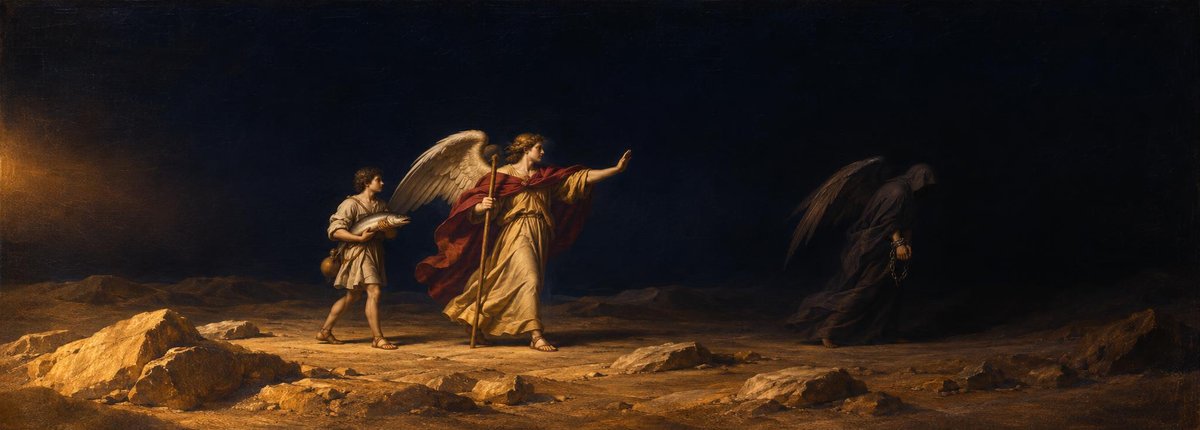
Asmodeus is the demon from the Book of Tobias: he kills Sara’s first seven husbands before they can be alone with her, and God sends the archangel Raphael “to heal the two of them” and “to bind Asmodeus, the most evil demon” (Tobias 3:17, translated from the New Vulgata). It is a singular page, where the demon has a name and it is an angel who binds him, and it is worth reading it slowly.
In summary
- Who is: Asmodeus, “the most evil demon,” the only demon named in the Book of Tobias (Tob 3:8).
- The book: Tobias is deuterocanonical: the Catholic Church receives it as Scripture, and Protestant tradition places it among the apocrypha.
- The central scene: Tobias burns the heart and liver of a fish, the demon flees to Egypt and Raphael captures him (Tob 8:2-3).
- Meaning: Smoke is a sign. Healing comes from God, who sends Raphael in response to Tobit and Sara’s prayer (Tob 3:16-17).
- The name: probably Persian, connected to Aeshma-daeva. It is a hypothesis of scholars, not a given in the text.
A book that Catholics receive as Scripture
Tobias is a deuterocanonical book. The Catechism includes it in the list of Old Testament books that the Church holds as sacred (n. 120). It is not in the Hebrew Bible, and thus Protestant Bibles place it apart, among the apocrypha. It has come down to us in Greek, in the Septuagint, and in ancient Latin forms. In the following reading, the verses are from the New Vulgata and the translations are ours.
Sarah, the Seven Husbands, and the Demon
The action takes place in exile. In Ecbatana, Media, Sara, daughter of Raguel, who had been given to seven men, lives. The text explains what was happening: “Asmodeus, the most evil demon, killed them before they could lie with her” (Tob 3:8). A servant insults her, and Sara thinks of hanging herself. She only gives up to avoid disgracing her father, and she asks God to let her die.
On the same day, in Nineveh, the old blind and weary Tobit also prays for death. Both pray without knowing each other, and the narrator combines their prayers into one sentence: “At that very time, their prayers were heard in the presence of the glory of God, and the angel Rafael was sent to heal both of them” (Tob 3:16-17). Rafael comes to heal Tobit from his blindness, to give Sara as a wife to Tobias, Tobit’s son, and to “bind Asmodeus, the most evil demon.”
The Fish, the Heart, and the Liver
Tobias sets out for Media with a companion whom he calls Azarias. It is Raphael, who only reveals himself at the end (Tob 12:15). By the river Tigris, a great fish leaps against Tobias, whom he seizes by the angel’s command. Raphael instructs him to preserve the heart, liver, and gall, explaining their use: “Let the smoke of the heart and liver of the fish go up before the man or woman who is assailed by a demon or a wicked spirit, and every assault will flee from them” (Tob 6:8). The gall would serve for Tobit’s eyes.
Rafael adds an instruction that is often overlooked: in the bridal chamber, “arise both of you first, and pray and entreat the Lord of heaven that he grant you mercy and health” (Tob 6:18). Smoke and prayer go together from the first announcement.
The Flight of Asmodeus and the Demon Imprisoned
On the night of the wedding, Tobias remembers what the angel had said and lays his heart and liver upon the coals of the incense. The text is brief: “The smell of the fish drove him away, and the demon fled to the upper regions of Egypt. And Raphael went there, seized him, and returned quickly” (Tob 8:3). The scene does not depict a struggle nor any formulas: the demon flees, and it is the angel who seizes him.
Then Tobias and Sarah prayed: “Blessed be God of our fathers” (Tob 8:5). Raguel, Sara’s father, had ordered a tomb to be dug out of precaution, and the servant he sent to inquire about the matter found them both alive.
What does the Greek text and the Vulgata say differently?
We compare the Nova Vulgata, the Greek text of the Brenton edition, and the traditional Latin Vulgata, which accompanies the Douay-Rheims Bible. The most visible difference lies in the traditional Vulgata. There, Raphael instructs Tobias to spend three nights in prayer before cohabiting with Sarah: “for three days abstain from her, and occupy yourself with nothing else but prayer with her” (Tob 6:18). Tobias repeats to his wife, “In these three nights we are united to God” (Tob 8:4). Neither the Nova Vulgata nor the Greek text we read includes these three nights. The Greek text merely prescribes prayer: “Arise both of you and cry out to the merciful God, and he will save you” (Tob 6:17, Greek text).
Other differences are minor. In Greek, Asmodeus “fled to the highest parts of Egypt, and the angel seized him” (Tob 8:3). In the traditional Vulgate, Raphael “seized the demon and bound him in the desert of Upper Egypt.” The traditional Vulgate also explains why the demon had power over the seven husbands: he has power over those who receive marriage excluding God (Tob 6:17). The Greek manuscripts also diverge from one another. According to Angelini, the Sinaiticus reads in Tob 3:17 “to free Asmodeus,” while other Greek recensions say “to bind Asmodeus.” The book therefore exists in different textual forms.
It is not magic: prayer and the instrument of God
Those who read quickly may conclude that the book teaches a recipe against demons. The text points to something else. The order of the events is this: first, the prayers of Tobit and Sarah, then the sending of Raphael, and only then the fish. The smoke is a sign and a means given by the angel. The victory over Asmodeus is of God, and it is the archangel who binds him.
Rafael himself declares this at the end of the book. He presented their prayer: “I presented the memory of your prayer before the glory of the Lord” (Tob 12:12). And he rejects any merit of his own: “I was with you not for my sake, but for God’s will” (Tob 12:18). He claims to be “one of the seven holy angels who assist and enter before the glory of the Lord” (Tob 12:15). The name Rafael, indeed, means “God’s healer,” according to Barton.
Angelini notes that the narrative does not oppose a magical remedy and a medical remedy. The recipe against the demon and the one for the eyes of the blind are on the same plane, both under the authority of God, exercised through Raphael. The Catechism teaches that the Church expels demons “by the spiritual authority that Jesus entrusted to his Church” (n. 1673), and adds that it is necessary to distinguish the presence of evil from a disease, whose treatment depends on medical science. On exorcism today, see Exorcism in the Catholic Church.
Where does the name Asmodeus come from?
The name is strange to the Hebrew world. Barton, in 1912, derives it from the Persian Aeshma-daeva, “divinity or evil spirit.” Angelini says the name is “probably of Persian origin,” where it should have meant “demon of wrath.” This is a hypothesis of scholars. The book itself does not explain the name.
What does this mean for us?
The Catechism states that human life, from the beginning to the end, is surrounded by the protection and intercession of the angels (n. 336), and the liturgy celebrates the memory of Saint Raphael (n. 335). The story of Tobias illustrates this: the angel walks by the side, teaches, protects, and brings the prayer of men to God. For the figure of the archangel, see Raphael, the Archangel.
## Frequently Asked Questions
Quem é Asmodeu no livro de Tobias?
É o demônio que mata os sete primeiros maridos de Sara, filha de Raguel, antes que fiquem com ela (Tb 3,8). O livro o chama «o demônio malíssimo». Deus envia o arcanjo Rafael para prendê-lo (Tb 3,17).
O livro de Tobias faz parte da Bíblia?
Para os católicos, sim. O Catecismo o inclui na lista dos livros do Antigo Testamento (n. 120). É um livro deuterocanônico, que não está na Bíblia hebraica, e as Bíblias protestantes o colocam entre os apócrifos.
O que Rafael fez com Asmodeu?
Quando Tobias queimou o coração e o fígado do peixe, o demônio fugiu para as regiões superiores do Egito, e Rafael foi lá, prendeu-o e voltou logo (Tb 8,3).
O peixe e a fumaça são magia?
O texto não os apresenta assim. Rafael dá a receita depois de a oração de Tobit e de Sara ser ouvida, e pede que Tobias e Sara rezem (Tb 6,18 e 8,4-5). No fim, o anjo diz que veio por vontade de Deus (Tb 12,18).
De onde vem o nome Asmodeu?
Provavelmente do persa Aeshma-daeva, segundo Barton, ou de um nome persa que significaria «demônio da cólera», segundo Angelini. É uma hipótese dos estudiosos, e o livro de Tobias não a confirma.
## References
- SACRED SCRIPTURE: Tob 3:7-17 · 6:2-18 · 8:2-5 · 12:12-18. Citations from Tobias by the Latin text of the Nova Vulgata (Libreria Editrice Vaticana, Liber Thobis), available at vatican.va. Our translations.
- TOBIAS. Greek text of the Septuagint, Brenton’s edition, available at ebible.org/grcbrent. Our translations.
- TOBIAS. Traditional Latin Vulgate (Douay-Rheims Bible numbering), available at drbo.org. Our translations.
- Catechism of the Catholic Church, nos. 120, 335, 336, and 1673.
- ANGELINI, Anna. The Imaginary of the Demonic in the Septuagint. Leiden: Brill, 2021, Chapter 8, pages 291-302.
- BARTON, George A. The Origin of the Names of Angels and Demons in the Extra-Canonical Apocalyptic Literature to 100 A.D. Journal of Biblical Literature, v. 31, 1912, pp. 158, 161, and 163.
Responses