Mary and the Contemplative Life

Prayer and Contemplation
In the spiritual life, prayer and contemplation are, so to speak, as necessary as the lungs are in physiological life: we need prayer, which has more to do with the lips, with listening, with the word. And we need contemplation, which has more to do with the eyes and, therefore, with the gaze.
To be men of prayer, to become burning bushes, we need prayer and also contemplation. Prayer without contemplation runs the risk of becoming cerebral and/or mechanical prayer, of falling into the danger, pointed out by Jesus, of wasting words like the pagans (Mt 6:7).
Therefore, only contemplation can enable us to practice with interiority the prayer we must offer, a prayer of reading, of meditation, and even of uttering words.
On the other hand, contemplation in the Christian vision needs prayer, words, listening: a contemplation that is only gazing, only concentration, runs the risk of becoming narcissism and a false mysticism, which is the silence and peace of the desert, not the silence that makes the Word audible, that allows us to listen to the Spirit who suggests the ways of God, and that allows us to meet the Lord who comes.
In English, as in Portuguese, “contemplation” translates the Greek term Θεωρια (theoria). But while contemplation derives from the Latin contemplari, theoria derives from the Greek θεωρειν. Thus two meanings of contemplation come to light, that of vision and that of temple, which nevertheless come together in a single central meaning: the gaze is always part of us, situated as we are in a particular place, which becomes the point of view from which we look. And everything we see and know is also organized around a center. So it is with the temple, which expresses the organizing action of our lived reality around a center in which we place God.
Now, in the Christian faith, the center of this activity that organizes all things is the Cross, the throne of the sacrificed Lamb, the heart of the Church and of the liturgical action, from which springs the gift of the Spirit: the Cross and Pentecost, which express and make present anew the mystery of Christ’s death and resurrection, give dynamism to the centrality of faith in the liturgy, which is an action of concentration and decentering of the life of the Church. And on the journey of faith, the life of each Christian also shares in this mystery of ecclesial concentration and decentering.
But the work of concentration and decentering is impossible unless there is truly a solid center. And this center is the presence of the Spirit of God in us, the kingship of Jesus, who reigns in our hearts from His Cross. Thus, to be contemplatives of the living God, indwelt by Him, our listening must be attentive to the Word, who has become Parable in our time. And the gaze must become penetrating (cf. Num 24:3-5 “and he took up his parable and said: Balaam the son of Beor speaks, and the man whose eyes are opened speaks. He speaks who has heard the words of God, who sees the vision of the Almighty, who falls down, and his eyes are opened: how fair are your tents, O Jacob, your dwellings, O Israel”!), capable of seeing the consubstantial Image of the Father (2 Cor 4:4 “in whom the god of this age has blinded the minds of the unbelievers, so that the light of the gospel of the glory of Christ, who is the image of God, may not shine on them”), in His icon, which is present in every image visible to the eyes of the flesh.
The Incarnation of the Word of God
We can practice prayer and contemplation with Mary starting from the event of the Incarnation of the Word of God, which is acceptable only if we recognize that there is no contradiction in it. How could God, who is pure spirit, have become incarnate? How could the Immaterial become matter, to use an expression of Saint John Damascene?
We read in the prologue of the Gospel of John: “In the beginning the Word already was, and the Word was directed toward the One who is God, and the Word was God” (Jn 1:1). A somewhat unusual translation, deliberately so, in order to bring out the similarity of disposition between the Word of God and the word addressed by God to His prophets (cf. Is 38:4; Jer 1:2, 4, 11, 13; Ezek 6:1; 7:1). The Greek expression πρὸς τὸν θεόν (= toward God) expresses the constitutive orientation of the Word of God. And this orientation remains present in Him even after the Incarnation, giving life to His every word and every gesture: everything comes from God and everything is oriented toward God.
In this Word of God, who is God, is contained, even before creation, the creative plan, which, in biblical terms, is called divine wisdom. Thus one begins to understand that to be contemplative means to be wise, not according to the mentality of the world, but according to “the mind of Christ” (1 Cor 2:16). This heavenly wisdom consists in discovering God’s design in things and in human events, in seeing everything with the eyes of God, for everything is like a word of God, which comes from the one Word made flesh and which leads to the “understanding” of Him.
We also read that “God, who had already spoken on many occasions in ancient times and in various ways to the fathers through the prophets, finally, in these days, has spoken to us through the Son. This Son, who is the radiance of his glory and the imprint of his substance, is the image of the invisible God, begotten before all creatures” (Heb 1:1-3; Col 1:15).
Therefore, the one Word of God, the Word who became flesh in the womb of Mary, is the whole expression of God and also the whole expression of creation: in Him is concentrated the meaning of all the words of God, both those that create and those that give meaning to creation. This has an enormous consequence for the life of faith: when we read the Sacred Scriptures, we find words. But these words, now that the Word has become flesh, are realized, fulfilled, and concentrated in the one Word who “pitched his tent among us” (Jn 1:14).
Jesus, therefore, holds the key to revealing the meaning of every word that comes from the mouth of the patriarchs and prophets. Therefore, everything we read in the Scriptures is a word that comes from His mouth; it is His bread broken for us who adhere to Him. Now the Word of God, through the gesture of the Incarnation, becomes matter by taking on a human voice and face, so as to be heard by our ears and seen by our eyes: He draws near to man by making Himself a parabolic Word (that is, Parable), and He shows Himself to man by becoming a visible Image (that is, Icon: an image that allows us to think, through what it shows, of what is invisible and cannot be seen with the eyes of the body). With this, all of Scripture becomes parabolic, because the Word, who was wholly directed toward God, in becoming incarnate also turned completely toward man and placed Himself beside man, thus becoming a parable.
Now we need to recognize this Word who lives beside us and constantly addresses us. It seems that the Word is beside us in order to walk the journey of life with us. And we can understand Him by agreeing to walk with Him, and only along the way, that is, after the decision to adhere to Him, can we attain an understanding of Him through a relationship with Him. The parabolic dimension encompasses the whole of God’s revelation, not only the revelation that is accomplished through words, but also the revelation that is accomplished through gestures and events.
Everything happens as with the disciples of Emmaus, who hear the explanation of the Scriptures and recognize Jesus in the act of breaking the bread. Therefore, there are two operations of the Incarnate Word of God: the Word becomes Parable (a word always spoken beside man). From Consubstantial Image of the Father, He becomes Icon (a historical image that shows Him in every event of human existence). And then He radiates into many words and parables, into many images and gestures (ordinary and extraordinary), so that we may find the way that leads us to Him.
On this journey toward the Incarnate Word, Jesus Christ, Mary is our mother and teacher, enabling us to use our ears and eyes to pass from words to the Word and from images to the one image of the invisible God. Therefore: “Blessed are your eyes, for they see, and your ears, for they hear” (Mt 13:16). This reference to the ears and the eyes expresses an anthropological law: man opens himself to reality through two windows, hearing and sight.
In the philosophical tradition, hearing and sight are considered the aesthetic senses par excellence. And this means that they are the bodily openings of the spirit, which allow man to enter into relationship with the reality that surrounds him. Now, in revealing the Lord to us and leading us to Him, Mary and the Church respect this structure of ours. That is why, in the Church, alongside the tradition of the Scriptures, there developed the tradition of sacred images, which make present the Word and the Image of God.
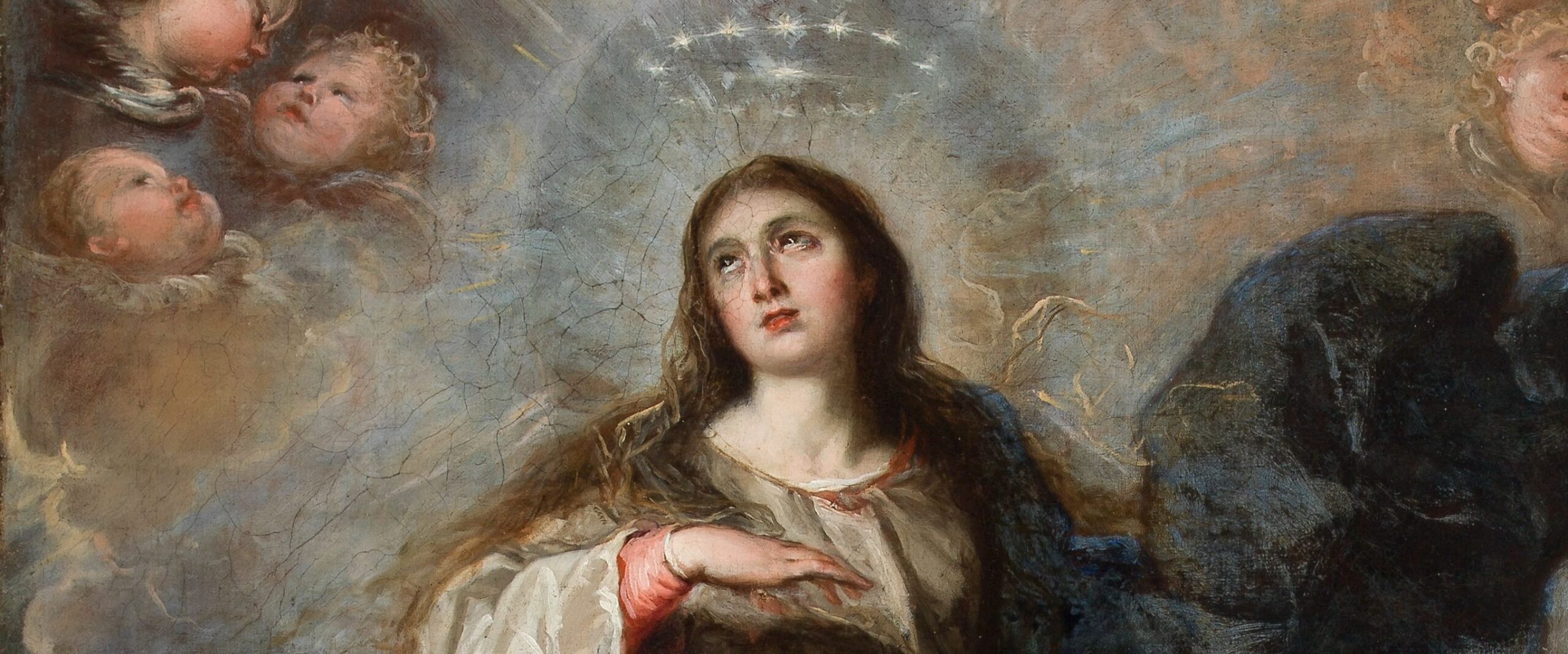
Thus one can broaden listening through contemplation: a deep understanding of revelation cannot neglect sacred iconography. At this point we can understand Mary’s role in prayer and in the contemplation of the Word of God. Mary, in fact, is always with Jesus; she is wholly relative to Jesus: just as the Word is wholly turned toward the Father, Mary is wholly turned toward the Son. Hence her exemplary character in the order of salvation. In keeping with this function, Mary shows us how to listen to the Word through the word, how to see the consubstantial image of the Father by looking at the icons of divine charity, and how to become a dwelling place of the Holy Spirit, that is, bushes of praise to God the Father in Christ Jesus.
No creature is as inclined toward the truth as Mary, who is prayer, absolute orientation toward Christ. Mary, therefore, also shows us how we must incline toward the truth, how to orient ourselves toward Christ, and how to be prayer and contemplation. For this, three passages are necessary, which Mary helps us to make: from the Parable to the Word, by listening to the words of God; from the Icon to the consubstantial Image of the Father, through the gaze of faith upon the icons (historical configurations of the saving events); and from contemplative orientation to the contemplation of the living God, who walks with us and beside us.
Listening to Mary is the key to understanding the Word, while the gaze is the key to seeing the Invisible: through her listening and her gaze we can illumine our lives with the fire of the Holy Spirit and become those burning presences. The Father is seeking them, as Jesus revealed to the Samaritan woman: “But the hour is coming, and now is, when the true worshipers will worship the Father in spirit and in truth. For the Father seeks such as these to worship him” (Jn 4:23).
To explore more deeply the reflection on Mary and the contemplative life, consult the encyclical Redemptoris Mater by John Paul II, which presents Mary as a model of contemplative faith and interior pilgrimage.
Deepen your studies: explore Mariology, Marian Theology, Marian apparitions, and the Postgraduate Program in Mariology.
Postgraduate Program in Mariology
Would you like to deepen your formation in Mariology? Discover the Postgraduate Program in Mariology at Locus Mariologicus, an academic formation that unites theological rigor, spiritual life, and the living tradition of the Church.
Would you like to study Mariology seriously?
This article grows out of the works in the Locus Mariologicus library. The Postgraduate Program in Mariology takes you to the same source, with academic guidance: Scripture, the Fathers of the Church, and the Magisterium, from the first dogma to contemporary questions.




Responses