Expedit vobis ut ego vadam: Mary and the Departure That Bears Fruit
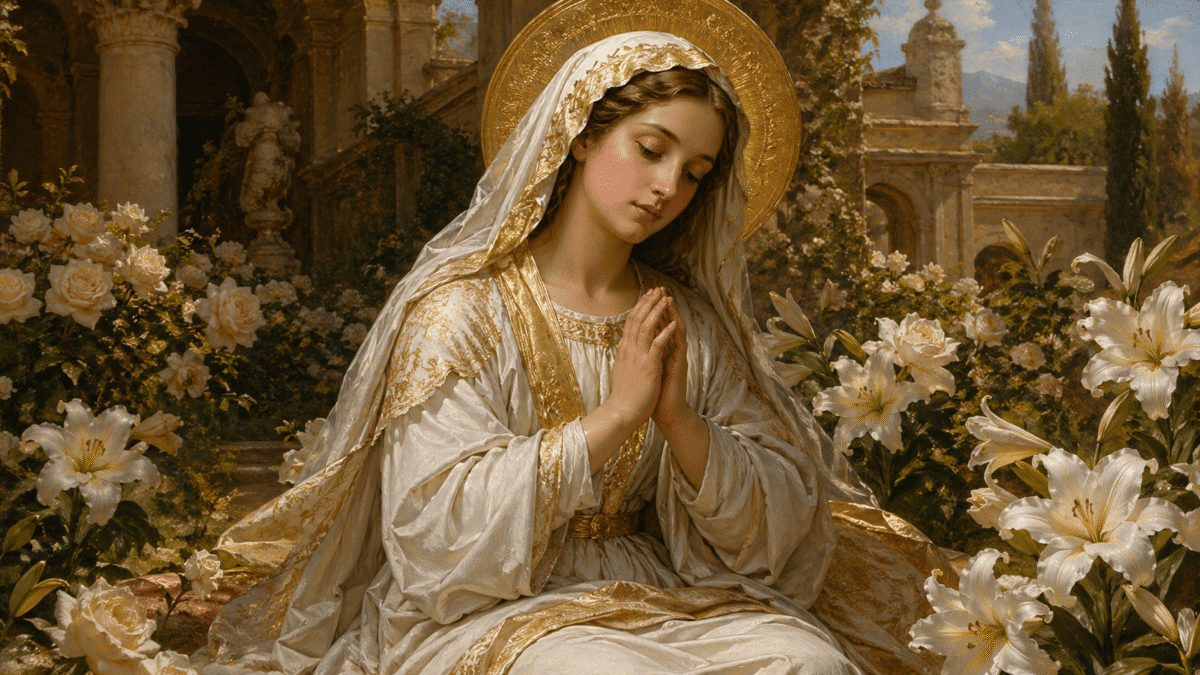
Expedit vobis ut ego vadam: si enim non abiero, Paraclitus non veniet ad vos.
Jn 16:7
“It is for your good that I go. For if I do not go, the Paraclete will not come to you.” This statement of Jesus, “my departure is good for you,” is paradoxical and scandalous: how can the loss of Jesus be “good” for His disciples? But Jesus’ logic overturns expectations: His physical presence was confined to one time and one place. The presence of the Paraclete whom He sends is universal and permanent. Mariology finds in this logic of the “fruitful departure” a principle of enormous richness: Mary, who also “departed” through the Assumption, became more present and more fruitful for the Church than when she was physically among us.
I. The Logic of the “Fruitful Departure” in the Fourth Gospel
Jn 16:7 is one of the most surprising statements in the Fourth Gospel: Jesus’ “departure” is presented not as a tragedy to be endured but as a condition for the good of the disciples. The underlying logic is pneumatological: while Jesus is physically present, His presence is necessarily limited; a body occupies one place, a voice carries only a certain distance, a person can be in only one place at a time. The presence of the Spirit, by contrast, is omnipresent, interior, universal.
This logic is not the easy consolation of someone trying to minimize a loss; it is a profound theological revelation about the nature of God’s presence. Jesus’ “departure” to the Father is not absence: it is the way in which His presence becomes more intense, more interior, more universal. He who “goes” will send the Spirit. And the Spirit who comes makes Him present not before a small group of disciples in Galilee, but within the heart of every believer of every time and place.
The principle of the “fruitful departure” has spiritual applications that the mystical tradition has explored. Saint John of the Cross, in his commentaries on the “dark night,” speaks of the withdrawal of sensible consolations as a condition for a deeper presence of God: when God “departs” in the experiential sense, He is preparing a more interior and more real form of presence. The “night” is not the absence of God; it is a form of presence deeper than any sensible consolation.
The grain of wheat of Jn 12:24 points in the same direction: “If the grain of wheat does not fall into the earth and die, it remains alone. But if it dies, it bears much fruit.” Fruitfulness comes from “death,” from departure, from visible disappearance. Jesus “dies” to the visible world and “rises” to an interior and universal presence mediated by the Spirit. This is the paschal logic that structures all Christian spirituality.
II. Mary’s “Departure”: The Assumption as Growing Fruitfulness
The Assumption of Mary, her “departure” to glory in body and soul, can be read in the light of the logic of Jn 16:7. Just as Jesus’ departure made possible the coming of the Paraclete, Mary’s “departure” to glory made possible her universal and permanent presence with all her spiritual children. While she was on earth, her physical presence was confined to one place. Now that she is in glory, her spiritual motherhood is universal: it reaches all who invoke her anywhere in the world.
The history of Marian apparitions is, from this perspective, the most visible sign of this “post-departure presence” of Mary. Lourdes, Fatima, Guadalupe, Czestochowa, La Vang, Kibeho: these places, spread across all the continents, bear witness that the Mary who “departed” for glory is more present to the world than the historical Mary of Nazareth. Her “departure” did not take her away; it brought her closer, making her contemporary to every generation and every culture.
The theology of Marian intercession is closely bound up with this logic. Mary, who intercedes “before the throne of the Son” (a recurring image in the devotional tradition), is not “far” from her spiritual children; she is “near” in the deepest sense: she is at the “center” of the Trinitarian heart from which all grace flows. Her “departure” to Heaven did not remove her from the earth; it placed her at the heart of the source of all grace, from where she can intercede more effectively than any earthly presence could allow.
Saint Bernard of Clairvaux, in one of his most famous sermons on Mary, described her intercession with a hydraulic image: Mary is the “aqueduct” (aqueductus) through which grace flows from the Son to the Church. This “aqueduct” does not obstruct the flow but facilitates it: it is the channel that directs the water to where it needs to go. Mary’s “departure” to glory deepened and universalized this function of “aqueduct”: she who was in Nazareth or in Jerusalem can now irrigate all the fields of the universal Church.
III. “The Spirit of Truth Will Guide You into All the Truth”: Mary and Dogmatic Development
Jn 16:13: “When he, the Spirit of Truth, comes, he will guide you into all the truth.” This promise of being “guided into the truth” by the Spirit is the theological foundation of dogmatic development: the Church does not possess “all the truth” at once from the beginning; she is guided progressively by the Spirit to an ever deeper understanding of the mystery revealed in Christ.
The Marian dogmas are paradigmatic examples of this process of “guiding into the truth.” The definitions of the Theotokos (Ephesus, 431), of the Immaculate Conception (1854), and of the Assumption (1950) are not “inventions” of the Church; they are explicitations of truths implicit in the deposit of faith, progressively unfolded under the guidance of the Spirit. The Spirit who “guides into all the truth” has guided the Church to an ever fuller understanding of who Mary is and what her role is in the plan of salvation.
Mariology is thus one of the privileged fields for observing dogmatic development. No other subject, except Christology and soteriology, has given rise to so many dogmatic definitions over the course of history. And each definition was preceded by centuries of intuition on the part of the faithful, of theological reflection, of doctrinal debate, which shows the organic process by which the Spirit guides the Church: not an arbitrary imposition “from above,” but a gradual maturing of the faith of the People of God.
The sensus fidei, the sense of the faith of the People of God, was particularly active in Mariology. The definition of the Immaculate Conception was preceded by centuries of popular devotion to December 8. The definition of the Assumption was preceded by a universal consultation of the Church, and more than 8 million faithful and 1,200 bishops asked for the definition. The Spirit who “guides into the truth” acted through the faith of the People of God, confirmed and defined by the Magisterium: this is the synodal structure of dogmatic development.
IV. “The World Cannot Receive” the Spirit: Mary and the Alternative to the World
Jn 14:17: “The Spirit of Truth, whom the world cannot receive because it neither sees him nor knows him.” The inability of the “world” (the human order organized around the refusal of God) to receive the Spirit is a theological observation with practical implications. The “world” that “hates” the disciples in Jn 15:18 is the same “world” that cannot receive the Spirit: the logic of self-sufficiency and of the refusal of God is impervious to the gift of the Spirit.
Mary is the most radical alternative to the “world” in this Johannine sense. She who was preserved from the logic of original sin, the logic of self-sufficiency, of “you will be like gods” (Gen 3:5), was also the most permeable to the Spirit. The Immaculate Conception is not merely a personal privilege of Mary; it is the fullest expression of the alternative to the “world”: a human creature who lived entirely outside the logic of the refusal of God and entirely open to the logic of the gift of the Spirit.
Devotion to Mary in the Christian tradition has always had this dimension of “alternative to the world.” The great reforms of the Church, from Gregory VII to Saint Francis, from Saint Charles Borromeo to the Charismatic Renewal, were often accompanied by an intensification of Marian devotion: as if the Spirit who renews the Church acted preferentially through Mary, the creature most “permeable” to His breath. The invocation of Mary as model and intercessor is, in this sense, the invocation of the logic contrary to that of the world.
The eschatology of the “fruitful departure” culminates in the hope of reunion: Jesus “goes” to prepare a place (Jn 14:2-3). Mary “departed” for glory to intercede for her spiritual children. The Spirit is now given as a “pledge” (2 Cor 5:5) of the future fullness. The paschal logic, departing in order to return more fully, is the logic of all Christian hope. The glorified Mary is the anticipation of this hope: she who “departed” is the guarantee that the Son will return and that the separation will come to an end.
Mary, who “departed” for glory to intercede for all her children, confirms by her Assumption the logic of Jn 16:7: the “departure” of the Beloved is not a loss but the condition for a deeper and more fruitful presence.
References
- Pius XII, Munificentissimus Deus, nos. 1-12 (1950).
- John Paul II, Redemptoris Mater, nos. 38-47 (1987).
- Saint Bernard of Clairvaux, Sermo in Nativitate B.M.V.
- Newman, An Essay on the Development of Christian Doctrine (1845).
- H. U. von Balthasar, Theodramatik IV: “Das Endspiel” (1983).
Postgraduate Program in Mariology
Would you like to deepen your formation in Mariology? Discover the Postgraduate Program in Mariology of Locus Mariologicus, an academic formation that unites theological rigor, spiritual life, and the living tradition of the Church.
Would you like to study Mariology seriously?
This article grows out of the works in the Locus Mariologicus library. The Postgraduate Program in Mariology takes you to the same source, with academic guidance: Scripture, the Fathers of the Church, and the Magisterium, from the first dogma to contemporary questions.





Responses