Collige primum zizania: the weeds and the wheat, and Mary in the patience of the Lord.
By Prof. Dr. Daniel C. Afonso · Updated
Inimicus homo qui seminavit ea est diabolus. Messis vero consummatio saeculi est, messores autem angeli sunt. Sicut ergo colliguntur zizania et igni comburuntur, sic erit in consummatione saeculi.
Mt 13:39-40
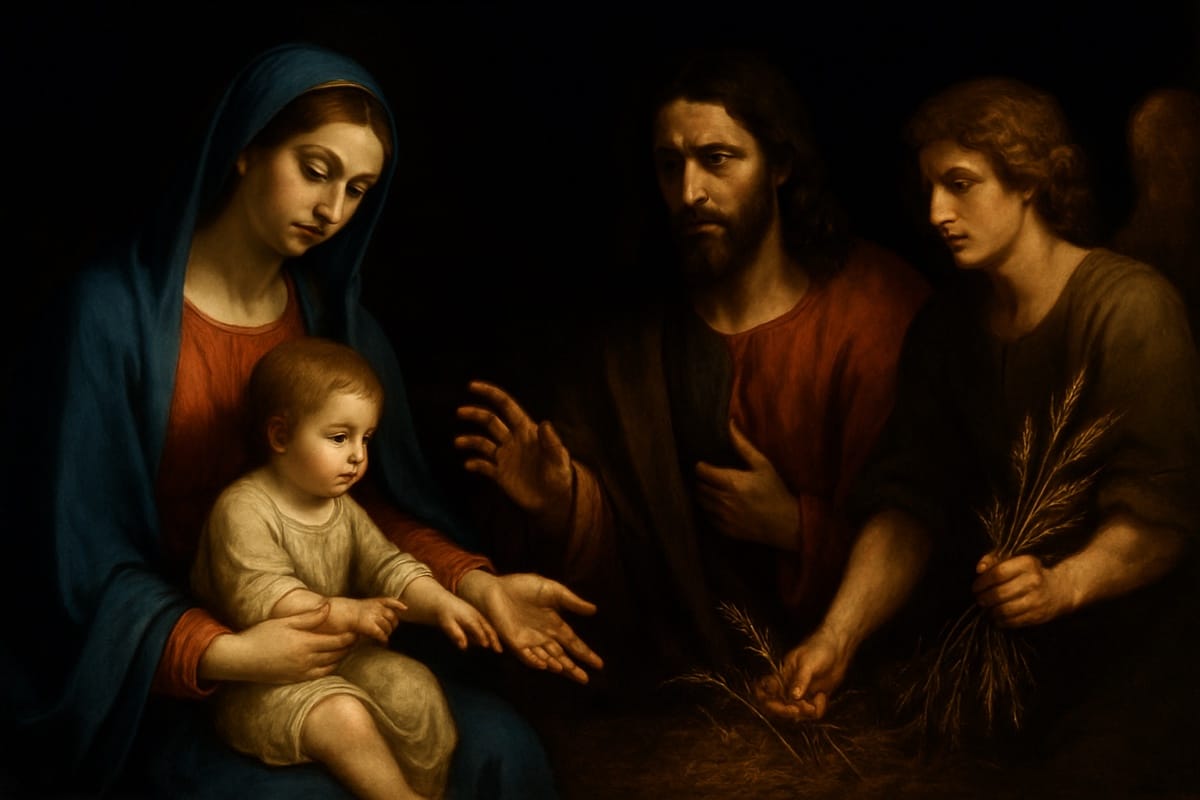
Mt 13:36-43 is the explanation Jesus gives the disciples, in private, of the parable of the weeds and the wheat (Mt 13:24-30). The original parable showed a farmer who, on finding weeds (zizania, probably Lolium temulentum, a weed that resembles wheat in the early stage of growth) sown among the wheat by the enemy, decides to wait for the harvest before separating them. The allegorical explanation, given privately to the disciples, identifies each element: the sower of the wheat is the Son of Man, the field is the world, the wheat are the children of the Kingdom, the weeds are the children of the Evil One, the enemy is the devil, the harvest is the consummation of the age, the reapers are the angels.
The decision to wait, not to pull up the weeds at once so as not to damage the wheat, is the theological key to the parable: the Lord is patient, He waits for full maturity before judgment. This patience is not indifference to evil but the recognition that spiritual growth requires time and that a premature separation can destroy what has not yet matured. The theology of divine patience of Mt 13:36-43 is the answer to the perennial question: why does God permit evil? The answer is not speculative but pastoral: because He waits for the weeds to become wheat, for the sinner to be converted, for the prodigal son to return.
I. “Inimicus homo hoc fecit”: the devil and the weeds in the field
“The enemy who sowed it is the devil” (Mt 13:39): the identification of the sower of the weeds with the devil is one of the most direct statements of the Gospel tradition about the action of the Evil One in the world. The devil does not create the field (the field belongs to the Lord), does not create men (the wheat is the seed of the Son of Man), but acts upon what already exists, sowing confusion, error, and division in the midst of what is good. The image of the weeds that resemble the wheat is the image of evil disguising itself as good, of falsehood imitating truth, of vice imitating virtue.
The action of the enemy “by night” (Mt 13:25: “while men were sleeping”) reveals the manner of acting of the Evil One: not in open confrontation but in secrecy, when vigilance is low. The spiritual tradition read in this image the danger of relaxation in the Christian life: the weeds are sown when the Christian “sleeps,” when he abandons the vigilance of prayer, of discernment, of the sacramental life.
In the patristic tradition, Mary is the adversary par excellence of the devil, the woman of Gen 3:15 whose offspring crushes the head of the serpent. In this context, the image of the weeds sown by the enemy contrasts with Mary, who “sowed” the very Son of God in the field of the world. Where the enemy sows death disguised as life (weeds that look like wheat), Mary brought the Life that seemed insignificant (a child in Bethlehem). The Eve/Mary contrast, which the patristic tradition developed (Eve disobeying, Mary obeying), here has an agronomic dimension: Eve welcomed the weeds of the enemy. Mary welcomed the grain of the Son of Man.
II. “Ne forte colligentes zizania”: the patience of God who waits
“No, lest in gathering the weeds you root up the wheat along with them. Let both grow together until the harvest” (Mt 13:29-30): the patience of the Lord who awaits the harvest is one of the most profound themes of Matthew’s theology. The God of Mt 13 does not intervene immediately to destroy evil, because a premature intervention would destroy the good together with the evil. This patience is the patience of love that respects organic growth, not the passivity of indifference but the active waiting of one who knows that ripening requires time.
The theology of divine patience has implications for ecclesiology: the Church (the field of the Lord) is, in this life, a mixture of wheat and weeds. The temptation of radical purity, of expelling at once the sinners, the heretics, the unworthy, is always present in the history of the Church. The parable of the weeds and the wheat is the Gospel answer: to wait, to discern, to let God be the judge at the moment of the harvest. Not out of moral relativism (the weeds remain weeds) but out of epistemic humility: who are we to know with certainty what is wheat and what is weeds in the hearts of others?
Mary as the figure of eschatological patience: she who lived for decades in the obscurity of Nazareth, who witnessed the slow and imperceptible growth of the Son until the moment of His public manifestation, who bore the “sword” of the Cross without losing faith, is the model of the patience that awaits the harvest. Mary’s “Holy Saturday,” between the death and the Resurrection, is the most extreme form of this patience: to await the harvest when everything seems destroyed, to hope for the separation between weeds and wheat when the wheat seems to have been destroyed together with the weeds.
III. “Fulgebunt iusti sicut sol”: the judgment and the transfiguration of the just
“Then the just will shine like the sun in the Kingdom of their Father” (Mt 13:43): the eschatological promise that closes the explanation of the parable is one of the most luminous in the Gospel of Matthew. The “shining like the sun” evokes the Transfiguration (Mt 17:2: “his face shone like the sun”); the final state of the just will be participation in the glory that Jesus revealed in the Transfiguration. What was transitorily visible on Tabor will become permanently visible in the eschatological consummation.
The expression “in the Kingdom of their Father,” not “His Kingdom” but “of the Father,” is significant: the Son of Man hands the Kingdom over to the Father (cf. 1 Cor 15:24), and it is in the Kingdom of the Father that the just shine. Matthew’s eschatology is Trinitarian: the Son sowed the wheat, the angels reap the harvest, and the final fruit is the Kingdom of the Father. Mary, who prayed “Thy Kingdom come” in praying the Our Father, prayed precisely for this moment: the moment when the “just will shine like the sun” in the Kingdom of the Father.
Mary already shares in this glory: the Assumption, defined dogmatically in 1950, affirms that Mary was taken up body and soul into heavenly glory. Mary “already shines like the sun” in the Kingdom of the Father; what the just await in hope, Mary already lives in reality. The Marian devotion that looks to Mary as the “anticipation” (prototype) of the resurrection of the dead has its foundation here: Mary is the “wheat” already harvested and already shining, sign and promise of what all who have persevered await.
IV. Mary in the judgment: Queen of mercy before justice
“The Son of Man will send His angels, and they will gather out of His Kingdom all scandals and all who work iniquity” (Mt 13:41): the final judgment in Matthew is severe: the “children of the Evil One” are separated from the “children of the Kingdom.” But the devotional tradition did not ignore the intercession of Mary before and during the judgment. Medieval iconography of the “Last Judgment” frequently placed Mary (and John the Baptist) beside Christ the judge as intercessors, the “Deesis” (δέησις, petition) that represents the intercession of Mary and John beside the glorious Christ.
The intercession of Mary in the judgment does not contradict the justice of God but anticipates it: Mary intercedes for those who, like weeds, still have the possibility of conversion before the final harvest. The title “Mother of Mercy” (Salve Regina: “Mater misericordiae”) has this eschatological context: Mary is invoked as merciful mother precisely because the judgment draws near. Not in order to escape the judgment but to convert the heart before the harvest, so that the weeds may become wheat before the reapers separate them.
The parable of the weeds and the wheat is, in the last analysis, a parable of hope: as long as the harvest has not come, there is time to grow, to ripen, to be converted. The intercession of Mary prolongs this time of mercy: she who obtained from Jesus the miracle of Cana before the time (Jn 2:4: “my hour has not yet come”) intercedes so that the time of mercy may be prolonged over every soul that has not yet matured. Mary as “Regina misericordiae” is the guardian of the time of conversion that precedes the harvest.
Postgraduate Program in Mariology
Would you like to deepen your formation in Mariology? Discover the Postgraduate Program in Mariology of Locus Mariologicus – an academic formation that unites theological rigor, spiritual life, and the living tradition of the Church.
Would you like to study Mariology seriously?
This article grows out of the works in the Locus Mariologicus library. The Postgraduate Program in Mariology takes you to the same source, with academic guidance: Scripture, the Fathers of the Church, and the Magisterium, from the first dogma to contemporary questions.
Responses