“De nazareth aliquid boni”: Bartholomew, Mary, and the City of the Fiat
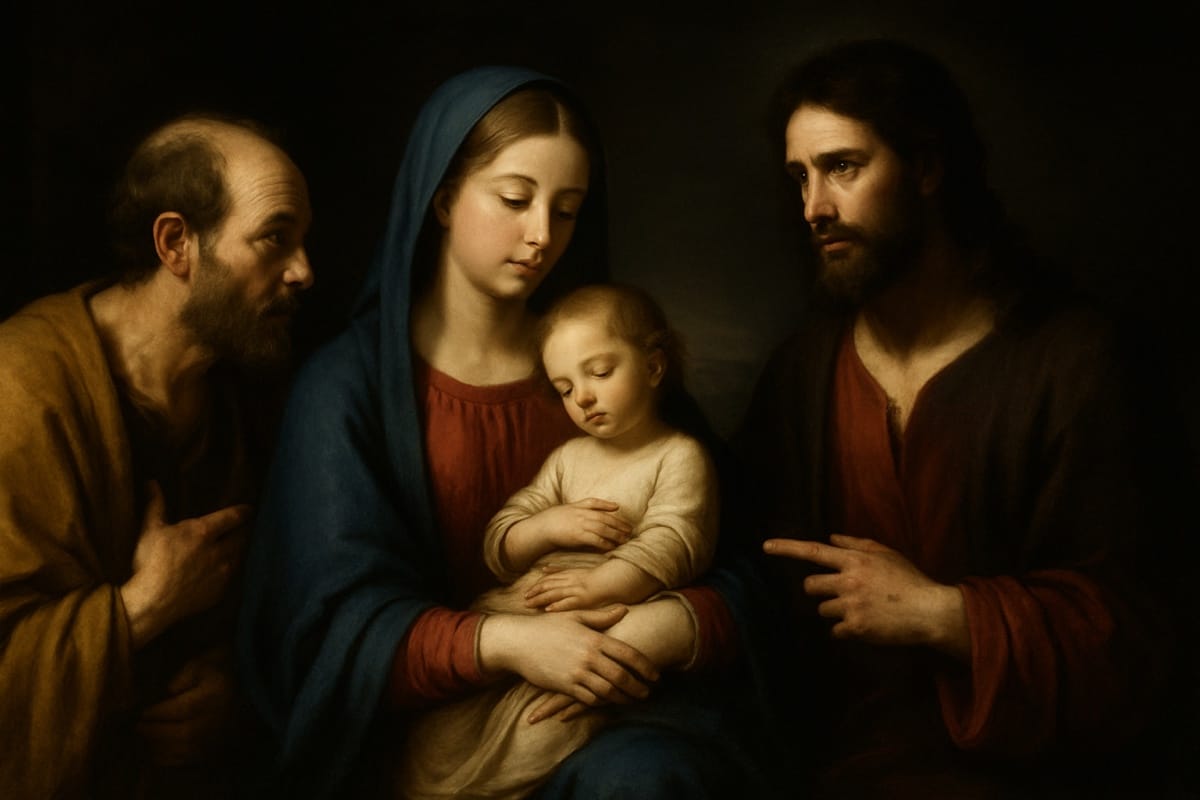
Veni et vide. […] Rabbi, tu es Filius Dei, tu es Rex Israhel.
Jn 1:46, 49
The feast of Saint Bartholomew the Apostle joins two readings on recognition and vocation: in Rev 21, the new Jerusalem comes down from heaven with the names of the twelve on its foundations. In Jn 1, Nathanael passes from skepticism (“can anything good come out of Nazareth?”) to the confession of faith (“You are the Son of God, You are the King of Israel”). Mary is the link: the city that Nathanael despised became the city of the Fiat that inaugurated redemption.
I. The First Reading: Rev 21:9b-14
John is carried away in the spirit and sees the new Jerusalem “like a bride adorned for her husband”. The twelve foundations bear the names of the twelve Apostles (v. 14), the covenant between the Old and the New Testament inscribed in the architecture of eternity. The number twelve is not merely honorific: it reveals that the apostolic mission is constitutive of the eternal city.
Bartholomew’s name on one of the foundations is the eschatological answer to Nathanael’s question about Nazareth. The apostle who doubted became a foundation stone. The reversal is the logic of the beatitudes applied to eternity: those who hesitated are the first foundations of the city that does not perish.
II. The Gospel: Jn 1:45-51
Philip did not argue: he invited. The “come and see” (v. 46) is the most effective apostolic method, not abstract demonstration but the invitation to direct experience. Nathanael, whose question expressed a genuine messianic expectation that Nazareth did not satisfy on the human level, went to meet Him and discovered that the despised city was exactly the place where the Messiah had dwelt.
“Before Philip called you, when you were under the fig tree, I saw you” (v. 48): the divine knowledge that precedes the call reveals that a vocation is not born of human merit but of the gaze that Jesus rests upon each person. Nathanael answers in the only way possible: total confession, from skepticism to faith in a single step.
Jesus’ final promise, “you will see heaven opened and the angels of God ascending and descending upon the Son of Man” (v. 51), is the Christological rereading of Jacob’s ladder (Gen 28:12). Jesus is the point of contact between heaven and earth. Nathanael came with skepticism and received the highest revelation of the chapter: the universal mediation of the Son of God.
III. “Veni et vide”: The Apostolic Method and the Conversion of the Skeptic
Philip’s “come and see” is the prototype of all authentic evangelization, not philosophical proof but the testimony of one who has found and who invites. Nathanael represents the authentic Israel that awaits the Messiah with intellectual honesty: he does not reject, but questions. His question about Nazareth is not ill will but fidelity to the Scriptures, which did not prophesy Nazareth.
The encounter with Jesus does not suppress the question: it reveals that God acts exactly where He was least expected. Surprise is the sign of God’s sovereign freedom over human categories. The converted skeptic is always the most solid apostle, because his faith has passed through the sieve of the honest question.
IV. Mary and Nazareth: The City That the Fiat Consecrated
The city that Nathanael despised was the place where Mary pronounced the Fiat that changed history. Nazareth was not in the prophecies because God did not want the Messiah to come from where men expected. He wanted Him to come from the city of the Yes. Mary’s Fiat at Nazareth is the definitive answer to Nathanael’s question.
The feast of Saint Bartholomew invites us to revise our expectations about where God acts. Mary, who said “fiat” in an outlying city of Galilee, and Nathanael, whose name will remain engraved forever on the foundations of the eternal Jerusalem, are the demonstration that God does not choose by human criteria. The despised city and the converted skeptic are the pillars of the economy of grace.
Postgraduate Program in Mariology
Would you like to deepen your formation in Mariology? Discover the Postgraduate Program in Mariology of Locus Mariologicus — an academic formation that unites theological rigor, spiritual life, and the living tradition of the Church.
Would you like to study Mariology seriously?
This article grows out of the works in the Locus Mariologicus library. The Postgraduate Program in Mariology takes you to the same source, with academic guidance: Scripture, the Fathers of the Church, and the Magisterium, from the first dogma to contemporary questions.




Responses