Marian spirituality: living the mystery of Christ with Mary
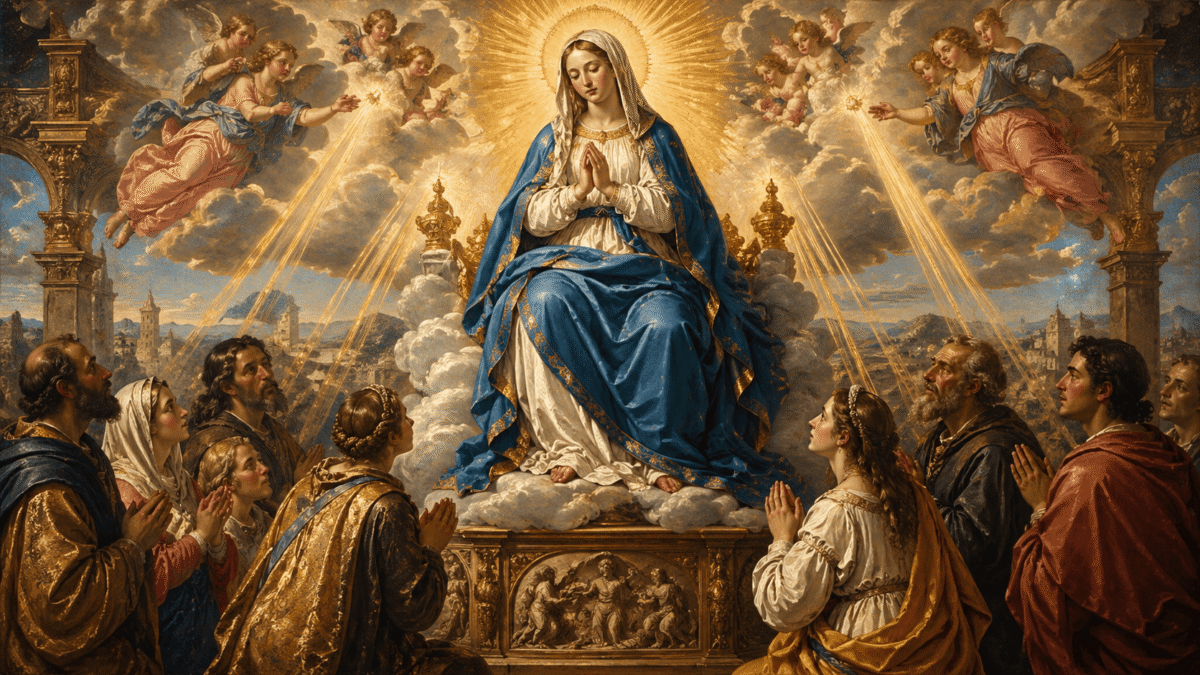
Marian spirituality, living the mystery of Christ with Mary
Marian spirituality is not a set of autonomous devotions: it is the way of participating, with Mary and after her example, in the paschal mystery of Christ. “The whole life of Mary is set within the paschal mystery of the Lord,” and it is this paschal rootedness that gives Marian spirituality its authenticity and its depth.
The spirituality of Mary: the paschal dimension
Luke and John set forth the spirituality of Mary within the paschal mystery of Christ. Her primary greatness is not her privileges, but her singular participation in the saving plan of the Son. Mary “lived the singular paschal experience that Christ was accomplishing for the salvation of humanity.” Her spirituality is not autonomous: it is “a pure reflection” of the paschal spirituality of Jesus. For this reason the fiat of the Annunciation is not merely a momentary consent, but the beginning of a total availability that extends all the way to Calvary, a “Marian kenosis” analogous to the kenosis of the Son.
The Gospel virtues of Mary
Faith: Mary lived the “pilgrimage of faith” (LG 58), with moments of darkness and of incomprehension (“but they did not understand,” Lk 2:50). Her faith grew in the paschal purification, from a physical motherhood to a spiritual and ecclesial motherhood (Jn 19:26-27). For this faith she was called blessed by the angel, by Elizabeth, and by Jesus (Lk 1:35, 45; 11:28).
Hope: not centered on herself but open to the liberation of the poor and of the humiliated. The Magnificat is the canticle of messianic hope, “the jubilation of seeing God present in human history and committed to completing His creation.”
Charity: The virginity of Mary is the highest expression of a total charity toward God and toward neighbor. Mary is “the woman of a single love, a love of pneumatic range.” Her charity takes concrete form in service: handmaid of the Lord (Lk 1:38), solicitude toward Elizabeth, intercession at Cana.
Poverty: Mary is “the poor one of Yahweh” (cf. Lk 1:38, 48), who recognizes herself as a handmaid. “God has looked upon the lowliness of His handmaid,” and it is in this interior emptiness that the Spirit can act fully.
Historical development of Marian spirituality
Patristic period (second to fifth centuries): Ignatius of Antioch, Justin and Irenaeus present Mary in the parallel between Eve and Mary as the beginning of an ecclesial Marian spirituality. Ambrose proposes Mary as the “exemplary model of virginity,” and monastic spirituality adopts her as its patroness (Athanasius). The Fathers distinguish two tendencies: the Chalcedonian one, which sets Mary within the mysteries of Christ, and the Ephesian one, which gives her a cult of her own as the Mother of God.
Medieval period: Bernard of Clairvaux sings of Mary with lyrical fervor, and popular devotion spreads through shrines and miracles. The Salve Regina and the Rosary crystallize the devotion of the faithful. In the fourteenth and fifteenth centuries, devotion tends to separate itself from the liturgy and to center on the favors of the Virgin for her devotees.
Modern period: The Protestant reaction (Luther) leads Catholics to stress devotion to the detriment of imitation. Well-structured movements of Marian spirituality arise: the oblatio of the Marian Congregations, the mariaform life of Carmel, the “holy slavery to Mary” of Saint Louis-Marie de Montfort (total consecration as an “easy and secure way to find Jesus Christ”). In the nineteenth century, the apparitions (Lourdes, 1858) and the definition of the Immaculate Conception (1854) renew devotion.
The Second Vatican Council and the renewal
The Second Vatican Council brings about a shift of emphasis: whereas the earlier Marian spirituality presented Mary above all as “the one to whom we must pray,” the renewed spirituality presents Mary as “the one whom we must imitate.” Marialis Cultus (Paul VI, 1974) proposes four notes for the renewed Marian cult: a Trinitarian, a Christological, a pneumatological, and an ecclesial note. Mary is the “most excellent figure of faith, hope, and charity” (LG 53) and “teacher of the spiritual life” (MC 21).
Mary as the ecclesial model of the Christian
Marian spirituality is intrinsically ecclesial. “In the Virgin Mary everything is relative to Christ and everything depends on Him” (MC 25). The Church, in contemplating Mary, “penetrates with veneration into the most sublime mystery of the Incarnation and becomes ever more conformed to her Spouse” (LG 65). The Assumption of Mary is the eschatological sign of this conformation: “In the Assumption of Our Lady the world was, as it were, brought to perfection in attaining its end.” Every Christian is called to live, after the example of Mary, a “paschal motherhood” in relation to the total Christ, begetting Christ in others through the witness of faith and of charity.
Deepen your studies: explore Mariology, Consecration to Mary, Marian Theology and the Postgraduate Program in Mariology.
Iter suum poenitens Maria in fide peregit, fidemque suam servans, iuxta Crucem constitit iuxta dictum divinum.
Second Vatican Council, Dogm. Const. Lumen Gentium, no. 58
📚 Literal translation: Mary made her penitential way in faith, and keeping her faith, she stood by the cross, according to the divine decree.
Postgraduate Program in Mariology
Would you like to deepen your formation in Mariology? Discover the Postgraduate Program in Mariology of Locus Mariologicus, an academic formation that unites theological rigor, spiritual life, and the living tradition of the Church.
Learn what the Church teaches about Mary, Mediatrix of All Graces.
Would you like to study Mariology seriously?
This article is born of the works in the library of Locus Mariologicus. The Postgraduate Program in Mariology brings you to the same source, with academic guidance: Scripture, the Fathers of the Church, and the Magisterium, from the first dogma to contemporary questions.





Responses