Iconography of Mary: Catacombs of Priscilla, the Annunciation

TL;DR – Summary. The Annunciation depicted in the Catacombs of Priscilla (3rd century, Rome) is the oldest known Marian image of Christian art. Mary is portrayed as a seated Roman matron, receiving the announcement of the wingless angel – an early iconographic type. The image bears witness to the centrality of Mary in early Christian faith even before the dogma of Theotókos (Ephesus, 431).
Key points
- The Catacombs of Priscilla (Via Salaria, Rome) contain the first documented Marian iconographic representation (3rd century).
- The Annunciation scene occupies the center of the ceiling of a cubiculum, with Mary on the left as a veiled Roman matron.
- The angel is represented without wings – the most ancient iconographic type, prior to the influence of Byzantine iconography.
- The image precedes by more than a century the conciliar definition of Theotókos at the Council of Ephesus (431).
- The central position in the vault, which it shares with scenes of Jonah and the Good Shepherd, gives the Annunciation the theological value of a key image of salvation.
The Annunciation in the Catacombs of Priscilla (3rd century): the virgin-matron, the angel, and the origins of Marian iconography
In the Catacombs of Priscilla, the Annunciation (third century) is represented at the center of the ceiling of a cubiculum, where there also appear the cycle of Jonah,

the resurrection of Lazarus

and the Good Shepherd.

As happened in some examples of the Adoration of the Magi, the privileged location at the center of the vault confers on this scene, which marks the beginning of the historical Theophany, the value of a key image in the history of salvation.

The Virgin, on the left of the scene, is portrayed as a Roman matron: seated in three-quarter view on a chair, wearing a long ungirded tunic with rich folds and with her head veiled. The angel, standing, wingless according to the most ancient iconographic type, dressed in tunic and pallium, extends his right arm toward the Virgin in the act of speaking. The fact that Mary receives the announcement seated symbolically indicates her preeminence over the angel.
Doctrinal images: the Virgin and Child with Balaam (Num 24:17) and the prophetic prefiguration of virginal motherhood

The Virgin and Child with a prophet of the Catacombs of Priscilla, assigned to the end of the second century or the beginning of the third, does not belong to the historical cycle of the Infancy, but is a symbolic image of the fulfillment of the Old Testament prophecies in the mystery of the Incarnation and of Mary’s virginal motherhood. The great representation of the Good Shepherd in the garden of Paradise, located nearby, not only confirms the identification of the mother-child group with the Virgin Mary and Christ, but also confirms the reference to the outcome of the Incarnation, which is precisely access to the Kingdom.
Mary, dressed in a long tunic and with her head covered by a short veil, is seated as though sunk in meditation on a backless seat, with her head bent slightly forward, while with her left hand she holds the Child, naked, who is seated upon her lap and keeps his head turned back as if he had just drawn away from his Mother’s breast. An eight-rayed star shines vertically above the mother-child group. On the left stands a man dressed in tunic and pallium, with a scroll in his left hand and his right raised in the act of pointing to the star. This star too, indicated by the prophet with reference to the mother-child group, constitutes an element for identifying the two figures with the Virgin Mary and Jesus.
Most scholars recognize in the male figure the prophet Balaam, the one who had foretold:
“A star shall rise out of Jacob” (Num 24:17). Others see him as Isaiah, but he may also be understood as a generic figure of prophecy, that is, of the prophecy concerning the divine virginal motherhood of Mary.
We should note that the prophet Balaam was particularly beloved in the Christian communities that came from the Gentiles, as the only prophet of non-Jewish lineage. It should also be recalled that, in listing the messianic witnesses, Justin (d. 165) compares the quotation of Num 24:17 with that of Isaiah and then attributes to the Prophet the prophetic synthesis:
A star shall be born of Jacob and a flower shall grow on the branch of the least. From Justin the testimony will then pass to Irenaeus of Lyons (d. 202), Origen (d. 264), and Cyprian of Carthage (d. 258).
The Mater lactans: the controversial identification of the nursing Virgin and the historiographical debate
Was the nursing of the Child Jesus regarded from the beginning as a theme worthy of being represented and commented on in connection with the Mother of the Lord?
The answer to this question has not been constant over the course of time. In any case, the event and the theme of nursing are cited and commented on without interruption by the Fathers from the third century onward, the first to speak of it being Clement of Alexandria (d. 215) and Hippolytus of Rome (d. 235) among the Greeks, and Tertullian (d. 220) among the Latins. As to the message that the image of the Virgo lactans intended to convey, one of the most profound explanations is that this iconography did not intend to evoke a family scene and thus to bring Christ closer to his faithful, nor to show in itself the fullness of the Incarnation, but to make understood, by the example of a human gesture, if ever there was one, that the perfect humanity of her son is that of the incarnate Logos and, consequently, that the reality of his theophany is total. In other words, the Virgin who nurses brought to light not the “Mother of Christ”, but precisely the Mother of God.
The praying Virgin in the catacombs: the iconographic type of the orans and its ecclesiological meaning

From the middle of the fourth century, the figure of the Orant, once used indiscriminately for all the dead, is reserved more and more exclusively for the portraits of martyrs, characterized by the twofold role of witnesses and intercessors. An unmistakable figure of the acceptance of the gift that comes from on high, the posture of the Orant was, however, extremely suited to Mary, witness par excellence of the historical Theophany and whose power of intercession has been invoked by Christians since apostolic times.
Precisely because it indicates that fruitfulness comes from above, the figure of the Orant lends itself more than the others to bringing out Mary’s exemplarity in relation to the Church: Mother and Virgin.
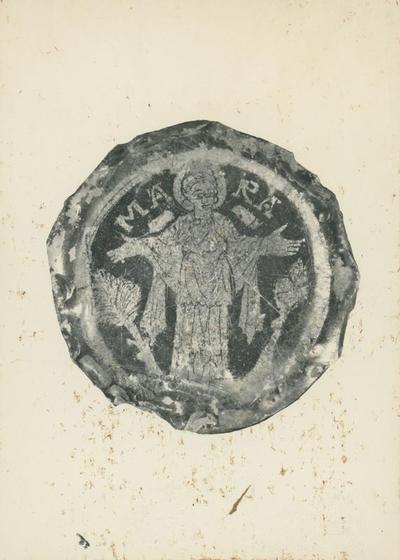
The oldest images of the praying Virgin that have come down to us are those of the glass bottoms that belonged to patens: here the figure of Mary praying is never found with the Child, but alone or flanked by the apostles Peter and Paul.

In a single case dating back to the second half of the fourth century, most scholars agree in recognizing, in the image of a woman praying with her son in front of her, a representation of the Virgin Mother. What can be seen on the back wall of an arcosolium in the catacomb of the Cimitero Maggiore in Rome is the half-length portrait (the lower part of the fresco was destroyed) of a woman in the attitude of praying with her son in front of her, axially. The son is portrayed motionless and not praying. The woman is dressed in a dalmatic with wide sleeves; she has elaborately dressed hair covered with a light white veil. Around her neck she wears a necklace of pearls and precious stones, and two large pearls as earrings. On both sides, at the height of her hands, appears the monogram of Christ, the chrismon, the one on the right inverted so as to be a mirror image of the one on the left.

As regards the basilicas of Constantine, it is certain that the Basilica of the Nativity in Bethlehem, completed in 333, housed a monumental representation of the Adoration of the Magi, probably on the façade. The construction of a basilica over the tomb of the Virgin, in the Valley of Cedron, therefore dates to the end of the fourth century, under the reign of Theodosius II. On the other hand, in the Church of Jerusalem, the creation of the principal feasts of the cycle of the Infancy with their respective offices also dates back to the fourth century:
- The Theophany of the Incarnation (the Nativity of the Lord).
- The Adoration of the Magi.
- The Presentation in the Temple.
To deepen your reflection on Marian iconography and its place in the life of the Church, consult the apostolic exhortation Marialis Cultus of Paul VI, which guides Marian piety including its artistic and iconographic expressions.
Deepen your studies: explore Mariology, Marian Theology, Marian apparitions, and the Postgraduate Program in Mariology.
Frequently asked questions about early Marian iconography
Where is the oldest representation of Mary in Christian art?
The oldest known Marian representation is found in the Catacombs of Priscilla, on the Via Salaria, in Rome, dated to the third century. It is a scene of the Annunciation painted on the ceiling of a funerary cubiculum, showing Mary as a seated Roman matron and the angel Gabriel standing, without wings.
Why is the angel represented without wings in the Catacombs of Priscilla?
The representation of the angel without wings corresponds to the most ancient Christian iconographic type, prior to the development of Byzantine iconography. Wings only become widespread in Christian art from the fourth-fifth century onward, inspired by classical models of the winged Victory and of the Roman Genius adapted to the new context.
What theological value does this iconography have before the dogma of Theotókos?
The image precedes by more than a century the conciliar definition of the Divine Motherhood (Ephesus, 431) and bears witness that the early Christian community already recognized Mary as a central figure in the economy of salvation. Iconography precedes dogma and prepares the ground for its formulation.
What other Marian scenes appear in the Roman catacombs?
Besides the Annunciation of Priscilla, there are the Adoration of the Magi (Catacombs of Domitilla, of Peter and Marcellinus), the prophecy of Balaam pointing to the Virgin (Priscilla), and scenes of the Virgin with the Child. These images share a Christological symbolism and are generally associated with funerary contexts of eschatological hope.
Postgraduate Program in Mariology
Would you like to deepen your formation in Mariology? Discover the Postgraduate Program in Mariology of Locus Mariologicus – an academic formation that unites theological rigor, spiritual life, and the living tradition of the Church.
See also: Patristic Mariology: The Fathers of the Church and Mary (2nd-8th Centuries)
📖 Would you like to study this seriously? Discover the Postgraduate Program in Mariology at Locus, a rigorous academic formation for theologians, priests, religious, and laypeople.
Discover the oldest Marian image in the Catacomb of Priscilla.



Responses