The Mother of God and Her Gaze of Tenderness

By Prof. Dr. Daniel C. Afonso · Updated
The Mother of God: Mary’s gaze of tenderness upon humanity
We begin with an edifying story from the Churches of the East: it is said that God was very grieved by the fact that His only-begotten Son had been rejected by men in the world. However, God the Father did not want the world to be lost, so He decided to send the Mother of Jesus so that her tenderness would draw everyone and no one could reject salvation.
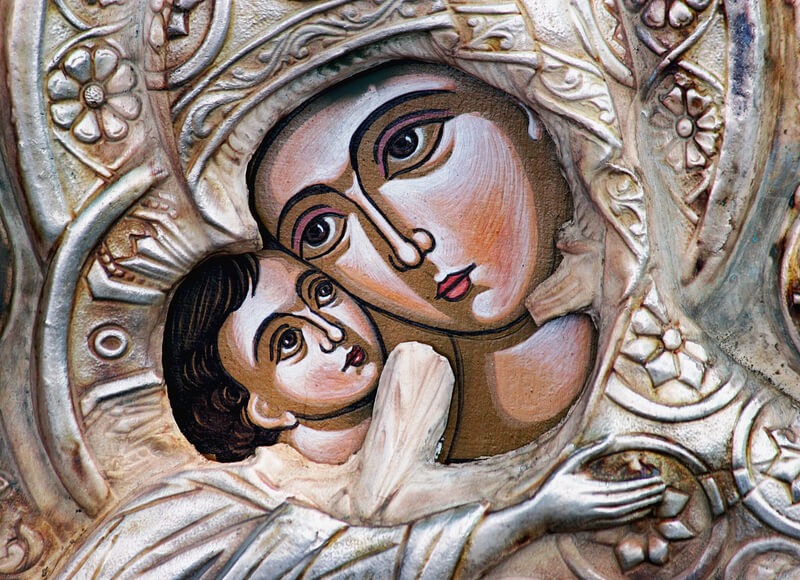
This story, though simple, nonetheless contains an important anthropological truth: being welcomed with tenderness is not outside God’s horizon. If it is true that the world of the industrial era is coming to an end as the information age opens, one problem remains: technology and work structures that do not humanize. In this sense, the value of tender welcome balances the frenetic life of metropolitan man, loneliness, aggressive competition, the invasive harassment of the web world, the endless discovery of unforeseen things, good and bad. All this is part of the great emblem of Mary: welcoming with tenderness the unpredictable, the wholly other.
Mary welcomed the Son of God into her heart and into her body. Unlike the scribes and Pharisees, who were hostile to Jesus, Mary is welcoming in all things. In her radical poverty she opened herself to God and saw His presence. For this very reason the iconography of Mary, unlike the emperors who are depicted in profile on coins, presents Mary facing forward, in the light of God, where she welcomes the pilgrims of the Church and shows them the life of Christ.

Mary’s tender welcome goes beyond the horizon of the world we know because it opens itself to a personal hospitality, beyond the local, for it welcomes the God who comes. This welcome of the Mother of Jesus is feminine but also the work of the Holy Spirit. It reflects the fatherhood of God by becoming the ‘maternal face of God,’ an expression of tenderness that evokes the mercy of the Father and that in the Latin tradition we express as Mother of Mercy. In this way Mary responds to two cries of our humanity: the need for tenderness and the appreciation of women. The ‘reinforced concrete’ of the metropolises houses but does not welcome; people communicate but without compassion in the harshness of their days. Mary, on the contrary, welcomed with tenderness the Child, the Crucified One, the Risen One, and the children in the Son who abandoned Him on the cross. From the feminine point of view, Mary nourishes, defends, and welcomes the life of all the crucified of all times. We cannot think of Mary without thinking of the women to whom she entrusts her treasures in every consecrated virginity or spousal motherhood.
If we think of the atheism of the contemporary age, we see this contempt for the Virgin Mother and for the women who safeguard the humanizing moral values capable of balancing materialist structures.
Pavel Evdokimov (a Russian theologian) said: “Now, if Christ saves the world, it is the Theotokos who protects it and introduces into its humanity the attentiveness that becomes sensitive to grace. The maternal tenderness that is bound to the veneration of the Theotokos infuses into Christian humanism an altogether particular note of gentleness”.
The world, the Church, can only gain from the encounter with Mary, for in the concrete reality of daily life she signifies the paradigm of divine compassion and of welcoming the other, placing no obstacles, prejudices, judgments, or conditions on her maternal tenderness. We leave you with the words of the Holy Father Pope Francis when he met with the Bishops of Mexico in 2016:
“I know that by looking into the eyes of the Virgin I reach the gaze of your people, who in her have learned to express themselves. I know that no other voice can speak so profoundly to the Mexican heart as the voice of the Virgin. She protects their highest desires, their most hidden hopes. She gathers their joys and their tears. She understands their many languages and answers them with a Mother’s tenderness, because they are her children. As Saint Juan Diego did, and as successive generations of children of the Guadalupana have done, the Pope too has for some time desired to see her. Even more, I myself wanted to be reached by her maternal gaze. I have reflected much on the mystery of this gaze, and I ask you to receive what comes from my heart as a Pastor at this moment. Above all, the Virgin Morenita teaches us that the only power capable of conquering hearts is the tenderness of God. What delights and attracts, what convinces and conquers, what opens and breaks chains is not the strength of instruments or the harshness of the law, but rather the omnipotent weakness of divine love, which is the irresistible power of its gentleness and the irreversible promise of its mercy”.
Invited by the tenderness of the Virgin, we also propose to every devotee of Mariology the practice of the “revolution of tenderness.” Here is a day to act concretely in your family, at home, with your loved ones, or perhaps with those who have long been waiting for an act of tenderness from you. Perhaps a phone call to someone who is waiting for it, a thank-you to your loved one who has taken care of your home, of your things. Perhaps a message of affection, a hug, an “I love you” said well. The Holy Spirit will inspire you on this day to concrete acts of tenderness.
Afterwards, we would like you to share with us here how your concrete act went!
To deepen the theology of Mary as Mother of God, consult the encyclical of John Paul II: Redemptoris Mater on Mary, Mother of the Redeemer, in the faith of the Church.
Deepen your studies: explore Mariology, Marian Theology, Marian apparitions, and the Postgraduate Program in Mariology.
Postgraduate Program in Mariology
Would you like to deepen your formation in Mariology? Learn about the Postgraduate Program in Mariology of Locus Mariologicus, an academic formation that unites theological rigor, spiritual life, and the living tradition of the Church.
Would you like to study Mariology seriously?
This article grows out of the works in the library of Locus Mariologicus. The Postgraduate Program in Mariology takes you to the same source, with academic guidance: Scripture, the Fathers of the Church, and the Magisterium, from the first dogma to contemporary questions.
Responses