“Because she loved much: a sinner, whose debt was forgiven, and who received much.”
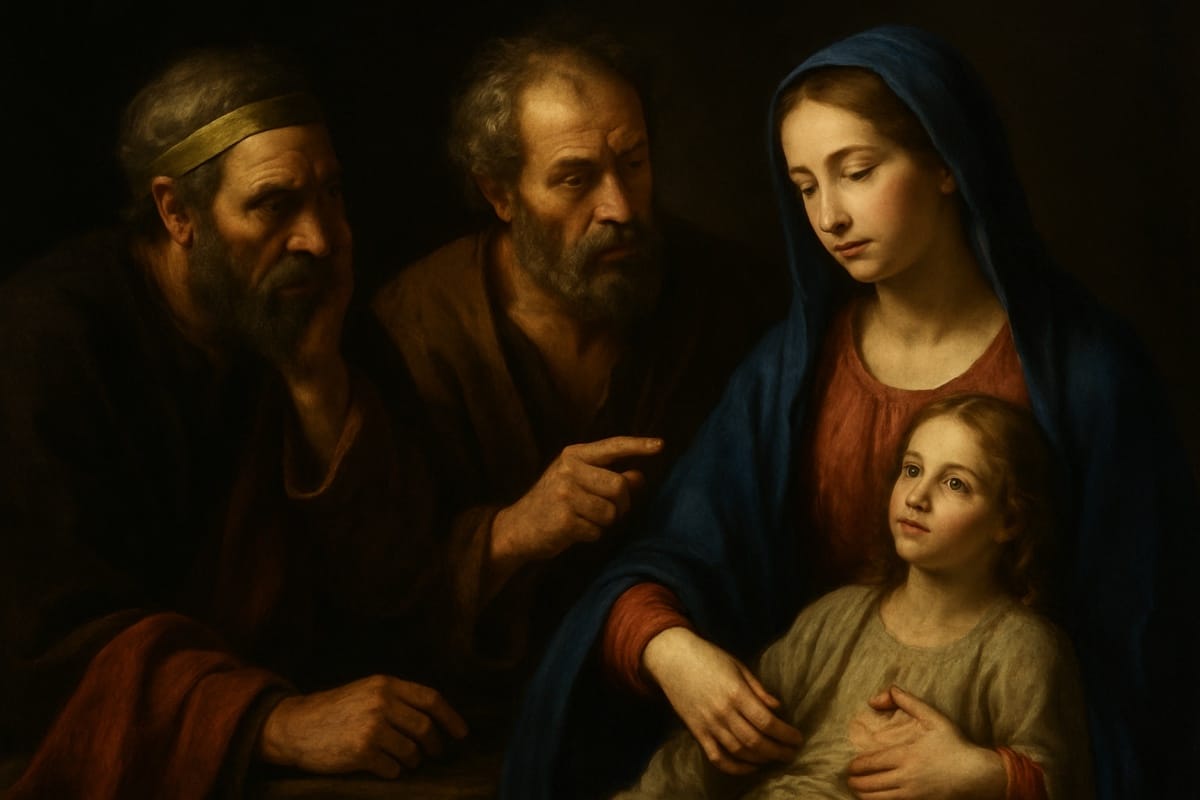
“I have indeed delivered to you first what I also received. […] Many sins are remitted to her because she loved much.”
(1 Corinthians 15:3 and Luke 7:47)
Thursday of Week XXIV of Ordinary Time places side by side the oldest formula of faith that we possess and the scene of a woman weeping at Jesus’ feet in a Pharisee’s house. Paul recalls what he received and transmitted, Christ died for our sins and raised on the third day. Luke shows what happens when someone realizes what this means for them. One passage offers the doctrine, the other its effect, and the second cannot be understood without the first.
I. The first reading: 1 Corinthians 15:1-11
This passage has a documentary value that few New Testament texts possess. Paul introduces what follows with technical verbs of transmission: “I transmitted to you first of all what I myself received” (v.3). He is citing a formula that was already older than him, probably learned a few years after Easter, and the letter fixes it around the year 56. Christ died for our sins according to the Scriptures, was buried, and rose on the third day according to the Scriptures, appeared to Peter, and then to the Twelve.
Next follows a list of witnesses, with a detail that no one would invent in a legend: “appeared to over five hundred brothers at one time, most of whom still survive” (v.6). It is an invitation to verification. Anyone in doubt could go ask. The list ends with the author, in a humility that is not a figure of speech: “last of all, I appeared to me also” (v.8). Paul calls himself the least of the apostles for having persecuted the Church, and resolves the tension in a phrase that sums up his entire theology: “by the grace of God, I am what I am” (v.10).
II. The Gospel: Luke 7:36-50
The scene is built on a contrast of hospitality. Simon, the Pharisee, invites Jesus and omits the basic gestures of welcome, water for the feet, the kiss, and anointing with oil. The woman, entering uninvited, does all three, and does each in excess, with tears instead of water, with continuous kisses, with alabaster perfume.
Jesus does not rebuke Simon for his thoughts, but responds to him with a parable of accounting. Two debtors, five hundred denarii and fifty, both forgiven. Which one will love more? Simon answers well, and his answer condemns him. Then comes the phrase that traditional spirituality has never let go: “he who is forgiven little, loves little” (v.47). The love of that woman did not buy forgiveness, it revealed it. What Simon did not have was not virtue, but consciousness of his debt. Whoever thinks he owes little loves little, and loves little because he calculated wrongly, not because he has been treated with less generosity.
III. Receiving before giving
The two texts follow the same order. Paul transmits because he received. The woman loves because she was forgiven. In neither case is the human initiative dispensable, and in neither case is the human response unnecessary. Christian faith is not a personal discovery to be communicated, but a deposit received from others and delivered intact, and holiness is not a merit to be accumulated, but a response to be given.
This has a practical consequence that affects especially those who grew up in a Catholic home and never strayed. It is easy to conclude that one owes little. This is Simon’s exact position, and Luke shows it to be the most dangerous position of all, because it produces no scandal and only slowly dries up the heart. The correct question is not how much we have sinned, but how much has been forgiven us, and this account includes everything we have been preserved from, without our even realizing it.
IV. Mary, Who Received Much
Here arises an objection that Mariology has faced for centuries, and it is important not to avoid it. If one loves much who has received much forgiveness, and Mary was preserved from all sin, did she love little? The answer of tradition is the exact opposite, and it is based on the nature of the gift. She did not receive less, she received more, because preservation is a higher form of redemption than cure. He who is prevented from falling owes his savior more than he who is raised after falling.
The Council reminds us that Mary is redeemed in an eminent way by the merits of her Son and united to Him by a close and indissoluble bond (LG 53), and that she was enriched from the first moment of her conception with the splendor of a sanctity entirely unique (LG 56). She is the debtor of the five hundred denarii she never incurred because someone paid for her before. That is why her song begins where it does: “My soul glorifies the Lord, and my spirit rejoices in God my Savior” (Lk 1:46-47). She calls Him her Savior. She knows what she was saved from.
And there is the gesture of the woman from the city, who tradition has always read in parallel with Mary’s in Bethany and her presence at the cross. What the sinner does with the perfume, Mary did with her entire life, without tears of repentance because she had nothing to repent of, but with the same disproportion. Love that responds to a received gift never keeps accounts, and it is always excessive in the eyes of him who sits at the table calculating.
The Thursday of the XXIV Week leaves a question, therefore, that is answered in silence. How much do we think we owe? Because the measure of our love is already decided in that answer.
Postgraduate Mariology Program
Do you wish to deepen your formation in Mariology? Get to know the Postgraduate Mariology Program at Locus Mariologicus – an academic formation that combines theological rigor, spiritual life, and the living tradition of the Church.
Register or learn more → Would you like to study Mariology seriously?
This article draws on the works of the Locus Mariologicus library. The Postgraduate Programme in Mariology takes you to the same sources with academic guidance: Scripture, the Church Fathers and the Magisterium, from the first dogma to contemporary questions.




Responses