So Great a Love: Ex 34, 2 Cor 13, and the Gift of the Only-Begotten Son in Jn 3
Sic enim Deus dilexit mundum ut Filium suum unigenitum daret.
Jn 3:16
The Most Holy Trinity C: So great a love: Trinity Sunday, the first Sunday after Pentecost, celebrates the central mystery of the Christian faith: God is Father, Son, and Holy Spirit, three Persons in one nature. Ex 34:4b-6, 8-9 presents the revelation of God’s name to Moses on Sinai: the Lord merciful and gracious, slow to anger, rich in grace and faithfulness. 2 Cor 13:11-13 closes with the most explicit Trinitarian blessing of Paul’s letters: the grace of the Lord Jesus Christ, the love of God, and the communion of the Holy Spirit. Jn 3:16-18 reveals the foundation of the Trinitarian mystery: God so loved the world that He gave His Only-Begotten Son so that the world might be saved through Him. The three texts describe the same God: merciful in the revelation to Moses, Trinitarian in Paul’s blessing, giver in the handing over of the Son in John.
I. So great a love: the first reading (Ex 34:4b-6, 8-9)
So great a love is revealed already in Ex 34: Moses goes up Mount Sinai with the replacement stone tablets, after the first ones were broken. The Lord comes down in a cloud and passes before Moses, proclaiming His own name: “The Lord, the Lord, a God merciful and gracious, slow to anger, rich in grace and faithfulness” (Ex 34:6). This self-proclamation of God is the most quoted text of the Old Testament within the Old Testament itself: other biblical books return again and again to these words as the definition of God’s character. Moses immediately bowed down and worshiped. And he asked: “If I have found favor before you, let the Lord go in our midst, for it is a stiff-necked people, and pardon our iniquities and sins, and take us as your inheritance” (v. 9). The experience of forgiveness precedes and grounds the knowledge of God as Trinity.
The liturgy of the Most Holy Trinity C chooses this passage of Saint Paul as the second reading precisely because it contains the oldest and most complete Trinitarian formula of the New Testament.
II. So great a love: the Trinitarian greeting in 2 Cor 13:11-13
So great a love: Paul closes the Second Letter to the Corinthians with a series of very brief exhortations: “Rejoice, press on toward perfection, exhort one another, be of one mind, live in peace” (2 Cor 13:11). The promise: “The God of love and peace will be with you”. And the final blessing: “The grace of the Lord Jesus Christ, the love of God, and the communion of the Holy Spirit be with you all” (v. 13). This Trinitarian blessing structures the life of the community: not as an abstract formulation but as the lived experience of the Son who gives grace, of the Father who gives love, and of the Spirit who gives communion. The Christian liturgy takes up this blessing as the greeting at the beginning of Mass precisely because the Trinity is the framework within which the whole celebration takes place.
In the Most Holy Trinity C, this Johannine text works as a synthesis of the whole Trinitarian revelation: the Father who loves, the Son who is given, the Spirit who (implicitly) makes salvation effective for those who believe.
III. So great a love: the Gospel of Jn 3:16-18
In the dialogue with Nicodemus, God’s so great love for the world, Jesus reaches the core of the mystery: “God so loved the world that He gave it His Only-Begotten Son, so that everyone who believes in Him may not perish, but may have eternal life” (Jn 3:16). The logic is that of the gift: not of demand, not of threat, but of the love that gives what it holds most precious. “God did not send the Son into the world to condemn the world, but so that the world might be saved through Him” (v. 17). The purpose is salvation, not judgment. Judgment is the consequence of refusal, not the intention: “Whoever believes in Him is not condemned. But whoever does not believe is already condemned, because he does not believe in the name of the Only-Begotten Son of God” (v. 18). The criterion is not behavior but faith: the acceptance or refusal of the Son whom the Father sent. Trinity Sunday centers on this verse because it reveals the inner reason of the Trinitarian mystery: the Father gives the Son out of love for the world, and the Spirit is the love with which the Father and the Son love each other and with which they love us. This Trinitarian “so great a love” is the source of every grace in Mary.
IV. So great a love: Mary and the Trinity
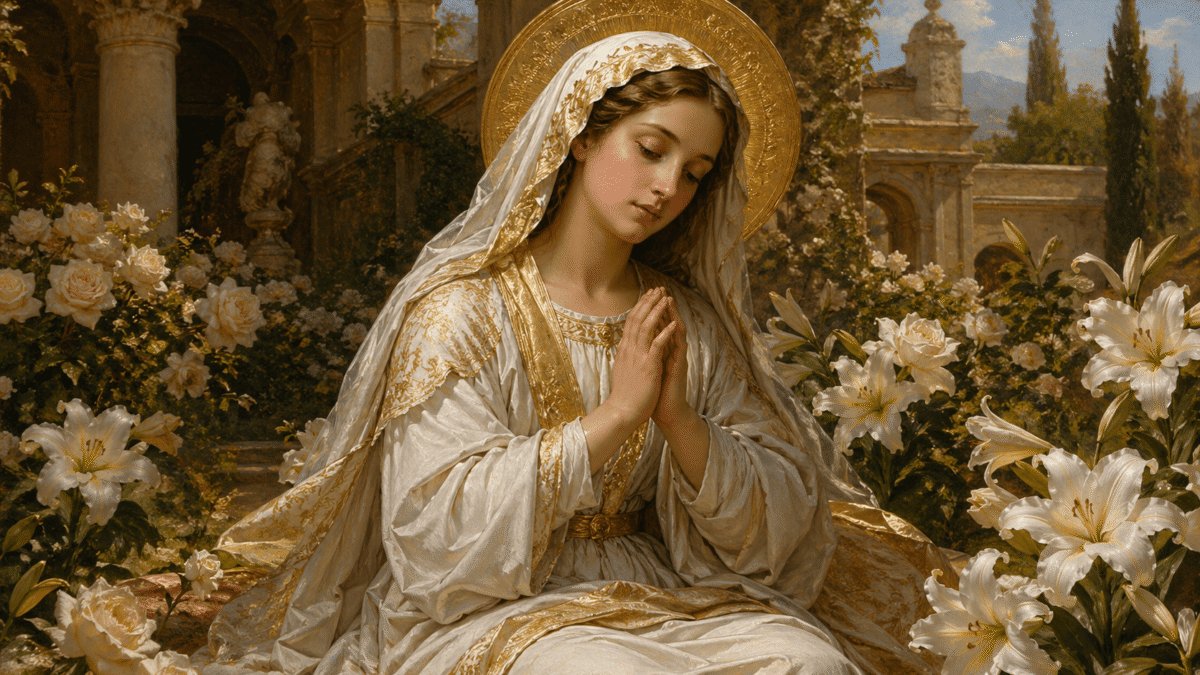
The Sunday of the Most Holy Trinity C invites us to contemplate the Trinitarian economy as a movement of love that has in Mary its most beloved creature. Daughter of the Father, Mother of the Son, Spouse of the Holy Spirit: in this threefold relation, the Virgin is the most perfect icon of the communion of the Three divine Persons.
The liturgy of the Most Holy Trinity C proclaims with Saint Paul: “The grace of our Lord Jesus Christ, the love of God, and the communion of the Holy Spirit be with you” (2 Cor 13:13). Mary lived this grace, this love, and this communion in an absolutely unique way, anticipating in herself the destiny of the whole Church.
In the Most Holy Trinity C, the Gospel of Jn 3:16 – “God so loved the world that He gave His Only-Begotten Son” – illuminates the Marian mystery: Mary is the virginal womb where the Only-Begotten Son becomes a gift for the world. The so great love of the Father passes through the “fiat” of the Mother.
For this reason, Catholic piety binds the Most Holy Trinity C inseparably to the figure of Mary, above all on the Marian Saturday that follows Trinity Sunday: the Virgin prolongs in the life of the Church the eternal doxology to the Father, to the Son, and to the Holy Spirit.
Ex 34 reveals God as merciful and gracious: in the Christian tradition, Mary is the icon par excellence of this mercy of God, the Mother of Mercy who intercedes for sinners before the Son. The Trinitarian formula of 2 Cor 13:13 structures Mary’s relation with the three Persons: the patristic and medieval tradition describes Mary as the beloved Daughter of the Father, Mother of the eternal Son, and Spouse or Temple of the Holy Spirit. The three relations are unique: no other creature stands in a personal relation with the three Persons in the way Mary does. Jn 3:16 says that God so loved the world that He gave the Son: Mary was the human instrument of this gift. God’s love for the world passed through Mary’s fiat: without her yes, the Only-Begotten Son would not have assumed human flesh. For this reason tradition calls her “cause of our joy” and “gate of heaven”: the Father’s “so great a love” finds in her its way of entry into the world: she is the point of contact where Trinitarian love entered time and became accessible to the world. Trinity Sunday contemplates the mystery that Mary received at the Annunciation with greater fullness than any other human being.
Postgraduate Program in Mariology
Would you like to deepen your formation in Mariology? Discover the Postgraduate Program in Mariology of Locus Mariologicus – an academic formation that unites theological rigor, spiritual life, and the living tradition of the Church.
Would you like to study Mariology seriously?
This article is born of the works in the library of Locus Mariologicus. The Postgraduate Program in Mariology brings you to the same source, with academic guidance: Scripture, the Fathers of the Church, and the Magisterium, from the first dogma to contemporary questions.




Responses