Peter of Alexandria (d. 311)
By Prof. Dr. Daniel C. Afonso · Updated
What is a Father of the Church?
The honorific title of Fathers of the Church is given to certain great theologians who did not limit themselves to apologetics alone but set as their main objective the theological deepening of the heritage of the faith, on the basis of revelation. Most of them were bishops, hence the name Father, originally reserved to the bishops of the communities. But some were simple priests, like Jerome, or laymen, like Tertullian. Later doctrine, in order to establish membership in the group of the Fathers of the Church, indicates as fundamental characteristics:
- orthodoxy in doctrine.
- holiness of life.
- approval by the Church.
- belonging to Christian antiquity.
Thanks to this last characteristic, the Fathers of the Church are distinguished from the Doctors (men and women) of the Church, who lived and taught in the Middle Ages and in modern times.
The themes of patristics were inspired, to a great extent, from outside and corresponded to a legitimate need of the time. Very close contact with Hellenistic philosophy and wisdom teaching, for example, had heightened the danger of no longer considering Christianity as a pure divine revelation, based on Sacred Scripture and apostolic tradition, but of misinterpreting it with syncretistic Gnostic speculations.

Moreover, from the earliest times, a gnosis that was in its essence entirely pagan tried to infiltrate Christianity, abusing the allegorical exegesis of Sacred Scripture to validate its intricate reasoning about the creation and redemption of the world, and mixing the genuine heritage of revelation with pagan theories of a strongly dualistic character.
Faced with the danger of Gnosticism, it was necessary to determine exactly the limits of the Christian faith and the sources of revelation, to fix definitively the number of those writings that constituted the norm of faith and morals (=canon), establishing a precise number of the books of the canon of Sacred Scripture, with the aim of clarifying even better the character of divine inspiration precisely for these Scriptures and of reserving authentic interpretation exclusively to the bishop.
To the arbitrary biblical exegesis of individual heretics was thus opposed, as the norm and as the only legitimate interpretation, the understanding of Scripture in the spirit of the apostolic tradition (Traditio). The only criterion that could guarantee the pure preservation of the revealed patrimony handed down by the apostles lay in the continuity of the episcopal tradition, which remained unbroken through apostolic succession. The Fathers of the Church therefore emphasized with extreme firmness that the true Christian gnosis can only be one that includes faith in the sense of the apostolic tradition. Orthodoxy can only be found in union with the bishops, the legitimate successors of the apostles. Whoever separates himself from the bishop certainly falls into error.
Christian scientific theology was born precisely out of the contrast with gnosis and other heretical doctrines. Its themes essentially concerned the person and work of Christ (Christology), the saving work of Christ (soteriology), and His relationship with the Father and the Holy Spirit (doctrine of the Trinity). These were, in fact, the main topics that engaged theological meditation in the centuries that followed. And so, when we approach Mariology in the patristic era, it relates to the truth about Christ and complements it, corresponds to the history of salvation, and evokes Mary’s different relationships with the persons of the Most Holy Trinity. Daughter of the Father, Mother of the Word, and Temple of the Spirit.
Bishop Peter of Alexandria
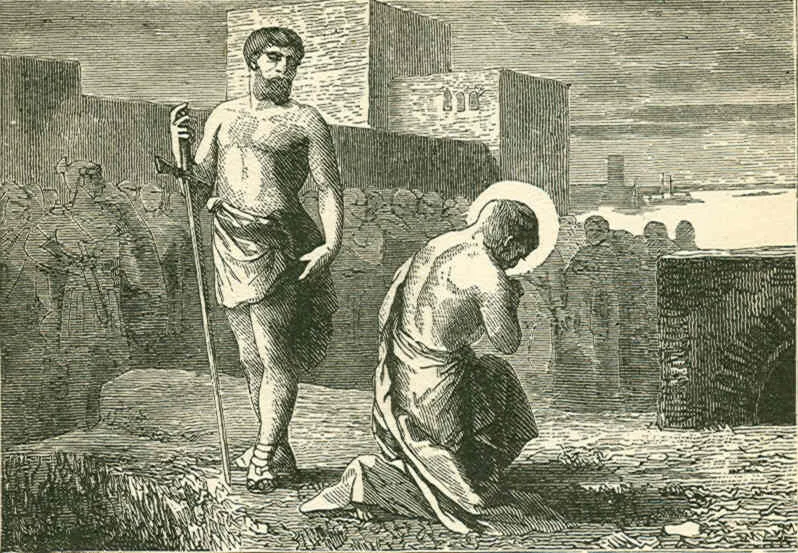
After having directed the catechetical school of Alexandria, he was elected bishop of that city around the year 300. He died as a martyr in 311. Only fragments of various works survive, in Greek and in ancient Eastern versions. A Christmas homily of much later date has been preserved in Arabic under his name.
The Marian fragment we present belonged to the work On the Godhead, now lost. This passage was read publicly at the Council of Ephesus in the year 431, confirming the correct doctrine of the hypostatic union of the two natures in the Word.
On the Godhead
The evangelist also affirms the truth, saying: “the Word became flesh and dwelt among us”. That is, from the moment when the angel greeted the Virgin thus: “Rejoice, full of grace, the Lord is with you”. This expression: “The Lord is with you” here, on Gabriel’s lips, should be understood in place of: “God the Word is with you”. Indeed, it indicates the Word who was begotten in the womb and became flesh, as it is written: “The Holy Spirit will come upon you, and the Power of the Most High will overshadow you. Therefore the holy one to be born will be called Son of God”.
(De deitate, I,1,2,39)
God the Word, however, became flesh in the Virgin’s womb without relations with a man, by the will of that God who can do all things. Nor did He need the work and presence of a man: indeed, the Power of God that overshadowed the Virgin, together with the Holy Spirit who descended upon her, acted much more powerfully than the power of a man.
To deepen the study of patristic Mariology, see the encyclical Redemptoris Mater by John Paul II, which places Mary at the heart of the theological tradition of the early Church.
Deepen your studies: explore Mariology, Marian Theology, Marian apparitions, and the Postgraduate Program in Mariology.
Postgraduate Program in Mariology
Would you like to deepen your formation in Mariology? Discover the Postgraduate Program in Mariology of Locus Mariologicus – an academic formation that unites theological rigor, spiritual life, and the living tradition of the Church.
Responses