Mary and the Eucharist

By Prof. Dr. Daniel C. Afonso · Updated
The commemoration of Mary in the Eucharistic Prayer: the universal tradition of the Church and the theological meaning of the memorial
According to the ancient and universal tradition of the Church, the commemoration of Mary is part of the celebration of the Eucharist. No one should consider the remembrance of Mary in the Eucharistic Prayer to be of a purely devotional nature: it is a sign that we cannot omit the commemoration of Mary in the memorial of the mysteries of Christ. In fact, the explicit remembrance of the Mother of God arises from a profound necessity: the Eucharist, being the full celebration of the saving mysteries accomplished by God through Christ in the Spirit, cannot fail to remember the holy Mother of the Savior, who is indissolubly linked to these mysteries (cf. Ecclesia de Eucharistia, nos. 53-58).
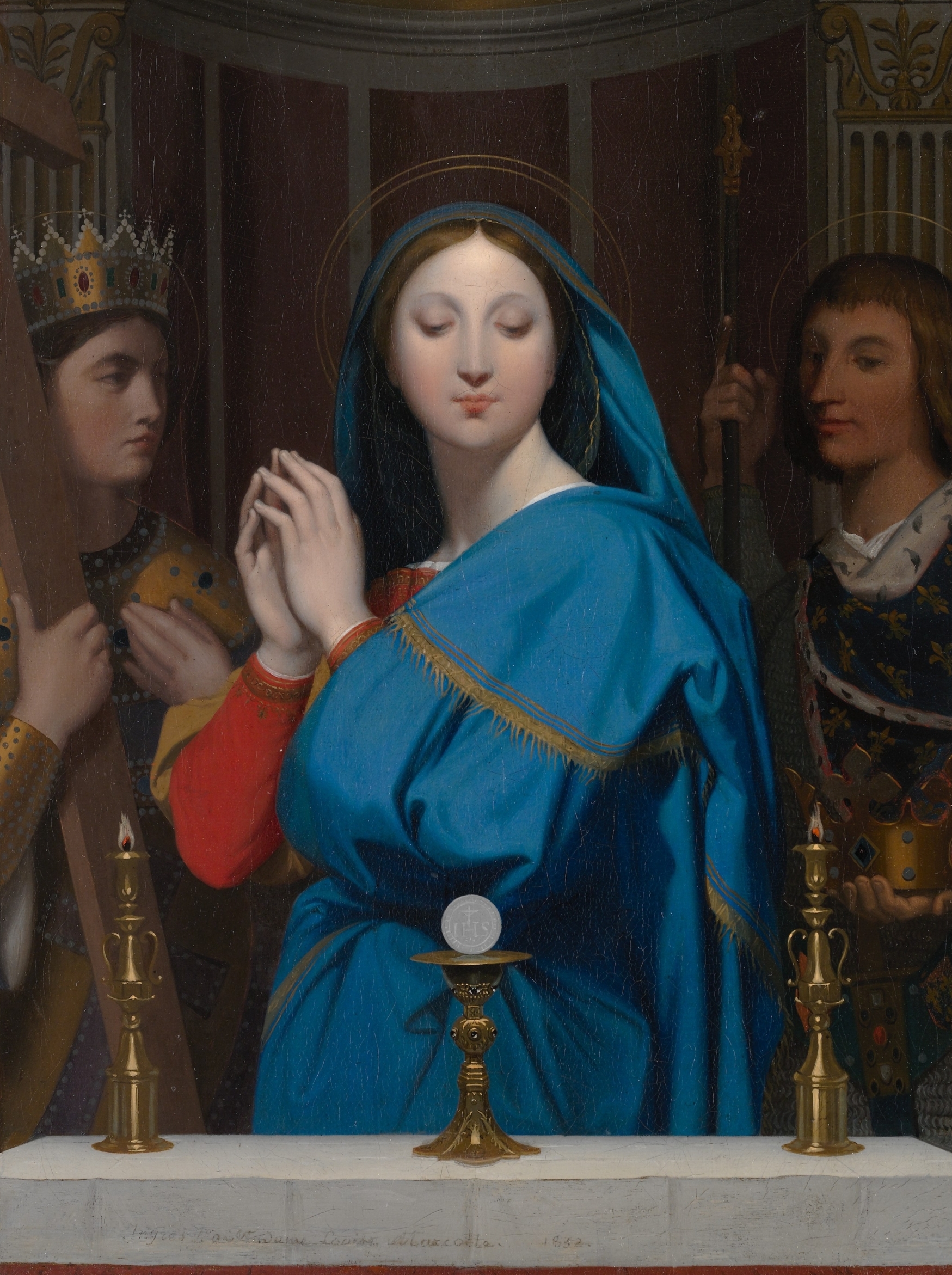
The connection between the Incarnation and the Eucharist, and within it communion with her from whom the body and blood of Christ were historically given to us, unites Marian devotion with the Eucharistic celebration. Thus prays Preface II/A of Advent in the Roman Missal: “from the virginal womb of the daughter of Zion sprang forth the one who nourishes us with the bread of angels.” Pope Saint John Paul II writes:
“In a certain sense Mary lived her Eucharistic faith even before the institution of the Eucharist, by the very fact that she offered her virginal womb for the Incarnation of God’s Word. The Eucharist, while commemorating the passion and resurrection, is also in continuity with the Incarnation. At the Annunciation Mary conceived the Son of God in the physical reality of his body and blood, thus anticipating within herself what to some degree happens sacramentally in every believer who receives, under the signs of bread and wine, the Lord’s body and blood.”
(Ecclesia de Eucharistia, n. 55)
The Incarnation as the beginning of the Eucharistic sacrifice: Mary as temple of the Redeemer and the new covenant in Christ Jesus
In Mary, consecrated by the Holy Spirit, the new and eternal covenant was established, which is Christ Jesus: in her most holy womb, as in a temple, the Redeemer began to offer to the Father the sacrifice that reconciles all humanity. From her, as from an ear of wheat ripened by the rays of the divine Sun, “the bread of life” is offered to the world. From her, the vine of the purest grape cultivated by the heavenly Vinedresser, flowed “the blood shed for all” that fills the chalice of our Eucharists.
The mystery we celebrate at the altar refers, in fact, to the hour of the Annunciation (cf. Lk 1:26-38). This is highlighted by a liturgical text that prays: “Accept, O God, the gifts we present at the altar and consecrate them with the power of your Spirit, who sanctified the womb of the Virgin Mary” (Prayer over the Offerings, Fourth Sunday of Advent). Indeed, the singular event of the Incarnation in the Virgin is perpetuated “sacramentally” in the Church through the celebration of the Eucharist.
The “signs” may change, but the reality is the same: as Saint Justin already explained in the second century, the sacrifice accomplished in the bread and wine is not a “sacrifice of bread and wine,” because we Christians “have learned that, by the power of the word of prayer that comes from Christ, that bread and that wine become the flesh and blood of that same Jesus who became incarnate” (Apology I, 66).
Therefore, since the flesh and blood of the Redeemer were historically given to us through Mary, it is fitting to affirm that her maternal presence lives again, in some way, in the mysteries that are the memorial of that flesh and that blood. Mary cannot be separated from the Eucharistic table: this was expressed artistically by Blessed Fra Angelico, who, in depicting the Communion of the Apostles from the hands of Jesus at the Last Supper, placed the Virgin Mary kneeling in prayer and absorbed in the Mystery.
In the light of Nazareth, the event of the Word of God becoming flesh and blood in Mary, through her faith and the Holy Spirit, profoundly illuminates the mystery of the Word becoming flesh and blood in the celebrating Church, so as to form with her, by the same Spirit, “one body, one spirit” (cf. Eucharistic Prayer III).
Following the example of the Virgin of the Annunciation, who forms “one body” with the Son of the Most High, the Church, through Eucharistic communion, becomes kin to the Son of God. The expression with which the apostle Paul seals his experience of communion with the Lord, “It is no longer I who live, but Christ who lives in me” (Gal 2:20), applies in a very special way to the faithful Virgin, as well as to the Church that partakes of the holy mysteries of the body and blood of the Lord.
The Marian imprint of the Eucharist: Jn 19:25-27 and the presence of Mary in the sacramental memorial of Christ’s sacrifice
The communion between Christ, Mary, and the disciples, established at the foot of the Cross (cf. Jn 19:25-27), draws its vitality from the memorial of the sacrifice of Jesus: the hour of the Cross sacramentally coincides with the hour of the Eucharistic celebration. And so, in the sacramental actualization of that sacrifice, the presence of Mary also has its place: she cooperates in forming, in the hearts of the faithful who take part in the holy mysteries, the image of her Son Jesus.
The Eucharist is, in fact, the moment in which all the wonderful gifts that Christ has given us “in sacrament” live again, including the gift of the Mother to us and of us to her. The Eucharist strengthens the perennial bond of love between “children and Mother,” in Christ. From antiquity, as can be seen in the Apostolic Tradition attributed to Hippolytus (3rd century) and the Roman Canon (4th-5th centuries), the Blessed Virgin Mary has been remembered and invoked in the Prayer that lies at the heart of the Eucharistic celebration.
And this does not stem from contingent circumstances, but from an intimate necessity: since the Eucharist is the celebration of the saving mysteries accomplished by God through Christ in the Spirit, it cannot fail to remember the Virgin, who was indissolubly linked to these mysteries as the Mother of the Redeemer and of the redeemed. As Saint John Paul II tells us:
“This motherhood is particularly noted and experienced by the Christian people at the Sacred Banquet, the liturgical celebration of the mystery of the Redemption, at which Christ, his true body born of the Virgin Mary, becomes present. The piety of the Christian people has always very rightly sensed a profound link between devotion to the Blessed Virgin and worship of the Eucharist: this is a fact that can be seen in the liturgy of both the West and the East, in the traditions of the Religious Families, in the modern movements of spirituality, including those for youth, and in the pastoral practice of the Marian Shrines. Mary guides the faithful to the Eucharist.”
(Redemptoris Mater, 44)
The “Woman” who, by the Holy Spirit, became the temple of the eternal Priest, always living to make intercession for us before the Father (cf. Heb 7:25), is the mirror of the Church that celebrates the holy mysteries. In Mary, dwelling place of the living God, the sacrifice of the eternal Covenant, which is Christ the Redeemer, was established; from her womb, perfect praise to the incarnate Word rose to the heavens. From her, the Bread come down from heaven that gives life to the world took form; from her, the Blood shed for all flowed for us. Therefore, in celebrating the Eucharist, the Church looks to Mary, experiencing communion of prayer with her and the exemplary nature of her figure for living in Christ, with Him, and for Him.
The Eucharistic dimension of Mary is masterfully set forth in the encyclical Redemptoris Mater of John Paul II, which presents Mary’s fiat as the first Eucharistic act in the history of salvation.
Deepen your studies: explore Mariology, Marian Theology, Marian apparitions, and the Postgraduate Program in Mariology.
Postgraduate Program in Mariology
Would you like to deepen your formation in Mariology? Discover the Postgraduate Program in Mariology of Locus Mariologicus – an academic formation that unites theological rigor, spiritual life, and the living tradition of the Church.
Would you like to study Mariology seriously?
This article was born from the works in the library of Locus Mariologicus. The Postgraduate Program in Mariology takes you to the same source, with academic guidance: Scripture, the Fathers of the Church, and the Magisterium, from the first dogma to contemporary questions.
Responses