Holiness and Marian Devotion
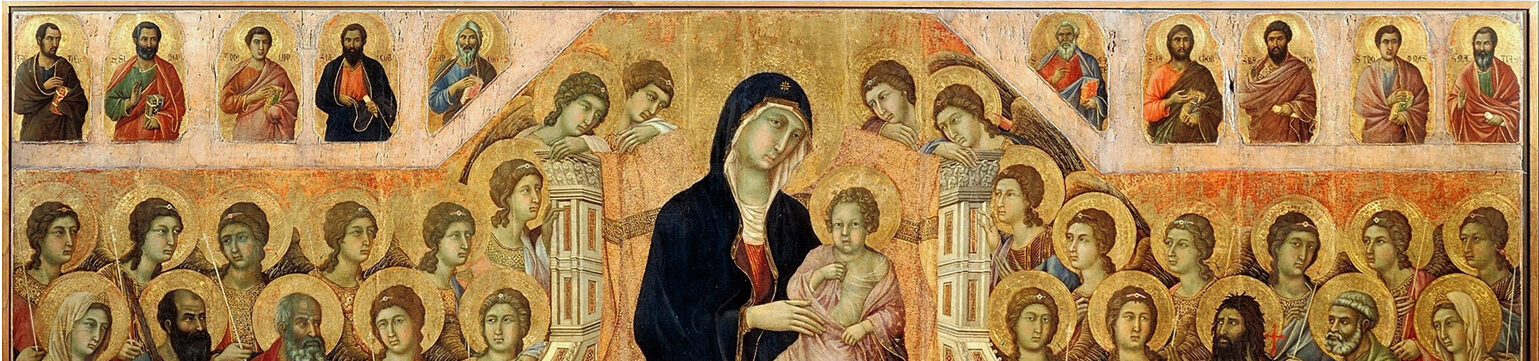
“Full of grace” (Lk 1:28): the holiness of Mary as panagia in the biblical and patristic tradition
Mary was called by the Angel “full of grace” (Lk 1:28). The one full of grace is the mother of Jesus, the Holy Son of God. As the Immaculate One and Mother of the incarnate Son of God, Mary is the all-holy one, the Panagia. From the pages of Scripture, through the writings of the Fathers of the Church, to the majestic and splendid medieval cathedrals and the paintings of the most celebrated artists in the world, as well as in the pages of the most distinguished theologians and spiritual masters, Mary is celebrated as the woman whom the Holy Trinity raised to the highest summits of evangelical perfection, through her humility and modesty.
Mary is an entirely holy creature, being the beloved daughter of the heavenly Father, mother of the Son, and tabernacle of the Holy Spirit. For this reason, the Christian faithful look to Holy Mary as the Queen of All Saints. Saints such as Saint John Bosco found in her inspiration and help for a heroic witness to the Christian virtues of faith, hope, and charity. The saints placed themselves, as diligent disciples, in the school of Mary, in order to become exemplary brothers of Jesus and credible witnesses of the evangelical beatitudes.
Marian devotion is part of the treasury of Catholic piety. In every Catholic church or oratory, beside the tabernacle, there is always, unfailingly, an image of Mary, the mother who leads her children to communion with Jesus and to His adoration in the tabernacle. In the constitutions, in the rules of religious families, and in the various present-day forms of consecrated life, there is never lacking the essential reference to devotion to Mary, the one most perfectly consecrated and the model of all consecrated life.
When the storm of persecution blows, invocation of the Virgin and prayer to her become anchors of perseverance in faith and in hope. History bears witness that the Christian faith remained alive even under the communist regimes of Eastern Europe, because mothers and grandmothers prayed the prayers to the Holy Virgin in secret, at night, imploring help and deliverance from the Mother of the Lord. And Mary, through Saint John Paul II, a wholly Marian pope, was the liberator of peoples from the oppression of tyrants. The Marian rosary is the crown that passes daily through the fingers of millions upon millions of the baptized throughout the world.
Mary, formator of the saints according to Augustine (†430) and Louis de Montfort (†1716): faith, humility, and obedience as a Marian itinerary
By her virtues, Mary becomes the formator of the faithful and of the saints, who, by imitating her, bear witness with greater constancy to the following of Jesus. The saints see in her, above all, the teacher, the educator, who teaches more by concrete attitudes of faith, humility, and obedience than by words.
The saints find in Mary the guide for following the straight path. For this reason, especially in Spain, the Blessed Virgin is often called the Good Shepherdess, the one who accompanies the saints in singing the praises of God and in living out, with joy and sacrifice, their baptismal or religious consecration.
For consecrated persons, Mary is an experienced guide, for she knows the way to climb the mountain and reach the summit of Tabor and of Calvary, where one meets Christ the Lord. She is the model of holiness. Saint Teresa Benedicta of the Cross saw Mary not only as a model before us, but as someone who is at our side, holding us by the hand and accompanying us, day after day and step by step, to the goal of holiness.
The saints are undoubtedly reflected in Jesus, the supreme model of our Christian life. Jesus is, in fact, the prototype of holiness: “I have given you the example, so that, as I have done, you also may do” (Jn 13:15). He is the Holy One of God (Acts 3:14) and the teacher of truth (Mt 22:16). The whole Christian life is an “imitation of Christ”. Consecrated life is founded on the words and the examples of the Lord.
Mary was the most faithful disciple of Christ. For this reason, she becomes the model of holy life for all disciples. Saint Ambrose of Milan said that the life of the Blessed Virgin is, in itself, a teaching for all. Contemporary spirituality continues to highlight the exemplarity of Mary, the mother who shines as a model of virtue before the community of the baptized.
Mary, spiritual mother of all the redeemed: the witness of Saint Pio of Pietrelcina (1887-1968)
Why is the Blessed Virgin teacher, educator, guide, and model of Christian life and of consecrated life? She is so because she is the mother of Jesus and the spiritual mother of all those redeemed in Christ.
Saint Pio of Pietrelcina felt the Blessed Virgin Mary particularly close to his filial heart. Giving voice to the experience and the sentiments of many faithful and consecrated persons, Padre Pio writes in one of his letters: “This dear Mother continues to offer me her maternal care with affection […]. Her care for me is full of tenderness […]. What have I done to deserve such delicacy? Has my conduct not been a continual denial, I do not say of her Son, but even of the very name of Christian? And yet this Mother, so tender, in her great mercy, wisdom, and goodness, has willed to chastise me in a most sublime way, pouring into my heart such and so many graces that, when I find myself in her presence and in that of Jesus, I am forced to exclaim: ‘Where am I, where do I find myself, who is at my side?’. I feel myself completely aflame without fire. I feel myself united and bound to the Son through this Mother […]. I would like to fly to invite all creatures to love Jesus, to love Mary. This is a pale description of what happens to me when I am with Jesus and Mary”.
The same Capuchin Saint also describes the concrete help of this heavenly Mother, who relieves him of physical infirmities and of spiritual anguish. For the feast of the Assumption, Padre Pio wrote: “We Catholics, who venerate in Mary Most Holy the most tender and affectionate Mother that can be imagined, cannot but exult with joy on this sacred day in memory of her greatest triumph, I mean, her Assumption into heaven and her coronation as Queen of the angels and of all the saints. Let us dwell, therefore, on contemplating the power and the glory of Mary Most Holy assumed into heaven, so that we may be inflamed still more in devotion and in confidence in her”.
The dogma of the Immaculate Conception (1854) and the martyrial holiness of Saint Maximilian Kolbe (1894-1941)
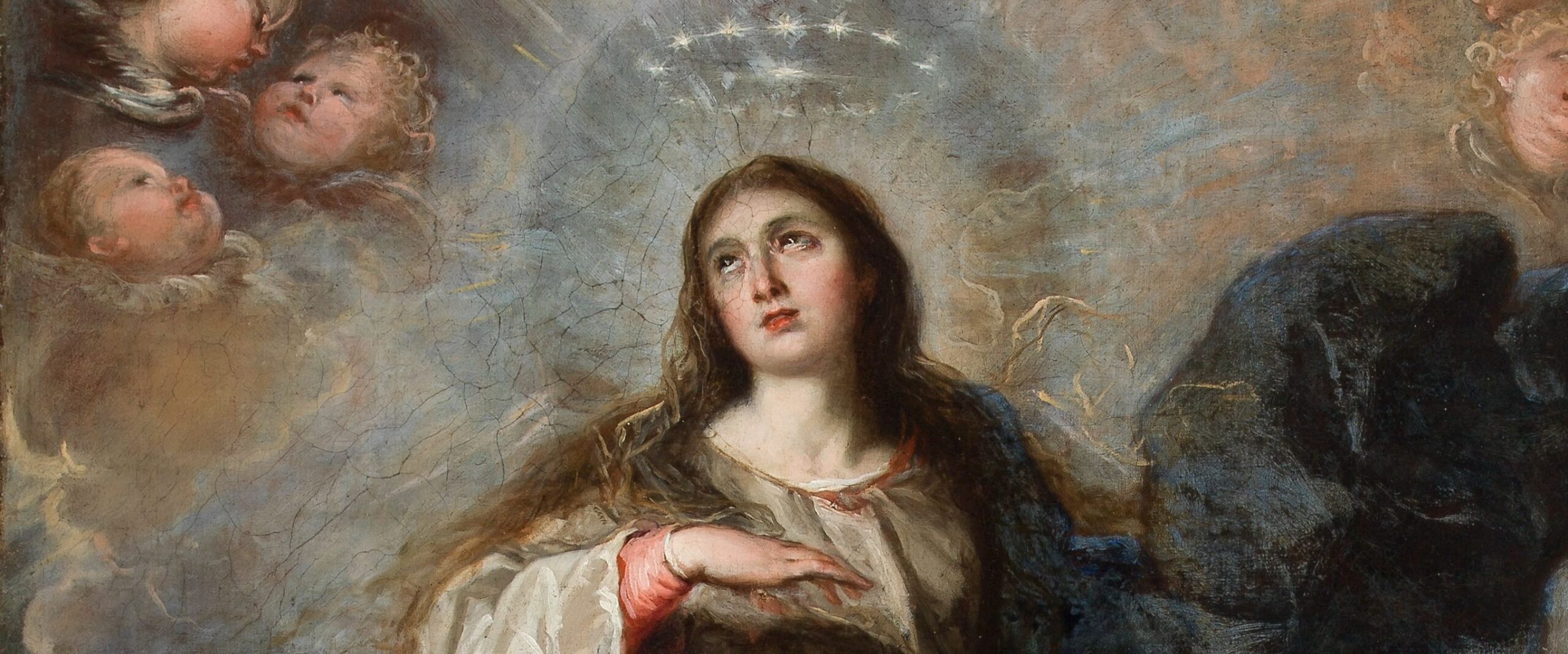
The dogma of the Immaculate Conception highlights the fullness of grace granted to the Blessed Virgin. The saints meditated deeply on this truth of faith, drawing from it inspiration for sanctification and for the apostolate. A notable example is Saint Maximilian Kolbe, whose mission and martyrial holiness have as their key his Marian devotion, his filial piety toward the Immaculate One. His soul sings the glories of the Blessed Virgin with enthusiasm and deep participation. For him, the Immaculate One is “the summit of the love of creation returning to God”. In the Immaculate One, the faithful can overcome the barriers of their own limits and attain holiness. The Immaculate One is necessary, not only as a model to be followed, but above all as an effective and powerful maternal mediatrix. Only in the Immaculate One can the faithful break through their limitations and reach “the summit of perfection”.
In celebrating the dogma of the Immaculate Conception fifty years after its proclamation, Pope Saint Pius X, in the Encyclical Ad diem illum of 1904, affirmed that Mary is the best guide for coming to the knowledge of Jesus. She is also the mother of all the faithful and the mediatrix and consoler of all humanity. Marian devotion thus becomes an incentive to fulfill the will of her divine Son. Being the Immaculate One, Mary is the second model to be imitated, after Jesus Christ. Her theological virtues, in particular, are examples to follow.
Saint Pius X underlines: “Although it is fitting that children imitate all the virtues of their Most Holy Mother, we desire that the faithful practice those that are the chief ones and, as it were, the sinews and joints of the Christian life: faith, hope, and charity, both toward God and toward neighbor. And although no period of the life of the Virgin was without the splendor of these virtues, they shone in a special way when Mary was present at the nativity and at the death of her Son”. (Ad diem illum).
Marian devotion and Christian holiness according to Vatican II (LG 66-67): Mary as the archetype of the human response to the divine mystery
In Mary we find the archetype of the human response to the divine mystery, a creature fully receptive to the action of God and, at the same time, active in the consent that transforms history. Her holiness, marked by the absolute purity of the Immaculate Conception, is not an end in itself, but the summit of the love that redeems, a total self-giving to the divine will that makes her the mother of all the redeemed. Mary lives in perfect consonance with Trinitarian Love, being, therefore, the human figure who best reveals and reflects the glory of God.
Christian spirituality recognizes that, in contemplating Mary, we look upon humanity itself transfigured by grace. For the saints, she is the “gate of heaven”, the threshold where the human and the divine meet in a profound harmony. In her humility, Mary does not point to herself, but to the Mystery that dwells within her, becoming the model of the spiritual exodus through which every disciple is called to pass in order to enter into communion with the Son. Devotion to Mary, far from being a gesture of mere veneration, is an introduction to the mystery of obedience and of love, a summons to live the faith in its totality, under the gaze of the Mother who leads us to the mystery of Christ.
Mary, therefore, is the “all-holy one” who remains as intercessor and spiritual educator. It is at her side that the faithful are invited to walk the way of the cross that leads to the resurrection. She is the icon of redeemed humanity, the one who, in the presence of the Trinity, dwells fully in the promised beatitude. In following her steps, we contemplate, in her glory and humility, the ultimate destiny to which we are called: the fullness of life in God.
Deepen your studies: explore Mariology, Marian Theology, Marian apparitions, and the Postgraduate Program in Mariology.
To deepen the connection between holiness and Marian devotion, consult the Apostolic Exhortation Marialis Cultus of Pope Paul VI.
Postgraduate Program in Mariology
Would you like to deepen your formation in Mariology? Discover the Postgraduate Program in Mariology of Locus Mariologicus, an academic formation that unites theological rigor, spiritual life, and the living tradition of the Church.
Would you like to study Mariology seriously?
This article is born from the works in the library of Locus Mariologicus. The Postgraduate Program in Mariology brings you to the same source, with academic guidance: Scripture, the Fathers of the Church, and the Magisterium, from the first dogma to contemporary questions.



Responses