“To Jesus, through Mary,” in Saint Peter Damian (d. 1072)
Introduction
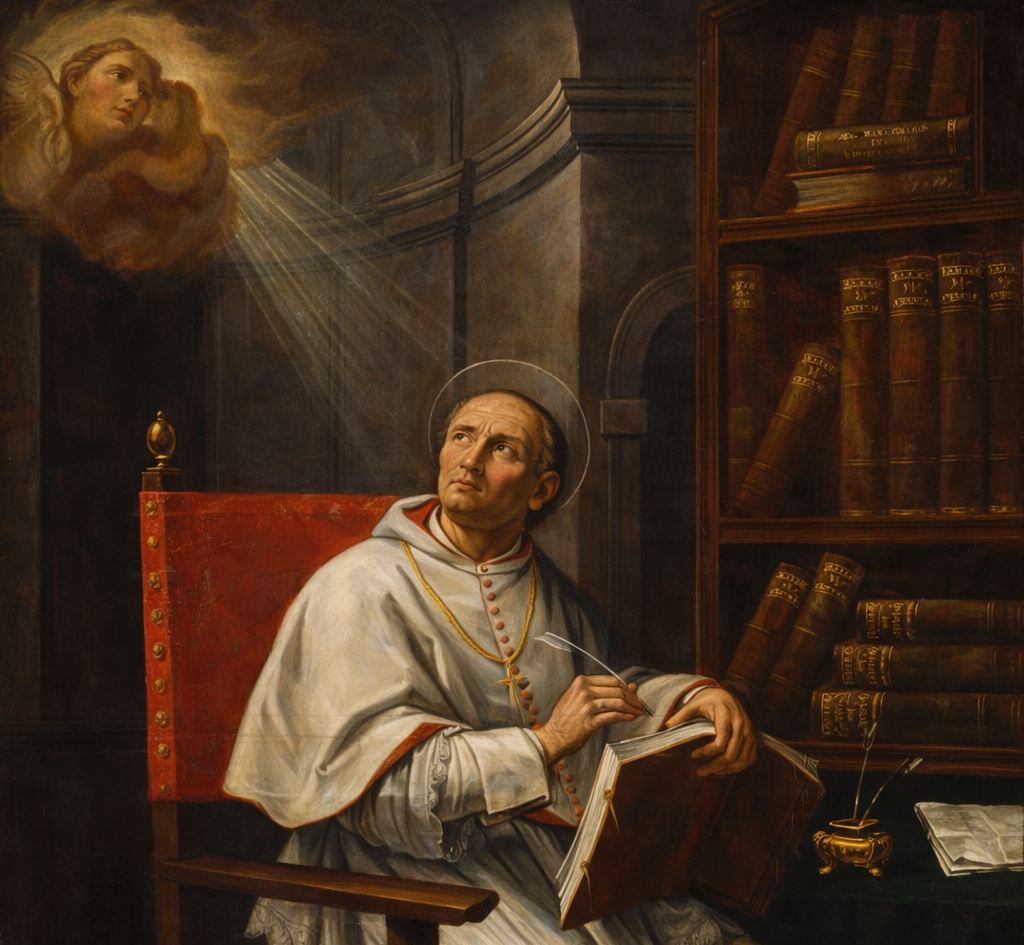
Echoing what the patriarch Germanus of Constantinople had already taught in the East, Peter Damian sums up in a single sentence his feelings of boundless admiration and love for the Mother of the Lord: “In your hands are laid up the treasures of God’s mercy” (Sermo XLIV, PL 144, 740 C). Endowed with remarkable gifts as an eloquent preacher and holding a position of great authority in the Church, personally committed to the reform movement of the eleventh century, he made a decisive contribution to the spread of devotion to the Holy Virgin, at a time that was witnessing a singular Marian flowering, both in the realm of doctrine and in that of piety.

Biographical Data and Works
Peter Damian was born in Ravenna in the year 1007. He was orphaned while still very young, which is why one of his older brothers, a priest, took care of him and supported his studies first in Faenza and then in Parma, where Peter later worked as a teacher. After some experiences of cenobitic life, around 1035 he withdrew to the Camaldolese hermitage of Fonte Avellana. He became an enthusiastic disciple of Saint Romuald, founder of Camaldoli, and a friend of the future Pope Gregory VII. In 1057 he was appointed bishop of Ostia and cardinal by Pope Stephen IX, despite his reluctance. A few years later, however, he was able to resign the episcopal see and return to the hermitage of Fonte Avellana, while still continuing to carry out the occasional missions entrusted to him. He died in Faenza in 1072, at the age of 65. In 1828 he was proclaimed a Doctor of the Church.
His main contributions to Marian doctrine come from sermons 45 and 46, devoted to the Nativity of Mary (PL 144, 740-761). Yet in other sermons as well, in the opuscula (PL 145, 19-858), in the hymns and in the prayers, he frequently returns to Marian themes. Peter Damian takes up practically all the doctrinal themes concerning the Mother of God that were present in the theological debate of his time, showing, however, an ability to confront them and to deepen them from new perspectives. Meditation on the mystery of the divine motherhood led him to extol both Mary’s sublime holiness and her mediation on behalf of the Church. By his prestige and his doctrine, Peter Damian offered a substantial contribution to the later development of Mariology and of the cult of the Holy Virgin. To him is attributed the explicit formulation of the principle: “To Jesus through Mary” (cf. Sermo XLVI, PL 144, 761 B).
The Singular Personality of the Mother of God
The divine motherhood of Mary is an ancient dogma in the Church. In Peter Damian, however, it becomes an occasion to extol, with new emphases, the spiritual richness that the Mother of the Lord necessarily received in order to measure up to her mission and to be able to honor it worthily. Taking up a theme dear to the tradition of the Greek Fathers, he affirms that it was the Holy Spirit who intervened to make Mary a fitting dwelling to receive the Son of God: “It was necessary first to build the house into which the King of heaven would descend and consent to be a guest. Of this house Solomon spoke: ‘Wisdom has built herself a house, she has hewn her seven pillars’ (Prov 9:1). Indeed, this virginal house is supported by seven pillars, because the venerable Mother received the seven gifts of the Holy Spirit” (Sermo XLV, PL 144, 741 BC).
In the hymn for the feast of the Annunciation, he expresses the same truth in more concise and inspired language: “The Son of the Father fills her with Himself, the Holy Spirit covers her with His shadow. The most chaste womb of the holy maiden becomes heaven” (Carmen 44, PL 145, 933 D).
For this reason Mary stands above all human praise, since her dignity and perfection confer on her merits that find no comparison in any other protagonist of the history of salvation: “How can the frailty of human nature worthily celebrate the feast of her who merited to bring forth the joy of the angels? How will the fleeting word of mortal man be able to praise her who from her womb gave birth to the Word that remains eternally?” (Sermo XLV, PL 144, 742 C).
The greatness of Mary’s mission has its root not only in the divine nature of the Son who was born of her, but also in the purpose of the incarnation, which consists in the redemption of the human creature, a redemption that could not be accomplished without her motherhood. Peter Damian goes so far as to attribute to Mary’s motherhood an almost necessary character: “Just as it was impossible for the human race to be redeemed without the Son of God being born of the Virgin, so it was necessary that the Virgin come into the world, so that from her He might take flesh” (Sermo XLV, PL 144, 741 A). It is clear that the author understands this necessity in a manner subordinate to Christ, but the boldness of the formulation reveals the lofty conception he had of the Holy Virgin’s mission in the economy of salvation.
In the same sermon, the idea is illustrated with the nuptial image: “It was necessary first to prepare the bridal chamber, so that it might be fit to receive the Bridegroom who was coming to wed the Holy Church” (Sermo XLV, PL 144, 741 B).
The Curse of Eve and the Blessing of Mary
Mary’s cooperation in the salvation of the human race, radically bound to her motherhood in relation to the Redeemer, finds in the Eve-Mary parallel a particularly clear expression. In both cases it is a question of generation: Eve generated sin, from which came the curse and death. Mary generated grace and, consequently, blessing and life. Peter Damian writes: “Blessed are you among women. Through a woman the curse fell upon the earth. Through a woman the blessing was restored. From the hand of the first was offered the cup of bitter death. From the hand of the second is presented the sweet cup of life. The abundance of the new blessing has wiped out the contagion of the ancient curse” (Sermo XLVI, PL 144, 758 AB).
In one of his hymns he offers a poetic interpretation of this doctrine, insisting on the virginal condition common to the two women: “Through a Virgin, man returns to the life that another virgin had destroyed. Death, conquered, perishes. With the Virgin life returns. As for you, O Mary, we beseech you: raise above the stars what Eve buried. She is weighed down by guilt. You, however, rise above the stars” (Carmen 65, PL 145, 941 A).
The Mother of God and the Eucharist
In the light of the Eve-Mary parallel, Peter Damian describes the relationship between the Holy Virgin and the eucharistic body of her Son. He stresses that the body conceived by her, brought forth, nourished and cared for with maternal solicitude is the same body that we receive at the eucharistic banquet and whose blood we drink as the sacrament of our redemption. This truth, he affirms, belongs to the Catholic faith and is taught by the Church.
Mary is the one who, from her immaculate flesh, generated the food of our souls, the bread come down from heaven. He concludes with a further allusion to Eve’s negative role: “Because of one food we were driven out of the beauty of paradise. Through another food we were readmitted to its joys. Eve ate a food that condemned us to the hunger of an eternal fast. Mary, on the contrary, prepared a food that opened to us the doors of the banquet of heaven” (Sermo XLV, PL 144, 743 C).
Mary and the Church
In the writings in which he develops his Marian doctrine, Peter Damian also takes up the bond between the Virgin and the Church, understood as a relationship of motherhood mediated by Christ: “The blessed Virgin Mary is a great and happy mother. From her womb Christ took flesh, and from Him the Church was born through water and blood. Thus it appears that the Church had its origin in Mary. Both are chaste, pure, and guarded by the girdle of perpetual virginity” (Sermo de sancto Iohanne, PL 144, 861 B).
If Christ came to men through the motherhood of the Virgin, it is in her that men find the way that leads to Him. This principle, later summed up in the expression “Ad Iesum per Mariam”, was explicitly formulated by Peter Damian (cf. Sermo XLVI, PL 144, 761 B).
Devotion to the Mother of the Lord
From his lofty esteem for the person and mission of Mary there arises in Peter Damian a profound devotion and a tender love toward her, evident above all in the numerous invocations of his prayers. He recommends practices of Marian piety, such as the daily recitation of the Ave Maria and of the “Five Joys of Our Lady” (Opusculum 33, 3, PL 145, 564 BC). He also composed a daily office “in honor of Saint Mary” (Carmina 48-65, PL 145, 935 B to 941 A).
He further explains why Saturday is dedicated in a special way to the Virgin: because on that day Wisdom built herself a house and rested in it by a mystery of humility (cf. Opusculum 33, 4, PL 145, 565 D to 567 B). Peter Damian is without doubt an eminent witness to the growing role assumed by the Mother of the Lord in the doctrine and life of the Church in the West. The awareness of the efficacy of her intercession led Christians to turn to her as Mother of Mercy, a title also used by him in the prayer of the second sermon on the Nativity: “O most clement one, Mother of piety and mercy itself, we who on earth rejoice to celebrate solemnly your outstanding praises beseech you that in heaven we may merit the help of your intercession” (Sermo XLVI, PL 144, 761 B).
Conclusion
The Marian reflection of Saint Peter Damian fits organically into the great movement of spiritual, doctrinal and disciplinary renewal of the eleventh century, of which he was an eminent protagonist. Far from constituting a marginal devotional appendix, his doctrine on the Mother of God proves to be structurally integrated into the economy of salvation and deeply rooted in the patristic tradition, above all the Eastern one, which he knew how to assimilate and rework with originality.
The fundamental axis of his Mariology is the divine motherhood, understood not only as a singular privilege granted to Mary, but as a hermeneutical principle capable of illuminating her personal holiness, her historical mission and her ecclesial function. Starting from this mystery, Peter Damian develops a lofty vision of the spiritual preparation of the Virgin, attributed to the action of the Holy Spirit, who makes her a worthy dwelling of the incarnate Word. Such a perspective allows him to articulate coherently Mary’s fullness of grace, her excellence over all creation and the impossibility of any comparison with other figures of the history of salvation.
Particularly significant is the way the author interprets Mary’s cooperation in human redemption. The Eve-Mary parallel, taken up with rhetorical vigor and symbolic richness, is not limited to a moral opposition, but assumes an ontological and soteriological scope. The generation of life and death, of blessing and curse, of grace and sin, is understood in the light of motherhood, which confers on the Virgin a decisive role, though always a subordinate one, in God’s redemptive design. Even when he resorts to bold formulations concerning the necessity of Mary’s motherhood, Peter Damian remains faithful to the absolute centrality of Christ, while nevertheless bringing out the singular dignity of Marian mediation in the order of the incarnation.
The relationship between Mary and the Eucharist constitutes another element of great theological depth. By identifying the eucharistic body with the body born of the Virgin, the author establishes a concrete continuity between the mystery of the incarnation and that of the sacramental presence, thus reinforcing the bond between Mary’s motherhood and the sacramental life of the Church. Such an approach reveals a unified understanding of the Christian mystery, in which Mary appears intimately associated not only with the historical birth of the Redeemer, but also with the permanent communication of His life to the faithful.
No less relevant is his ecclesiological vision. The Church, born from the open side of Christ, is presented as having, in a certain way, her origin in Mary, which grounds a true spiritual motherhood of the Virgin in relation to the ecclesial body. This insight anticipates later developments of medieval and modern Marian theology, as well as the explicit formulation of the spiritual principle according to which access to Christ passes through the maternal mediation of Mary, summed up in the expression Ad Iesum per Mariam.
Finally, Peter Damian’s Marian doctrine finds its vital expression in devotion. Piety does not arise as a mere affective consequence, but as a coherent response to the theological truth contemplated. The recommendation of concrete practices, the composition of hymns, offices and prayers, as well as the insistence on the merciful intercession of the Virgin, bear witness to the unity between faith, theology and spiritual life that characterizes his thought.
In sum, Saint Peter Damian occupies a prominent place in the history of Western Mariology. His contribution stands out for its speculative depth, its fidelity to tradition and its capacity to integrate Mary harmoniously into the center of the Christian mystery. His work significantly prepares the Mariological flowering of the following centuries and remains a sure reference for a balanced theological understanding of the Mother of God, in which doctrine, spirituality and ecclesial life illuminate one another.
For the contemporary magisterial framework on Mary as the way to Christ, the encyclical Redemptoris Mater of John Paul II takes up Saint Peter Damian’s spiritual insights on Mary’s mediation.
Deepen your studies: explore Mariology, Marian Theology, Marian apparitions and the Postgraduate Program in Mariology.
Continue your Marian formation: Explore our resources on Mariology, Marian Theology and Marian apparitions. Discover the Postgraduate Program in Mariology of the Locus Mariologicus Institute.
Postgraduate Program in Mariology
Would you like to deepen your formation in Mariology? Discover the Postgraduate Program in Mariology of Locus Mariologicus – an academic formation that unites theological rigor, spiritual life and the living tradition of the Church.
Would you like to study Mariology seriously?
This article grows out of the works in the library of Locus Mariologicus. The Postgraduate Program in Mariology takes you to the same source, with academic guidance: Scripture, the Fathers of the Church and the Magisterium, from the first dogma to contemporary questions.



Responses