“She stood by the cross”: Mary’s compassion, Hebrews 5, and the gift of the Son
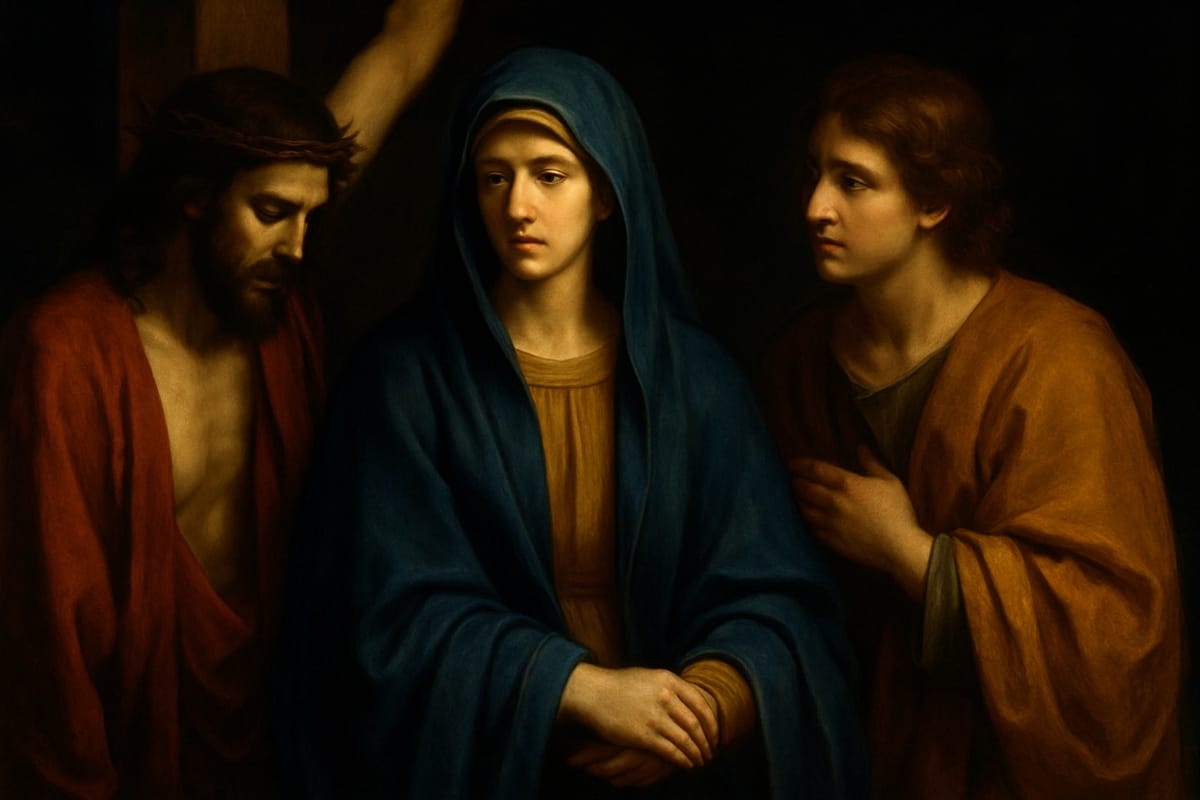
The liturgical memory of Our Lady of Sorrows is connected to Hebrews 5 and John 19 in a reflection on suffering as a path to perfection. In Hebrews 5, the Son learns obedience through suffering and becomes the cause of eternal salvation for all who obey Him. In John 19, Mary stands at the Cross, receiving the beloved disciple as her son. Mary’s compassion is inseparable from the Son’s obedience: both obey the Father in the moment of greatest suffering, and this common obedience is the source of Mary’s spiritual motherhood over all disciples.
I. The first reading: Heb 5:7-9
Hebrews 5:7-9 presents one of the most surprising affirmations of the New Testament about the Son of God: «though he was a Son, he learned obedience through suffering» (v.8). It is not a matter of prior ignorance but of existential learning: the obedience practiced by the Son in the Incarnation reached its full form in the hour of Gethsemane and the Cross. «Crying out with a loud voice and with tears, he committed himself to him who could save him from death» (v.7): the praying Son is the same one the disciples saw heal and teach, now at the limit of human suffering.
«Having been perfected, he became the cause of eternal salvation for all who obey him» (v.9): the perfection of the Son is the completion of obedience through suffering. Hebrews 5 does not glorify suffering itself but the obedience embraced in suffering that leads to «perfection». Mary, who heard Simeon say that «a sword shall pierce through your own soul» (Lk 2:35), walked the same path: obedience to the Father that leads to the maximum suffering as a way to the maximum participation in the work of salvation.
II. The gospel: John 19:25-27
John 19:25-27 is the foundational text of Mary’s spiritual motherhood: standing at the Cross are Mary, Jesus’ mother, and his aunt, Mary Magdalene. When Jesus sees his mother and the beloved disciple, he says: «Woman, behold your son» and to the disciple: «Behold your mother» (v.26-27). Jesus’ testament on the Cross establishes a new motherhood: Mary is not ceasing to be the mother of the Son, but her motherhood expands to the beloved disciple and through him to all disciples.
The title «Woman» that Jesus uses for Mary in John 19 echoes the same title in John 2:4: at Cana, where the mission begins, and on the Cross, where the mission is consummated, Jesus calls Mary «Woman». The tradition interprets this title to the «woman» of Genesis 3:15: Mary as the new Eve who stands where the old one fell. The «stabat» of John 19:25 is the posture of the new humanity that embraces the Cross as a gift and does not flee before the suffering of the Son.


Responses