“Vinum novum”: New Wineskins, Premature Judgment, and Mary Full of Grace
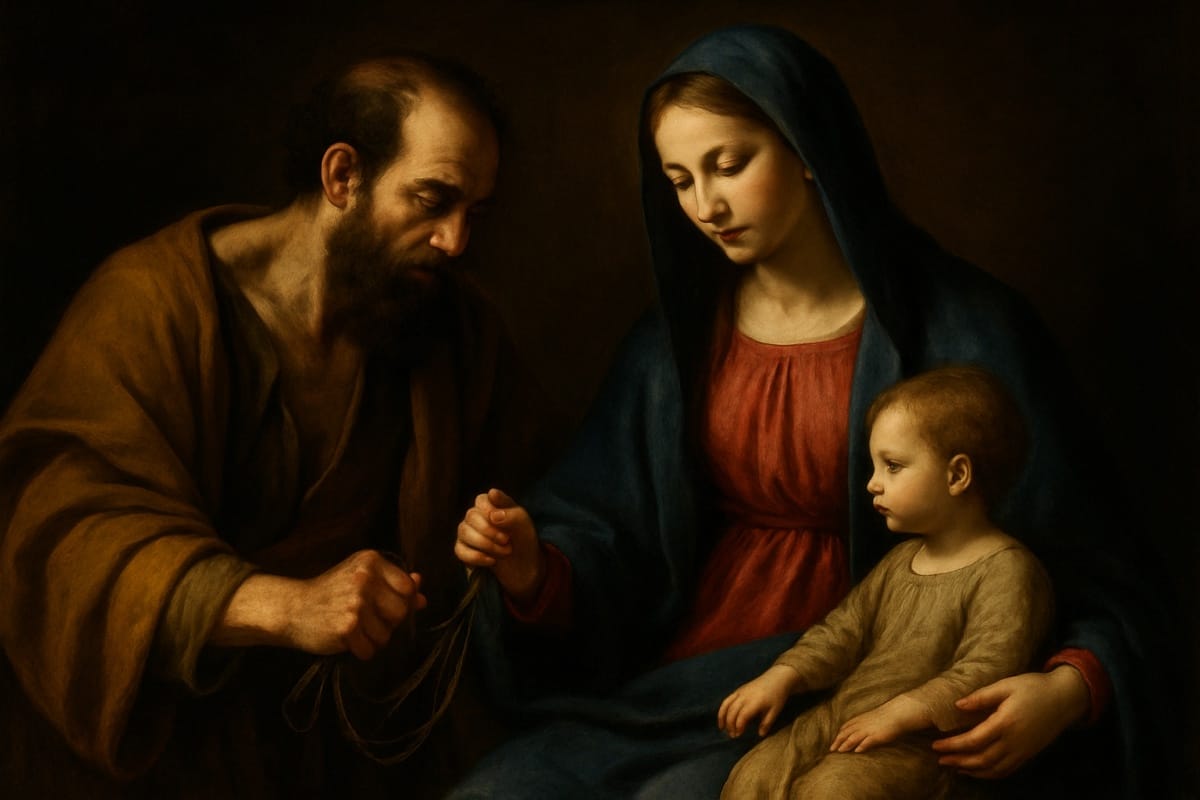
Sic nos existimet homo ut ministros Christi et dispensatores mysteriorum Dei. […] Sed vinum novum in utres novos mittendum est.
1 Cor 4:1 and Lk 5:38
Friday of the Twenty-Second Week in Ordinary Time joins two warnings about the same temptation, that of reducing God to what we already know of God. Paul defines the apostle as a “steward of the mysteries” and refuses to be judged before the time, whether by the Corinthians or by himself. Jesus answers the objection about fasting with three images, the bridegroom present, the new patch, and the new wine, and ends with the most disconcerting sentence of the passage: “the old is good” (v.39). The newness of grace does not fit into the earlier forms, and most people prefer the earlier forms.
I. The First Reading: 1 Cor 4:1-5
The definition of ministry that Paul proposes has a sobriety that time has not worn away. The apostle is hypéretes, the subordinate who carries out the orders of another, and he is a “steward of the mysteries of God” (v.1). Neither of the two words admits of ownership. The steward manages what does not belong to him, and the only thing required of him is fidelity: “what is required of stewards is that they be faithful” (v.2). Not success, not approval, not measurable results.
Hence the strange freedom of the next sentence. Paul declares that it matters little to him to be judged by the Corinthians or by a human court, and he adds something that usually goes unnoticed, “I do not even judge myself” (v.3). He distrusts the court of others as much as his own. And he explains why with a precision that has run through the whole theology of grace: “my conscience accuses me of nothing, but that is not what justifies me” (v.4). A tranquil conscience is not proof of innocence, because the final criterion is not within us. The one who judges is the Lord, and His judgment awaits the hour when what is hidden will be brought to light.
II. The Gospel: Lk 5:33-39
The objection of the Pharisees is reasonable and for that very reason dangerous. John’s disciples fast, theirs fast as well, and those of Jesus eat and drink. The answer moves the question from the plane of discipline to the plane of Christology: “Can you make the companions of the bridegroom fast while the bridegroom is with them?” (v.34). The criterion of fasting is not a fixed rule, it is the presence or the absence of the bridegroom. And Jesus adds, with a serenity that already contains the Passion, “days will come when the bridegroom will be taken away from them” (v.35).
The two parables that follow say the same thing through domestic images. The patch of new cloth ruins both garments. Wine still fermenting bursts the wineskin that has already lost its elasticity. In both cases the problem is neither the new nor the old in itself, it is the attempt to put one inside the other without anything changing. The final sentence is the psychological portrait of the one who resists: “no one who drinks old wine wants the new, for he says: the old is good” (v.39). This is not a matter of ill will. It is a matter of a formed palate, and a formed palate is the hardest resistance to overcome, because it does not even present itself as resistance.
III. Premature Judgment and the Hardened Wineskin
The two readings converge on a point that matters above all to those who serve in the Church. Judging before the time, which Paul forbids, and preferring the old wine, which Jesus diagnoses, are the same operation seen from two angles. In both cases the question is closed before God has closed it. Whoever already knows what God is going to do has no need to wait for God.
The hardened wineskin is an image of the heart that has organized itself definitively around one form of piety and has ceased to allow grace to manifest itself in another register. This can happen with good practices, and that is the subtlety of the parable. The fasting of the Pharisees was not bad. It was authentic, demanding, costly. It simply was not the criterion, and they had turned it into the criterion. Every spiritual life knows this risk of taking the means for the end, and the only defense is the one Paul indicates, to defer judgment and to remain faithful in the administration of what is not ours.
IV. Mary, the New Wineskin
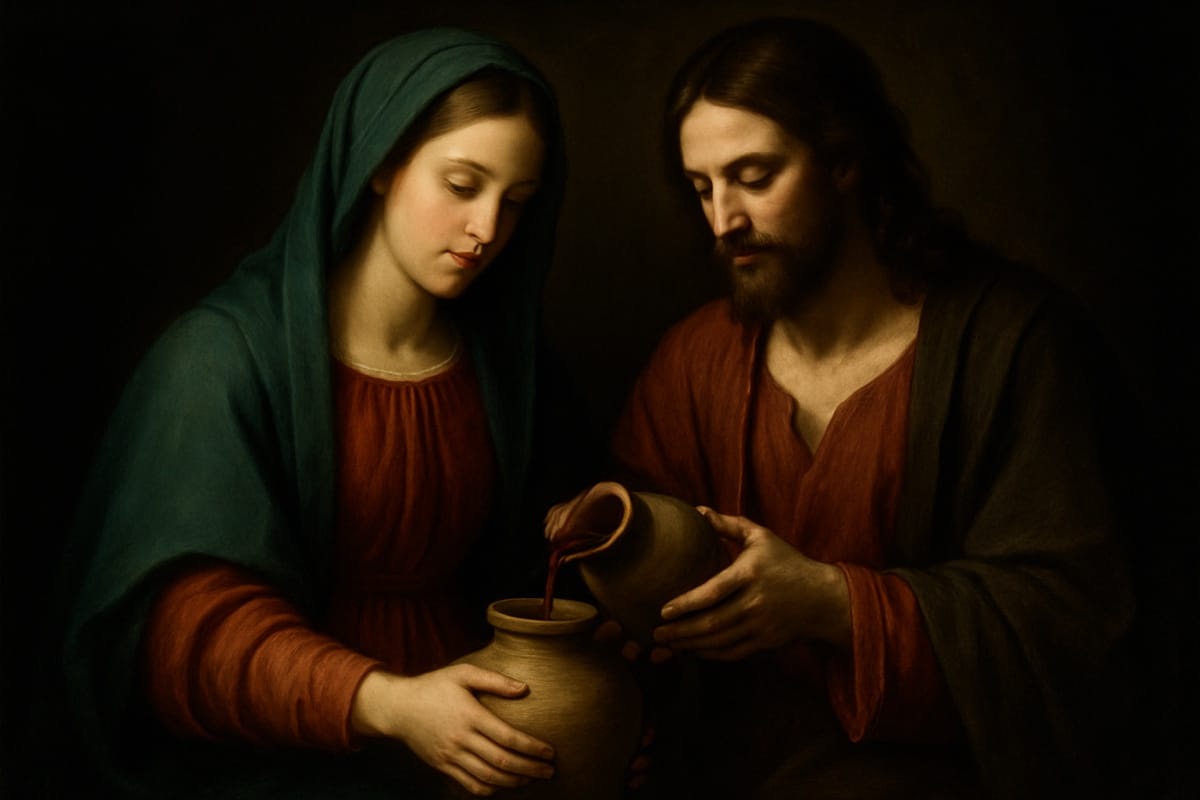
If new wine requires new wineskins, then Mariology has here one of its densest affirmations. What God willed to give to the world could not be poured into any earlier form, and for that reason He prepared a new capacity. Mary is, in the order of grace, the wineskin that God made for the wine He was about to pour out. She did not receive the Son in spite of being a creature like the others, she received Him in a condition prepared for that very purpose.
That is the meaning of the name the angel gives her before any other, kecharitoméne, “full of grace” (Lk 1:28). The participle does not describe a state of mind at that instant, it describes a work already accomplished in her. The Council affirms that Mary was enriched from the first instant of her conception with the splendor of an altogether singular holiness (LG 56). The elasticity that the old wineskins lacked was given to her beforehand.
And there is the note of the bridegroom, which in Luke is sounded in connection with fasting and which the Marian tradition has always read in two directions. Mary is the one who had the bridegroom with her for thirty years of hidden life, and she is also the one from whom the bridegroom was taken away, standing by the cross (Jn 19:25). She knew the two hours of which Jesus speaks and did not confuse one with the other. She did not fast when there was a banquet, she did not feast when there was mourning. She adjusted herself to God’s hour instead of imposing her own hour on God, and it is in this that the Church recognizes in her its own type in the order of faith (LG 63).
Friday of the Twenty-Second Week therefore leaves a question that is best not answered quickly. When the new wine appears, what do we do with it? Or, to put it another way, how many times have we already said “the old is good” about something that God was beginning?
Postgraduate Program in Mariology
Would you like to deepen your formation in Mariology? Discover the Postgraduate Program in Mariology of Locus Mariologicus – an academic formation that unites theological rigor, spiritual life, and the living tradition of the Church.




Responses