Cherub: what it is and what the Bible says about the cherubim
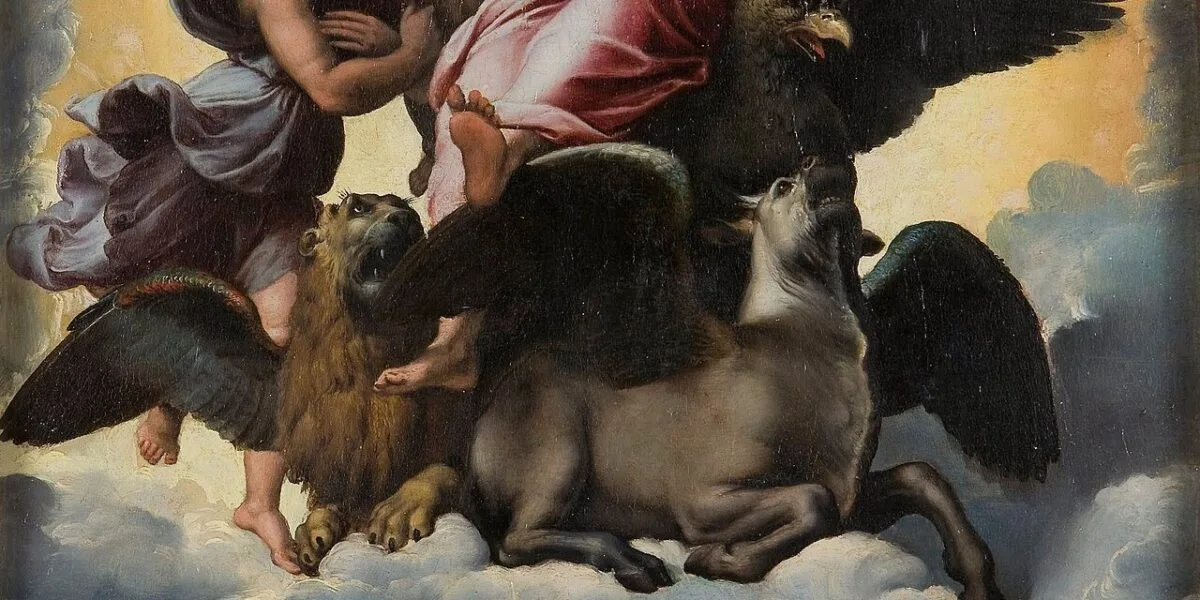
The cherub (plural, cherubim) is, according to the Bible, an angel of the first celestial hierarchy, guardian of God’s holiness and bearer of his throne. It guards Eden (Gen 3:24), covers the ark of the covenant (Ex 25:18-22), and carries the throne of God in Ezekiel (Ezek 10). It is not a winged baby: that image comes from the putti of Renaissance art.
The name comes from the Hebrew keruv (plural keruvim), probably related to the Akkadian karibu, the guardian genius carved at the gates of the temples and palaces of Mesopotamia. In Scripture, the cherub is a fearsome creature, set between sinful man and the thrice-holy God. Going through the texts in which the cherubim appear is one of the best doors into Catholic angelology: in them we see how the Bible speaks of the invisible world with powerful images, and how theology must read those images without lowering them to decoration.
What is a cherub
A cherub is a spiritual, personal, and real creature, an angel. The Catholic faith does not treat the cherubim as poetic symbols: the Catechism teaches that angels are purely spiritual creatures, endowed with intelligence and will, “personal and immortal creatures” (CCC 330). Among the angels, the cherubim are distinguished by the function the Bible gives them: they do not carry messages to men, they guard the holiness of God and uphold his throne. Theological tradition, beginning with Pseudo-Dionysius, placed them in the second of the nine angelic choirs, just below the seraphim.
It is worth noting at once what the cherub is not: it is not a “messenger.” The generic term for angel, mal’akh (מלאך), means “sent one” and describes an office of communication, as we explain in the article on the word angel in Hebrew. The messenger par excellence is an archangel such as Gabriel, sent to Nazareth (Lk 1:26). Now, in the Bible the cherubim never deliver a message to anyone. They guard, they uphold, they carry. Their place is not before men, it is beside God.
Meaning of the name cherub (Hebrew כְּרוּב)
In Hebrew the word is keruv (כְּרוּב), with the plural keruvim (כְּרוּבִים). The English form “cherubim” is already the Hebrew plural, so that “cherubims” would be, strictly speaking, a double plural, exactly as happens with “seraphims.” The Greek New Testament simply transcribes the word (Cheroubin, Heb 9:5), and Latin does the same (Cherubim).
The etymology most accepted by contemporary exegesis relates the term to the Akkadian karibu or kuribu, the name of the guardian and intercessor genii that flanked the entrances of Mesopotamian temples and palaces, often in the form of winged bulls or lions with human faces. There are therefore two “meanings” that should not be confused:
- Philological meaning: the kinship with karibu points to the idea of a guardian or intercessor beside the deity, which fits well with the biblical role of the cherub.
- Traditional theological meaning: Pseudo-Dionysius, relying on those who knew Hebrew, interpreted the name as abundance of knowledge or outpouring of wisdom (The Celestial Hierarchy, ch. VII), and Saint Thomas Aquinas took up this reading by explaining that the name is interpreted as “fullness of knowledge” (Summa Theologiae I, q. 108, a. 5, ad 5).
The first reading is that of the science of ancient languages, the second is a spiritual reading that tradition used to describe what the cherubim are before God. Both converge on one point: the cherub is near God, not near us.
The cherubim in the Bible: the main texts
The word appears more than ninety times in the Old Testament, above all in the descriptions of the sanctuary and in the book of Ezekiel. The texts below are the ones that define the biblical profile of the cherub. The translations are literal, made by us from the Hebrew Masoretic text.
Genesis 3:24: the cherub guards Eden
The first appearance of the cherubim in the Bible happens right after the fall, and the tone is anything but decorative:
וַיְגָ֖רֶשׁ אֶת־הָֽאָדָ֑ם וַיַּשְׁכֵּן֩ מִקֶּ֨דֶם לְגַן־עֵ֜דֶן אֶת־הַכְּרֻבִ֗ים וְאֵ֨ת לַ֤הַט הַחֶ֙רֶב֙ הַמִּתְהַפֶּ֔כֶת לִשְׁמֹ֕ר אֶת־דֶּ֖רֶךְ עֵ֥ץ הַֽחַיִּֽים׃
“And he drove out the man, and he made to dwell at the east of the garden of Eden the cherubim and the flame of the sword that turned every way, to guard the way of the tree of life” (Gen 3:24, our literal translation of the Masoretic text).
The Hebrew verb is unmistakable: the cherubim (hakkeruvim) are there lishmor, “to guard.” Their first function in the history of salvation is to forbid, to mark with a sword of fire the border between sinful man and the life he lost. The Catechism of the Catholic Church recalls this episode when listing the angelic interventions in Scripture: the angels “closed the earthly paradise” (CCC 332). Whoever begins here can no longer imagine the cherub as a smiling baby.
Exodus 25:18-22: the cherubim of the ark of the covenant
The second great setting is the worship of Israel. At Sinai, Moses receives the order to make two cherubim of beaten gold at the two ends of the mercy seat (kapporet), the lid of the ark of the covenant (Ex 25:18-19). The text describes their posture and says what they are for:
וְהָי֣וּ הַכְּרֻבִים֩ פֹּרְשֵׂ֨י כְנָפַ֜יִם לְמַ֗עְלָה סֹכְכִ֤ים בְּכַנְפֵיהֶם֙ עַל־הַכַּפֹּ֔רֶת וּפְנֵיהֶ֖ם אִ֣ישׁ אֶל־אָחִ֑יו אֶ֨ל־הַכַּפֹּ֔רֶת יִהְי֖וּ פְּנֵ֥י הַכְּרֻבִֽים׃
“And the cherubim shall be stretching out their wings on high, covering the mercy seat with their wings, and their faces, each toward his brother. Toward the mercy seat shall be the faces of the cherubim” (Ex 25:20, our literal translation of the Masoretic text).
וְנוֹעַדְתִּ֣י לְךָ֮ שָׁם֒ וְדִבַּרְתִּ֨י אִתְּךָ֜ מֵעַ֣ל הַכַּפֹּ֗רֶת מִבֵּין֙ שְׁנֵ֣י הַכְּרֻבִ֔ים אֲשֶׁ֖ר עַל־אֲר֣וֹן הָעֵדֻ֑ת אֵ֣ת כׇּל־אֲשֶׁ֧ר אֲצַוֶּ֛ה אוֹתְךָ֖ אֶל־בְּנֵ֥י יִשְׂרָאֵֽל׃
“And I will meet with you there, and I will speak with you from above the mercy seat, from between the two cherubim that are upon the ark of the testimony, all that I will command you for the children of Israel” (Ex 25:22, our literal translation of the Masoretic text).
There is a precious theological paradox here. The same God who forbids making images for worship commands these two. The contradiction is only apparent: the cherubim of the ark are not an image of God, they are his throne. Between their wings there is no statue at all, there is a void inhabited by the invisible presence. In Solomon’s temple the same logic takes on monumental scale: two cherubim of olive wood overlaid with gold, about five meters tall, fill the Holy of Holies with their outstretched wings (1 Kgs 6:23-28), and the veil that closes the sanctuary is embroidered with cherubim (2 Chr 3:14). The cherub is, throughout the Old Testament, the visible sign that the holy God is there, and that one does not enter there just any way.
The Psalms: God “enthroned upon the cherubim”
Because of the ark, Israel invokes the Lord as the one who sits upon the cherubim, a title that appears in 1 Sam 4:4, in 2 Sam 6:2, and in Psalm 80:
רֹ֘עֵ֤ה יִשְׂרָאֵ֨ל ׀ הַאֲזִ֗ינָה נֹהֵ֣ג כַּצֹּ֣אן יוֹסֵ֑ף יֹשֵׁ֖ב הַכְּרוּבִ֣ים הוֹפִֽיעָה׃
“Shepherd of Israel, give ear, you who lead Joseph like a flock. You who sit upon the cherubim, shine forth” (Ps 80[79]:2, our literal translation of the Masoretic text). Literally, yoshev hakkeruvim is “the one who sits [upon] the cherubim.”
And Psalm 18 gives the cherubim an image of movement, that of a celestial war chariot on which God descends to save his anointed:
וַיִּרְכַּ֣ב עַל־כְּ֭רוּב וַיָּעֹ֑ף וַ֝יֵּ֗דֶא עַל־כַּנְפֵי־רֽוּחַ׃
“And he rode upon a cherub and flew, and he soared on the wings of the wind” (Ps 18[17]:11, our literal translation of the Masoretic text. In Bibles that follow the English numbering, it is verse 10. The same verse appears in 2 Sam 22:11).
The double numbering of the Psalms follows the custom of Catholic Bibles: the first number is that of the Hebrew text, the second, in brackets, that of the Septuagint and the Vulgate.
Ezekiel 1 and 10: the mobile throne
In the exile of Babylon, by the river Chebar, Ezekiel beholds four “living creatures” (chayyot):
וּמִ֨תּוֹכָ֔הּ דְּמ֖וּת אַרְבַּ֣ע חַיּ֑וֹת וְזֶה֙ מַרְאֵיהֶ֔ן דְּמ֥וּת אָדָ֖ם לָהֵֽנָּה׃ וְאַרְבָּעָ֥ה פָנִ֖ים לְאֶחָ֑ת וְאַרְבַּ֥ע כְּנָפַ֖יִם לְאַחַ֥ת לָהֶֽם׃
“And from the midst of it, the likeness of four living creatures, and this was their appearance: they had the likeness of a man. And four faces each one had, and four wings each one of them had” (Ezek 1:5-6, our literal translation of the Masoretic text).
These living creatures have the face of a man, of a lion, of an ox, and of an eagle (Ezek 1:10), they are accompanied by wheels full of eyes, and above them is the likeness of a throne (Ezek 1:15-26). In chapter 10, the prophet identifies them expressly:
הִ֣יא הַחַיָּ֗ה אֲשֶׁ֥ר רָאִ֛יתִי תַּ֥חַת אֱלֹהֵֽי־יִשְׂרָאֵ֖ל בִּֽנְהַר־כְּבָ֑ר וָאֵדַ֕ע כִּ֥י כְרוּבִ֖ים הֵֽמָּה׃
“This is the living creature that I saw beneath the God of Israel by the river Chebar, and I knew that they were cherubim” (Ezek 10:20, our literal translation of the Masoretic text).
וְאַרְבָּעָ֥ה פָנִ֖ים לְאֶחָ֑ד פְּנֵ֨י הָאֶחָ֜ד פְּנֵ֣י הַכְּר֗וּב וּפְנֵ֤י הַשֵּׁנִי֙ פְּנֵ֣י אָדָ֔ם וְהַשְּׁלִישִׁי֙ פְּנֵ֣י אַרְיֵ֔ה וְהָרְבִיעִ֖י פְּנֵי־נָֽשֶׁר׃
“And four faces each one had: the face of the first was the face of the cherub, and the face of the second, the face of a man, and the third, the face of a lion, and the fourth, the face of an eagle” (Ezek 10:14, our literal translation of the Masoretic text).
Note that in Ezek 10:14 the “face of a cherub” occupies the place that in Ezek 1:10 belonged to the face of an ox. The vision is deliberately disconcerting: multiple faces, wings, fire, and the mysterious wheels that we study in the article on the wheels of Ezekiel and the ophanim. But the theological message is limpid. The throne of God has wheels: the glory of the Lord is not tied to the temple of Jerusalem and can accompany his people into exile. The cherubim, who on the ark were motionless gold, reveal themselves here as living bearers of a throne that goes where God wills.
The cherubim in the New Testament
The New Testament names the cherubim only once, when describing the ark of the old sanctuary:
ὑπεράνω δὲ αὐτῆς Χερουβὶν δόξης κατασκιάζοντα τὸ ἱλαστήριον
“And above it, the cherubim of glory, overshadowing the mercy seat” (Heb 9:5, our literal translation of the Greek text).
The four living creatures that surround the throne in the Book of Revelation, like a lion, a calf, a man, and an eagle, full of eyes and with six wings each, who never cease to proclaim the holiness of God (Rev 4:6-8, in paraphrase), take up the images of Ezekiel and Isaiah. Christian tradition read them in the light of Ezekiel’s cherubim and made of them the tetramorph, symbol of the four evangelists.
Was Lucifer a cherub? The case of Ezekiel 28
Many readers come to the cherubim because of a verse of Ezekiel, often quoted in connection with Lucifer:
אַ֨תְּ־כְּר֔וּב מִמְשַׁ֖ח הַסּוֹכֵ֑ךְ וּנְתַתִּ֗יךָ בְּהַ֨ר קֹ֤דֶשׁ אֱלֹהִים֙ הָיִ֔יתָ בְּת֥וֹךְ אַבְנֵי־אֵ֖שׁ הִתְהַלָּֽכְתָּ׃
“You, anointed cherub who covers, and I set you: on the holy mountain of God you were, in the midst of stones of fire you walked” (Ezek 28:14, our literal translation of the Masoretic text).
The immediate context is a lament over the king of Tyre (Ezek 28:12), described with images of Eden and of the sanctuary: the precious stones, the holy mountain, the cherub who covers, as they covered the ark. The term translated as “anointed” is rare and its sense disputed. Some Fathers read the oracle beyond the historical king: Origen, for example, maintains that these words refer to an adverse power that was holy before it fell (On First Principles I,5,4). Applying it to the devil is therefore a possible traditional reading, but not a definition of faith, and the Church has never determined to which angelic choir the fallen angel belonged. For the general picture, see our article on the hierarchy of angels according to the Bible.
The place of the cherubim in the celestial hierarchy
The Bible names several groups of angels, but does not order them in a scheme. The one who organized them was Pseudo-Dionysius the Areopagite, an author of the late fifth century, in the treatise The Celestial Hierarchy: nine choirs distributed in three hierarchies of three. In the first hierarchy, the one closest to God, are the seraphim, cherubim, and thrones. Saint Thomas Aquinas adopts this order and cites it expressly:
“Seraphim ut primos, Cherubim ut medios, thronos ut ultimos”: “the seraphim as first, the cherubim as intermediate, the thrones as last” (Saint Thomas Aquinas, Summa Theologiae I, q. 108, a. 6, sed contra, summarizing Pseudo-Dionysius).
The reason for the order is what each name means. For Saint Thomas, the name of the cherubim comes from the excellence of knowledge:
“Similiter etiam nomen Cherubim imponitur a quodam excessu scientiae, unde interpretatur plenitudo scientiae”: “In the same way, the name cherubim is imposed from a certain excess of knowledge, and for this reason it is interpreted as fullness of knowledge” (Summa Theologiae I, q. 108, a. 5, ad 5).
And, in the following article, he specifies what distinguishes the cherubim from the other two choirs of the first hierarchy: the thrones receive God familiarly in themselves, the seraphim excel in being united to God himself, and the cherubim “supereminenter divina secreta cognoscunt,” “know the divine secrets in a supereminent way” (Summa Theologiae I, q. 108, a. 6, body of the article). This hierarchy is a theological systematization of great authority, not a dogma: faith obliges us to believe in the existence of the angels (CCC 328), not in the exact number of the choirs.
Cherub and seraph: what is the difference
Cherubim and seraphim are the two highest choirs and for that reason are usually confused. The Bible, however, distinguishes them clearly:
| Cherub | Seraph | |
|---|---|---|
| Hebrew name | keruv, plural keruvim, related to the Akkadian karibu (guardian) | saraf, plural seraphim, from the root meaning “to burn” |
| Where it appears | Gen 3, Ex 25, 1 Kgs 6, Psalms, Ezek 1 and 10, Heb 9:5 | Only in Is 6:2-7 |
| Wings | Two on the ark and in the temple (1 Kgs 6:24), four in Ezekiel (Ezek 1:6) | Six (Is 6:2) |
| Biblical function | To guard the holy place and uphold the throne of God | To acclaim the holiness of God and purify the prophet (Is 6:3-7) |
| Place in the hierarchy | Second choir of the first hierarchy | First choir of the first hierarchy |
| Distinctive note in tradition | Fullness of knowledge | Ardor of love |
The text of Isaiah shows the contrast of offices well:
שְׂרָפִ֨ים עֹמְדִ֤ים ׀ מִמַּ֙עַל֙ ל֔וֹ שֵׁ֧שׁ כְּנָפַ֛יִם שֵׁ֥שׁ כְּנָפַ֖יִם לְאֶחָ֑ד בִּשְׁתַּ֣יִם ׀ יְכַסֶּ֣ה פָנָ֗יו וּבִשְׁתַּ֛יִם יְכַסֶּ֥ה רַגְלָ֖יו וּבִשְׁתַּ֥יִם יְעוֹפֵֽף׃
“Seraphim stood above him: six wings, six wings each one had. With two he covered his face, with two he covered his feet, and with two he flew” (Is 6:2, our literal translation of the Masoretic text).
In short: to the seraphim it belongs to acclaim and to burn, to the cherubim it belongs to guard and to uphold. Saint Thomas sums up the difference in one line: “Cherubim habent excellentiam scientiae; Seraphim vero excellentiam ardoris,” “the cherubim have the excellence of knowledge, the seraphim the excellence of ardor” (Summa Theologiae I, q. 108, a. 5, ad 6).
Why the cherubim are not winged babies
The Bible spoke the visual language of its time. In the ancient Near East, royal thrones were flanked by winged sphinxes, and gigantic human-headed bulls guarded the gates of Assyrian palaces. Israel knew this vocabulary and used it, but with a decisive difference: its cherubim are never objects of worship nor lesser deities. They are creatures in the service of the one God, and the throne they uphold remains empty of images.
The break came much later. In the Renaissance, the putti (in Italian, “boys”), winged children inherited from the erotes and amorini of Greco-Roman art, invaded sacred painting as a decorative element, and popular language ended up calling them “cherubs.” The inversion is total: the armed guard who closed the way to paradise became an ornament on a greeting card. Nothing in the biblical text authorizes that image. The cherub of the Scriptures has a sword of fire, faces of a lion and of an eagle, wings that cover the ark, and a throne above its head.
How the cherubim are represented in art
Before the putti, Christian art preserved biblical seriousness. A few models help to recognize a cherub faithful to Scripture:
- The tetramorph: the four faces of Ezekiel and the four living creatures of Revelation became the man, the lion, the ox, and the eagle of the evangelists, present on the covers of gospel books, on portals, and in apses.
- The Byzantine cherubim: faces surrounded by wings, often covered with eyes, recalling the wheels and the living creatures “full of eyes” of the visions.
- The cherubim of the ark: two figures face to face, with outstretched wings, which Jewish and Christian art reproduced from Ex 25.
- The guardian of Eden: the angel with the sword of fire in the scenes of the expulsion of Adam and Eve.
To recover the biblical cherub is to give faith back its seriousness. As we like to recall, quoting the line of Rilke in the second of the Duino Elegies, “Jeder Engel ist schrecklich,” every angel is terrifying: the beauty of the angel is not a pleasant ornament, it is the splendor of the holy, which fascinates and makes tremble at the same time. Whoever wishes to check how Scripture actually describes these creatures can continue with the article on what angels are like according to the Bible.
The cherubim in the Fathers and in the liturgy
Figures of what? Clement of Alexandria and the cherubim of the ark
One of the problems the Fathers faced is the same one the article raised above: how can the God who forbids making images in order to worship them command that two be made? Clement of Alexandria, at the end of the second century, answers that the golden cherubim do not portray an animal that exists in heaven:
“Nunquam enim, qui jussit ut ne sculptile quidem fabricaretur simulacrum, ipse sanctorum effinxisset imaginem.” “For he who commanded that not even a carved image be made would never himself have fashioned the image of holy beings” (Clement of Alexandria, Stromata V,6, PG 9, 61).
Each feature of the figure is, for him, a sign. The face is a symbol of the soul endowed with reason, the wings are “ministeria et operationes sublimes,” the sublime ministries and operations of the powers, and the voice is “φωνὴ δὲ δόξα εὐχάριστος ἐν ἀκαταπαύστῳ θεωρίᾳ,” “the voice is grateful praise, in contemplation that does not cease” (ibid.). The reading is sober: the cherub is spirit, and the sculpture of the ark is a symbol of it, not a portrait of an animal of heaven nor an idol.
The two cherubim who look at each other: Christ on the mercy seat
The detail of Ex 25:20, the two cherubim with faces turned toward each other and both toward the mercy seat, was for the Fathers one of the most fruitful images of the Old Testament. Cyril of Alexandria sees in the fixed gaze of the cherubim the desire of the heavenly powers, which never tires of contemplating, and says plainly what the mercy seat is:
“Τὸ ἱλαστήριον οὖν ἄρα Χριστός.” “The mercy seat, therefore, is Christ” (Cyril of Alexandria, De adoratione in spiritu et veritate IX, PG 68, 609).
In the same passage, the perpetual gaze of the cherubim upon the mercy seat seems to indicate, in the Latin version of Migne, “supernarum virtutum intentum, et inexplebile Dei videndi desiderium,” “the attention of the powers on high and their insatiable desire to see God” (ibid.).
Saint Gregory the Great, in the West, gives the scene a reading that would become classic. The two cherubim are the two Testaments, and the mercy seat between them is the incarnate Word:
“Et quid per duo cherubim nisi utraque Testamenta signantur? Quid vero per propitiatorium nisi incarnatus Dominus figuratur?” “And what do the two cherubim signify if not both Testaments? And what does the mercy seat figure if not the incarnate Lord?” (Gregory the Great, Homiliae in Evangelia II,25, PL 76, 1191).
The cherubim look at each other because the Old and the New Testament do not contradict each other. They both look toward the mercy seat because both speak of Christ. In the homilies on Ezekiel, Gregory adds a detail about the gold: “Duo autem cherubim ex auro mundissimo facta sunt, quia utraque Testamenta pura ac simplici veritate describuntur,” “the two cherubim were made of the purest gold, because both Testaments are written with pure and simple truth” (Homiliae in Hiezechielem I,6, PL 76, 835). Whoever reads the Bible in this way already has, like the cherubim, eyes fixed on the same center.
“You were a cherub”? Ezekiel 28 between Hebrew and Greek
The question about Lucifer, treated above, gains precision when the Hebrew text is compared with the Septuagint. The Masoretic text, quoted above in full, says “אַתְּ־כְּרוּב,” “you [were] a cherub,” followed by a rare word that tradition translates as “anointed.” The Greek translation of the Seventy transmits another reading, “with the cherub,” perhaps by understanding the same word as a preposition, perhaps by following another tradition of the Hebrew text. It is this text that Theodoret of Cyrrhus comments on, in the fifth century:
“Κατεσκευάσθης γὰρ, φησὶ, μετὰ τοῦ Χερούβ, κεχρισμένος παρὰ Θεοῦ.” “For you were constituted, he says, with the cherub, anointed by God” (Theodoret, In Ezechielem 28,14, PG 81, 1095).
For Theodoret, the oracle goes beyond the king of Tyre and describes a created spirit, holy, who fell: “Talis enim fuit ante lapsum diabolus,” “such, in fact, was the devil before the fall” (ibid., 1096). The “stones of fire” of the verse are, for him, the most holy powers, in the midst of whom that angel walked.
Saint Gregory the Great develops another detail of the same oracle. Commenting on the preceding verse, where the prophet lists the precious stones that covered that creature, he writes: “Ecce novem dixit nomina lapidum, quia profecto novem sunt ordines angelorum,” “behold, he said nine names of stones, because there are truly nine orders of angels” (Homiliae in Evangelia II,34, PL 76, 1251). The first angel was clothed with all of them, “quia dum cunctis agminibus angelorum praelatus est, ex eorum comparatione clarior fuit,” “because, set above all the ranks of angels, he shone brighter than they” (ibid.). Gregory stresses that the first angel was placed at the head of all the angelic ranks, without enclosing him in a determinate choir.
Thus three ways of reading the verse stand side by side: the Hebrew calls the figure of the oracle a cherub, the Seventy and Theodoret place it with the cherub, Gregory places the first angel at the head of all the choirs. The Church, as was said above, has never defined to which choir the fallen angel belonged, and these readings show how the question remained open.
In the liturgy: the cherubic throne and the Mother of God
The Church did not keep the cherubim only in commentaries. She sang them. The Liturgy of Saint John Chrysostom, still celebrated today in the Churches of Byzantine rite, names them at the heart of the rite. The prayer of the Trisagion invokes the holy God “qui ter sancta voce a Seraphim laudibus celebraris, et a Cherubim glorificaris,” “who are celebrated with the thrice-holy voice by the seraphim and glorified by the cherubim” (PG 63, 909). The priest, going up to the high place behind the altar, blesses the one who is on the throne of the glory of his kingdom, “qui sedes super Cherubim,” “who sit upon the cherubim” (PG 63, 909). In the anaphora, the cherubim and the seraphim are present “sex alis instructi, multos oculos habentes, sublimes et alati,” “furnished with six wings, having many eyes, lofty and winged” (Liturgy of Saint John Chrysostom, Latin version, PG 63, 915).
And in the prayer that accompanies the cherubic hymn, the priest addresses Christ as the one “qui super thronum Cherubicum veheris, Seraphinorum Dominus et Rex Israel,” “who are borne upon the cherubic throne, Lord of the seraphim and King of Israel” (ibid., PG 63, 911). The cherubim, who on the ark formed the imageless throne of the invisible God, appear in the liturgy around the throne of the Word made flesh.
Here Mary enters. If the throne of God is cherubic, what is to be said of her who carried God in her womb? The Liturgy of Saint John Chrysostom answers, habitually, in the hymn sung after the consecration (on certain feasts it is replaced by another):
“τὴν τιμιωτέραν τῶν Χερουβὶμ καὶ ἐνδοξοτέραν ἀσυγκρίτως τῶν Σεραφίμ.” “More honorable than the cherubim and incomparably more glorious than the seraphim” (hymn Ἄξιόν ἐστιν, Byzantine liturgy).
The logic is the same as that of the Fathers. The cherubim upheld the throne, Mary was the very place where the Word sat. That is why the liturgy places her above the highest choirs. Not because she is of a nature superior to the angels, but because she was chosen for a closeness to God that no cherub ever knew.
The theological meaning: holiness guarded and the way reopened
What does the Catholic faith affirm behind these images? First, that the cherubim really exist. The Catechism teaches:
“The existence of the spiritual, non-corporeal beings that Sacred Scripture usually calls ‘angels’ is a truth of faith. The witness of Scripture is as clear as the unanimity of Tradition” (CCC 328).
The Fourth Lateran Council professes that God, “from the beginning of time made at once (simul) out of nothing both orders of creatures, the spiritual and the corporeal, that is, the angelic and the earthly” (Lateran IV, apud CCC 327). And the Catechism specifies that, “as purely spiritual creatures angels have intelligence and will” (CCC 330), personal and immortal creatures. From this follows a sober rule of reading: the four faces, the wings, and the eyes of the visions are not anatomy, they are visionary language. The real cherub has no body at all. It is pure spirit and person, someone and not something, and therefore the right question is never only “what is a cherub,” but “who is it.”
The theological meaning of its biblical mission is then clear. The cherub marks the distance between the holiness of God and sinful man: it guards Eden, it guards the ark, it guards the veil of the sanctuary. And it is precisely this guarding that gives the measure of the Gospel. When Christ dies, the veil of the temple, that veil embroidered with cherubim, is torn from top to bottom (Mt 27:51, in paraphrase), and the Letter to the Hebrews reads in that gesture the opening of a new and living way through the veil (Heb 10:19-20, in paraphrase). The way to the tree of life, closed in Gen 3:24, is reopened. The guardians were not dismissed: they were transformed into liturgists. That is why the Church, in the “Cherubic Hymn” of the Byzantine liturgy (CCC 335), joins them in adoration, singing: “Οἱ τὰ Χερουβὶμ μυστικῶς εἰκονίζοντες,” “We who mystically represent the cherubim.” And tradition contemplated in the ark flanked by cherubim a prefiguration of that creature in whom the presence of God dwelt in a unique way, the Virgin Mary. The true cherub does not decorate: it adores, it guards, and it points to the throne. Exactly the opposite of a greeting-card baby.
For those who wish to study these texts with method, Locus Mariologicus offers the Postgraduate Program in Angelology and Demonology, devoted to the systematic study of angels and demons in the light of Scripture and Tradition.
References
CLEMENT OF ALEXANDRIA. Stromata V,6. In: MIGNE, Jacques-Paul (ed.). Patrologia Graeca. Paris: J.-P. Migne, [1857-1866]. v. 9, col. 61.
CYRIL OF ALEXANDRIA. De adoratione in spiritu et veritate IX. In: MIGNE, Jacques-Paul (ed.). Patrologia Graeca. Paris: J.-P. Migne, [1857-1866]. v. 68, col. 609.
GREGORY THE GREAT. Homiliae in Evangelia II,25 and II,34. In: MIGNE, Jacques-Paul (ed.). Patrologia Latina. Paris: J.-P. Migne, [1844-1855]. v. 76, col. 1191, 1251.
GREGORY THE GREAT. Homiliae in Hiezechielem I,6. In: MIGNE, Jacques-Paul (ed.). Patrologia Latina. Paris: J.-P. Migne, [1844-1855]. v. 76, col. 835.
HYMN Ἄξιόν ἐστιν (Axion estin), from the Byzantine Liturgy of Saint John Chrysostom. Latin version in Mariologia seu potiores de S. Deipara quaestiones, p. 44.
LITURGY OF SAINT JOHN CHRYSOSTOM. Latin version of the liturgy. In: MIGNE, Jacques-Paul (ed.). Patrologia Graeca. Paris: J.-P. Migne, [1857-1866]. v. 63, col. 909-915.
THEODORET OF CYRRHUS. In Ezechielem 28,14. In: MIGNE, Jacques-Paul (ed.). Patrologia Graeca. Paris: J.-P. Migne, [1857-1866]. v. 81, col. 1095-1096.
Frequently asked questions
What is a cherub?
The cherub is an angel, a spiritual and personal creature, whom the Bible presents as guardian of God’s holiness and bearer of his throne. It appears guarding Eden (Gen 3:24), upon the ark of the covenant (Ex 25:18-22), in Solomon’s temple (1 Kgs 6), and carrying the glory of God in the visions of Ezekiel (Ezek 1 and 10). In the celestial hierarchy of Pseudo-Dionysius, the cherubim form the second choir, just below the seraphim.
What does the word cherub mean?
Cherub comes from the Hebrew keruv, whose plural is keruvim, so that the English form “cherubim” is already a plural. The most accepted etymology links the term to the Akkadian karibu, the name of the guardian genii carved at the gates of the temples and palaces of Mesopotamia. Theological tradition, with Pseudo-Dionysius and Saint Thomas Aquinas, interpreted the name as “fullness of knowledge” (Summa Theologiae I, q. 108, a. 5, ad 5).
Where do the cherubim appear in the Bible?
The first mention is Gen 3:24, where the cherubim guard with a flaming sword the way to the tree of life. Afterward they appear as figures of gold on the mercy seat of the ark (Ex 25:18-22), as colossal statues in the Holy of Holies of the temple (1 Kgs 6:23-28), in the divine title “who sit upon the cherubim” (Ps 80[79]:2), and in the image of God who “rode upon a cherub” (Ps 18[17]:11). In Ezekiel 1 and 10 they emerge as the four living creatures who carry the throne of God, and in the New Testament they are named in Heb 9:5.
What is the difference between a cherub and a seraph?
The seraphim appear only once in Scripture, in Isaiah 6, with six wings, crying out the “Holy, holy, holy” before the throne. The cherubim appear in many texts, with two or four wings, and have another office: they guard Eden and the sanctuary and uphold the throne of God. In the celestial hierarchy, the seraphim form the first choir and the cherubim the second. Saint Thomas sums it up: the cherubim have the excellence of knowledge, the seraphim the excellence of ardor.
Are the cherubim winged babies?
No. The image of the winged baby comes from the putti of Renaissance art, decorative children inherited from Greco-Roman art, which popular language confused with the cherubim. In the Bible the cherub is a fearsome figure, with multiple faces, wings, and eyes, set as a guard between man and the holiness of God.
Was Lucifer a cherub?
The idea comes from Ezek 28:14, which calls “anointed cherub” a figure in a lament over the king of Tyre. Some Fathers, such as Origen (On First Principles I,5,4), read the text as a reference to an angelic power that fell. It is a possible traditional reading, but the Church has never defined to which angelic choir the angel who rebelled belonged.
Would you like to study angelology and demonology in depth?
This article comes from the Locus Mariologicus library. The postgraduate specialisation in Angelology and Demonology (360 hours, fully online) studies angels and demons in Scripture, the Fathers and the Magisterium, with a whole area on practical demonology, exorcism and deliverance prayer. The new class begins on 18 January 2027. Classes are taught in Portuguese.
Responses