In regionem gerasenorum: the exorcism, the swine, and Mary victorious over the Evil One
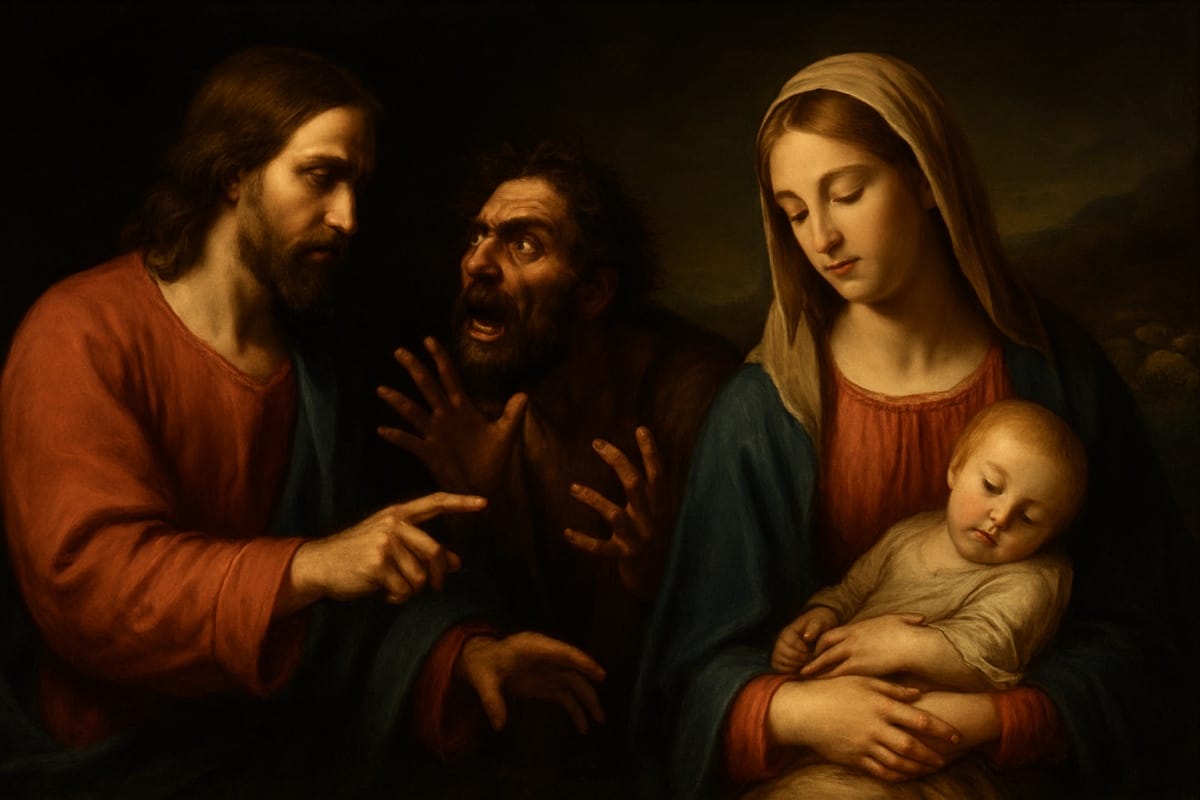
Et ecce clamaverunt, dicentes: Quid nobis et tibi, Fili Dei? Venisti huc ante tempus torquere nos?
Mt 8:29
The episode of the demoniacs of Gadara (Mt 8:28-34) is one of the strangest and most disturbing in the Gospels, and one that contemporary exegesis tends to soften or to reread in a purely psychological key, losing the theological density that Matthew gives it. Two men with unclean spirits come out of the tombs, so fierce that no one could pass along that road, and they immediately recognize who Jesus is: “What have we to do with you, Son of God? Have you come here to torment us before the time?” (Mt 8:29). This recognition, the most explicit Christology in the episode, comes from the demons, not from the disciples: the spirits of evil recognize the Son of God with a precision the disciples have not yet attained.
The scene has a threefold structure that Matthew composes with precision: the recognition (v. 29), the request (v. 31, “if you cast us out, send us into that herd of swine”), and the outcome (vv. 32-34: the swine plunge into the lake, the herdsmen flee, the inhabitants ask Jesus to leave). The most disturbing outcome is not the death of the swine; it is that the inhabitants of the region, on seeing what had happened, “begged Him to leave their territory” (v. 34). The deliverance of two men from possession was met not with joy but with a request that He go away: the Liberator had disturbed the established order too much.
I. “Son of God”: the demons know what the disciples are still learning
The paradox of demonic recognition runs through the Gospels: in Mark, an unclean spirit in the synagogue at Capernaum proclaims, “I know who you are, the Holy One of God” (Mk 1:24). The demons cast out in Lk 4:41 “knew that He was the Christ”. This demonic knowledge is different in nature from human faith: it is recognition without adherence, knowledge without love, certainty without conversion. The devil knows that God exists (as James observes, “the demons also believe, and tremble”, Jas 2:19), but that knowledge does not save him, because it does not transform him.
“Have you come here to torment us before the time?” (Mt 8:29): the reference to “the time” is eschatological. The demons know that there is an appointed moment for their definitive judgment, and that this moment has not yet come. For them, Jesus’ presence is a “before the time”, an anticipation of the end they dread. This eschatological awareness on the part of the spirits of evil is theologically rich: evil itself recognizes that history has an end, that this end is God’s judgment, and that Jesus’ presence signals that the end is near. What the disciples learn through faith, the demons know through terror.
The identification of Jesus as “Son of God” by the demons of Gadara anticipates Peter’s confession in Mt 16:16 and that of the disciples after the calming of the storm (Mt 14:33: “Truly you are the Son of God”). Matthew uses the demons’ recognition as an ironic counterpoint to human incomprehension: those who ought to recognize Him do not. Those who ought to be ignorant of Him recognize Him with trembling. This irony has a pedagogical purpose: to make the reader ask, “And I, where do I stand on this spectrum? With those who recognize Him in faith, or with those who refuse Him out of convenience, like the inhabitants of Gadara?”
In the Marian tradition, Mary is the human being who responded to the “Son of God” with the most complete faith, unlike the demons, who recognize Him without loving Him, and unlike the inhabitants of Gadara, who ask Him to leave out of economic interest. Mary’s “fiat” is the most complete human response to the announcement “you will be the mother of the Son of the Most High”: not trembling (like the demons), not refusal (like the Gadarenes), but welcome: “let it be done to me according to your word” (Lk 1:38).
II. The demons’ request and Jesus’ permission
“The unclean spirits came out and entered the swine” (Mt 8:32): Jesus grants the demons’ request to enter the swine, with the result that two thousand swine plunge into the lake. Jesus’ permission raises the theological question of divine action with regard to evil: God does not cause evil, but He can permit evil to run its course within limits that God Himself sets. The “before the time” of v. 29 is the eschatological limit. The permission regarding the swine is the operational limit. Evil acts within the space that divine sovereignty allows it, and not beyond.
The destruction of the swine as a consequence of the demons’ entering them reveals the destructive nature of evil when it is permitted to act: demonic action is neither creative nor ordered; it is always destruction, dissolution, a plunge into the abyss (the waters of the lake are the realm of chaos, as in the storm of Mt 8:23-27). When the demons leave the men, the men are set free. When they enter the swine, the swine perish. This asymmetry is theologically significant: the evil that goes out of the human being, who has a soul and is the image of God, does not have the same destructive power as evil has over animals that lack this ontological dimension.
The reaction of the inhabitants, who ask Jesus to go away, is the second expulsion in the episode: first the demons are expelled from the men; then the inhabitants call for Jesus to be expelled from their territory. The parallel is disturbing: those who had been possessed implicitly ask to stay with Jesus (Mt 8:34: Matthew says that “the whole city came out to meet Jesus”, without saying that they asked Him to leave, but the request comes from the city). Those who were free ask the Liberator to go away. The economy of the swine (probably owned by Gentiles, since Jews did not raise swine) weighed more heavily than the deliverance of two men.
Mary never asked Jesus to go away, even when His presence disturbed the established order of her life. The flight into Egypt (Mt 2:13-15), the loss of Jesus in the Temple (Lk 2:41-51), the request at Cana before “His hour” (Jn 2:4): at each of these moments when Jesus upset Mary’s expectations, she did not ask Him to leave, but attuned her heart to what He was and what He did. This readiness to be disturbed by Jesus’ presence, which the Gadarenes lacked, is one of the most remarkable traits of Marian discipleship.
III. Maria virgo potens: the Immaculate One and the victory over evil
The Litany of Loreto invokes Mary as “Virgo Potens”, Virgin Most Powerful. This title does not refer to political or military power: it is the power of grace that overcomes evil from the very origin. The dogmatic definition of the Immaculate Conception (Pius IX, “Ineffabilis Deus”, 1854) affirms that Mary was “preserved free from all stain of original sin”, that is, that the “gates of the Abyss” (the demons of Gadara and what they represent) never had any power over her. Mary is the human being in whom the “Son of God” confessed by the demons of Gadara (“you have come to torment us”) had full effect from the first moment of her existence.
Genesis 3:15, “I will put enmity between you and the woman, between your offspring and her offspring”, has been interpreted by tradition as the first announcement of Mary’s victory over evil: the “enmity” between the woman and the serpent prefigures the Immaculate One, who was conceived without the serpent having any power over her. Mary did not overcome evil by her own strength; she was preserved by the grace of the Son whom she was to bear. But the preservation is real: whereas the demons of Gadara had access to the men’s bodies and to the lives of the swine, they never had access to Mary’s being.
Marian devotion as a spiritual resource against the forces of evil (the praying of the Rosary, blessings with medals of Mary, Marian shrines as places of deliverance) rests on this theological foundation: Mary, who was preserved from the power of evil, can intercede in an especially effective way for those who struggle against that same power. It is neither magic nor superstition; it is the logic of intercession: whoever has conquered can help others to conquer. Whoever has been healed can be a physician. Whoever has been set free can be a liberator.
The inhabitants of Gadara asked Jesus to leave because His presence disturbed their economy. Authentic Marian devotion does not ask Jesus to leave; it asks Mary to keep Him present even when His presence is disturbing. “Virgo Potens” is she who kept Jesus present even on Calvary, when all the others asked (by fleeing) that His presence come to an end. Mary’s power is not a power that drives the Son away but a power that keeps Him present: the presence that sustains the Son’s presence where fear and self-interest sought to eliminate it.
Postgraduate Program in Mariology
Would you like to deepen your formation in Mariology? Discover the Postgraduate Program in Mariology of Locus Mariologicus, an academic formation that unites theological rigor, spiritual life, and the living tradition of the Church.
Would you like to study angelology and demonology in depth?
This article comes from the Locus Mariologicus library. The postgraduate specialisation in Angelology and Demonology (360 hours, fully online) studies angels and demons in Scripture, the Fathers and the Magisterium, with a whole area on practical demonology, exorcism and deliverance prayer. The new class begins on 18 January 2027. Classes are taught in Portuguese.





Responses