“Scoptúi te vixísti”: Capernaum, Louis IX, and Mary in Spiritual Warfare
Quid nobis et tibi, Iesu Nazarene? […] Scio te quis sis: Sanctus Dei.
Lk 4:34
The Tuesday of the Twenty-Second Week unites Paul’s spiritual epistemology with Luke’s spiritual warfare: in 1 Cor 2, “we have the mind of Christ” (v.16) means that the Spirit reveals what no human wisdom attains. In Lk 4, the unclean spirit of Capernaum recognizes Jesus precisely when the disciples have not yet confessed Him. It coincides with the feast of Saint Louis IX, whose reign translated the “mind of Christ” into the exercise of temporal power.
I. The First Reading: 1 Cor 2:10b-16
Paul distinguishes two forms of knowledge: that of the “natural man” who “does not receive the things of the Spirit of God” (v.14) and that of the “spiritual man” who discerns all things by the Spirit who dwells in him. The foundation is participation in the Son’s knowledge of the Father: “no one has known what belongs to God except the Spirit of God” (v.11), and the believer receives that Spirit.
The corollary, “we have the mind of Christ” (v.16), is not epistemological arrogance but an affirmation of the new life in Baptism. The believer who lives in the Spirit begins to see reality with the eyes of Christ. It is this discernment that explains how the disciples slowly recognize what the unclean spirit of Lk 4:34 recognizes at once: “the Holy One of God”.
II. The Gospel: Lk 4:31-37
The scene at Capernaum is paradoxical: the “Holy One of God” is recognized first by an unclean spirit, while the crowd marvels only at the authority of the teaching (v.32). The devil knows who Jesus is. The crowd does not yet. The enemy’s perverse recognition precedes the recognition of faith, because faith demands a conversion that the demonic instinct does not need.
The silence imposed on the unclean spirit, “be silent and come out of him” (v.35), is Luke’s “messianic secret”: Jesus does not accept the testimony of one who cannot be a disciple. Recognition without obedience is not faith. It is merely identification. The true confession of Christ demands the interior conversion that the spirit of Capernaum refuses.
III. Saint Louis IX: The “Mind of Christ” in the Exercise of Power
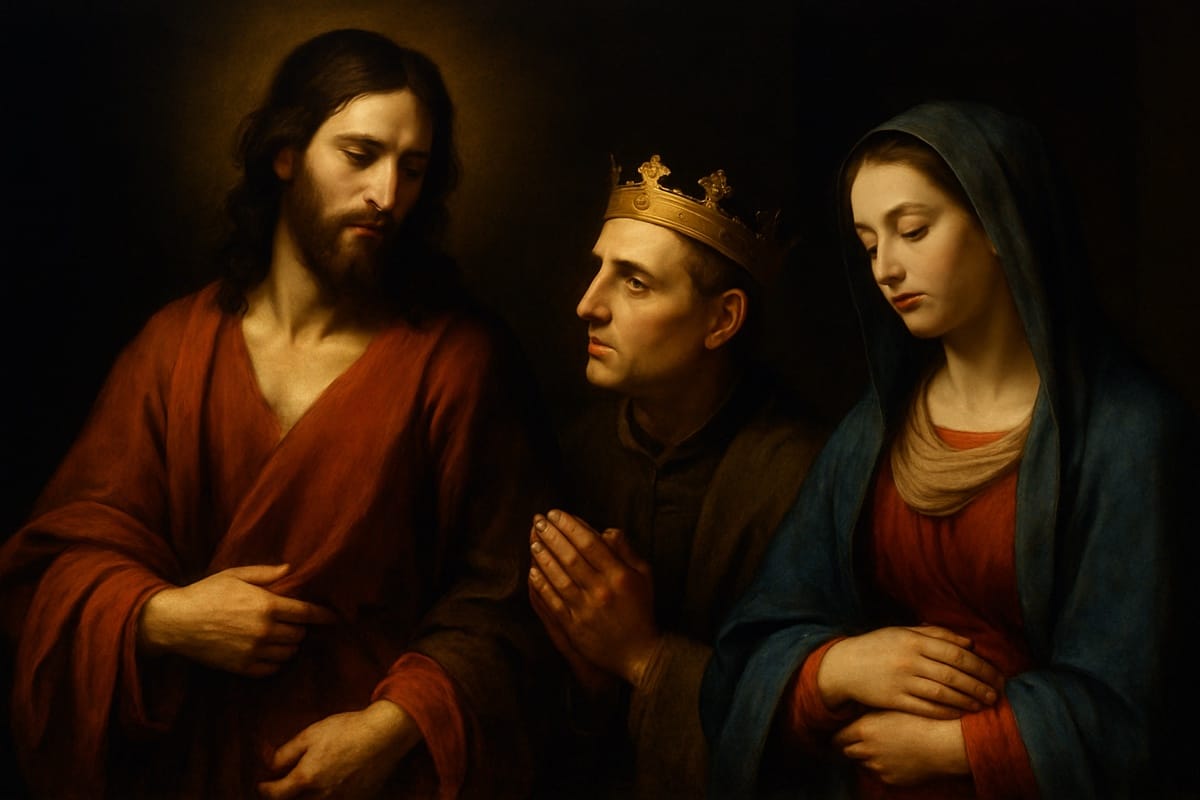
Louis IX of France (1214-1270) is the historical paradigm of “we have the mind of Christ” applied to temporal power. A king who administered justice personally under an oak at Vincennes, who founded hospitals and the Sainte-Chapelle, demonstrated that governance can be exercised with the mind of Christ without losing political effectiveness. His canonization (1297) recognized in royal holiness not a compromise but an achievement.
The Mariology of Louis IX was centered on devotion to Our Lady of Victory. He understood that the “mind of Christ” is learned in the school of Mary, who kept in her heart what the disciples were slow to understand (Lk 2:19). The Lady from whom the Son received His humanity is also the teacher who teaches humanity to receive the Son.
IV. Mary: The One Who Had the “Mind of Christ” Before All Others
Paul’s “we have the mind of Christ” finds in Mary its most perfect realization: she who dwelt with Christ for thirty years, who “kept and pondered in her heart” (Lk 2:51). Mary did not possess total knowledge in advance, but she had the disposition that allows the Spirit to reveal what the “wise of this world” do not attain.
The Tuesday of the Twenty-Second Week poses the unclean spirit’s question in reverse: do you know who Jesus is? Paul says yes, through the Spirit we have received. Mary says yes, through the intimacy of an entire lifetime. Louis IX says yes, through the practice of justice and mercy. The spiritual discernment of 1 Cor 2 is not a theory: it is a life that lets itself be shaped by the “mind of Christ” until it sees the world as He sees it.
Postgraduate Program in Mariology
Would you like to deepen your formation in Mariology? Discover the Postgraduate Program in Mariology of Locus Mariologicus — an academic formation that unites theological rigor, spiritual life, and the living tradition of the Church.
Would you like to study Mariology seriously?
This article grows out of the works in the Locus Mariologicus library. The Postgraduate Program in Mariology takes you to the same source, with academic guidance: Scripture, the Fathers of the Church, and the Magisterium, from the first dogma to contemporary questions.




Responses