“Decollatus est in carcere”: John the Baptist, Martyrdom, and the Sword of Simeon
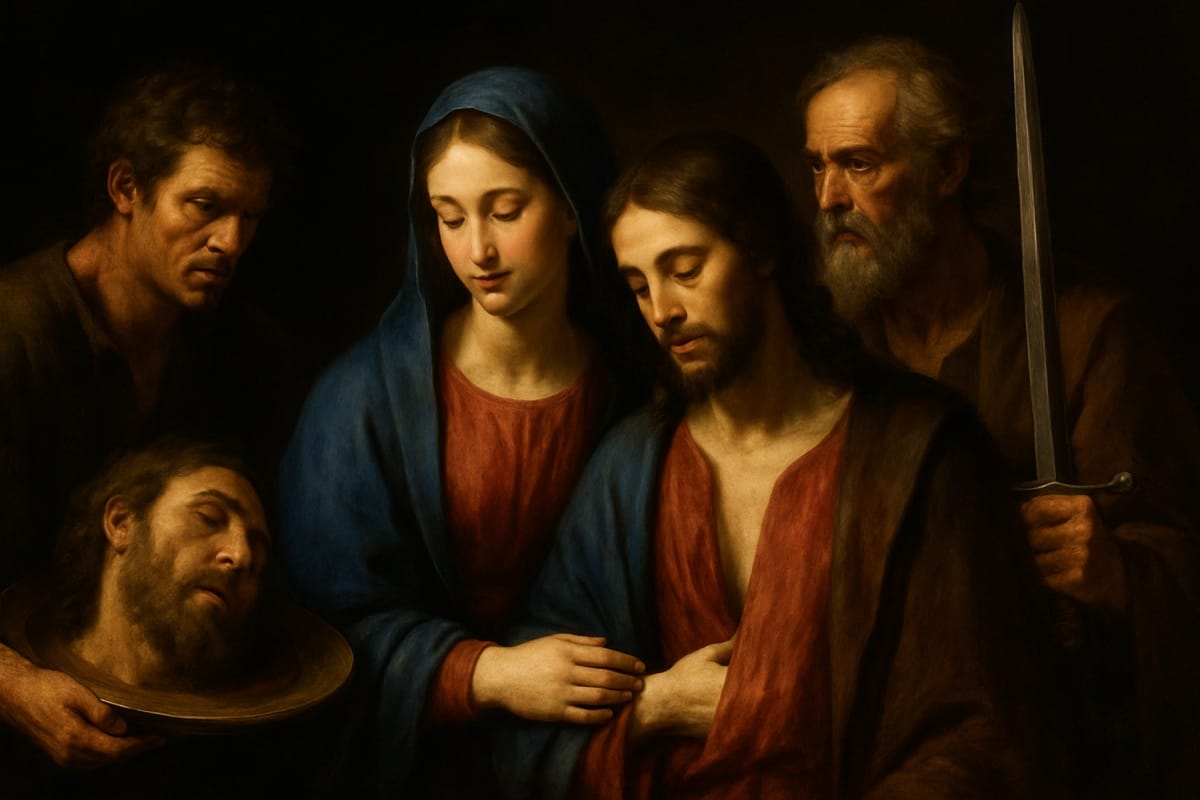
Et misso spiculatore praecepit adferri caput eius in disco. Et decollavit eum in carcere.
Mk 6:27
The memorial of the Martyrdom of Saint John the Baptist unites two texts on prophetic fidelity before power: in Jer 1:17-19, God exhorts Jeremiah not to be afraid because “I am with you to deliver you” (v.19). In Mk 6:17-29, John the Baptist is executed for having said to power what power did not want to hear. Mary, who “stood by the Cross” (Jn 19:25), lived the same fidelity that John proclaimed with his life and with his death.
I. The First Reading: Jer 1:17-19
The call of Jeremiah sets out the structure of every prophetic vocation: “do not be ashamed before them, lest I shame you before them” (v.17). Courage is not an autonomous virtue but a consequence of the divine presence: “I am with you to deliver you” (v.19). The prophet is sustained by the One who sends him. When that support seems to fail, the prophet falls. When the support is real, even death is victory.
The promise, “this day I make you a fortified city, a pillar of iron” (v.18), does not promise the absence of suffering but interior indestructibility. The kings, princes, and priests “will fight against you but will not prevail” (v.19). John the Baptist died by beheading. But he was not defeated. Apparent defeat is the highest form of the fulfillment of the prophetic promise.
II. The Gospel: Mk 6:17-29
Mark constructs the scene with dramatic precision: Herod, who “feared John and protected him” but was dominated by Herodias. The banquet, the dance, the rash oath, the head demanded and brought on a platter. The tragic irony is complete: the tetrarch who knew that John was “righteous and holy” (v.20) let the logic of the feast and of pride dictate what the logic of conscience forbade.
The final note, John’s disciples came to take the body and “went and told Jesus” (v.29), is the link between the martyrdom of the Precursor and the mission of the Messiah. John was sent to prepare the way. He died on the way he had prepared. His death was not an accident but the fulfillment of his function: the precursor who opens the way is the first to walk it to the end.
III. The Prophet Who Told Power What Power Did Not Want to Hear
John the Baptist embodied the “do not be ashamed” of Jer 1:17 in its most literal form: he told Herod Antipas what was morally true, “it is not lawful for you to have your brother’s wife” (Mk 6:18), without calculating the political consequences. This fidelity to the truth without calculation of consequences is the mark of the authentic prophet: not the one who says what is expedient, but the one who says what is true, regardless of the audience.
The Christian tradition has seen in John’s martyrdom the prototype of every martyrdom for the witness of moral truth: not only faith as belief, but faith as an ethical demand that confronts power. The martyrs of the twentieth century, from Maximilian Kolbe to Óscar Romero, walked the same road: the true word spoken to a power that did not want to hear it, with the readiness to pay the price.
IV. Mary: The Sword of Simeon and Fidelity to the Condemned Son
Simeon prophesied to Mary: “a sword will pierce your soul” (Lk 2:35). The memorial of John the Baptist illuminates the content of this sword: not generic psychological sorrow, but the specific sorrow of seeing the truth condemned by power. Mary witnessed the condemnation of her Son by authorities who knew, as Herod knew about John, that they were condemning Him unjustly.
The feast of the Martyrdom of John the Baptist poses the question of the quality of our fidelity: do we stand firm when what we defend is not popular? John the Baptist, who lost his head for telling the truth; Mary, who remained standing when everyone fled; Jeremiah, who was thrown into the cistern for proclaiming what God had sent: these are the model of the fidelity that does not depend on applause. The promise of Jer 1:19 is the only reason for this fidelity: “I am with you to deliver you”.
Postgraduate Program in Mariology
Would you like to deepen your formation in Mariology? Discover the Postgraduate Program in Mariology of Locus Mariologicus — an academic formation that unites theological rigor, spiritual life, and the living tradition of the Church.
Responses