Dedication of Saint Mary Major: the first Marian shrine of Rome
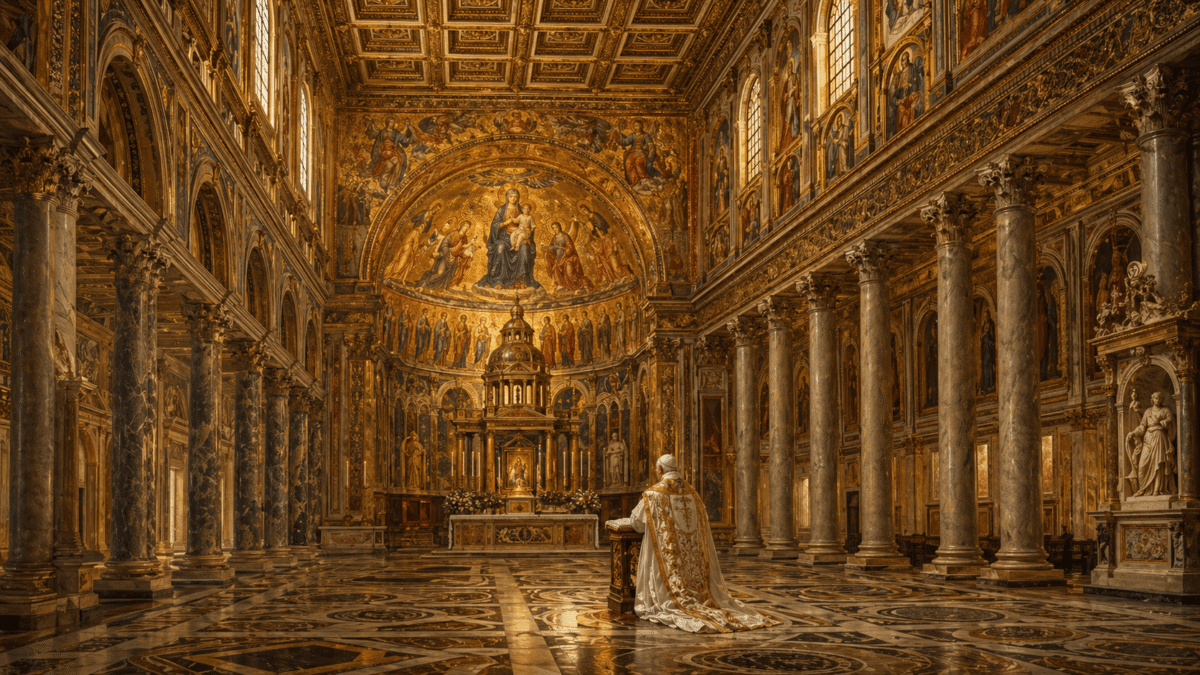
Dedication of Saint Mary Major, the first Marian shrine of Rome
The Basilica of Saint Mary Major is considered the first and most magnificent Marian shrine of Rome. Its dedication is celebrated on August 5 and recalls the construction of this basilica by Sixtus III (432-440) immediately after the Council of Ephesus (431) as a monument of praise to the divine motherhood of Mary, to the Theotokos.
Historical origin and the legend of the snow
A charming popular tradition attributes the construction of the basilica to a miraculous snowfall on the Esquiline Hill on August 5, under the pontificate of Liberius (352-366). Historically, however, the basilica that has come down to us was erected by Sixtus III (432-440), exactly one year after the solemn proclamation of the dogma of the divine motherhood at the Council of Ephesus. The liturgical reform of the Second Vatican Council replaced the ancient title “Santa Maria ad Nives” with the present one, “Dedication of the Basilica of Saint Mary Major,” underscoring the theological value of the building rather than the legendary narrative.
The triumphal arch and the fifth-century mosaics
The most precious artistic element of the basilica is the fifth-century triumphal arch, which constitutes a glorification of the divine motherhood in the perspective of the whole history of salvation. At the center, the throne of the Lord with the “crux gemmata” and, on both sides, scenes of the Annunciation, of the Presentation in the Temple, of the Magi, and of the cities of Bethlehem and Jerusalem, representing the beginning and the end of the earthly life of Jesus, as well as the birth of the Church. In both cities Mary is present and active.
The “Salus populi romani”
The Virgin Theotokos is venerated in a particular way in this basilica under the expressive title of “Salus populi romani” (“Health of the Roman People”). Her image, displayed in the Pauline Chapel (built at the order of Paul V, 1605-1621), is one of the most venerated Marian icons of Rome. Bound up with it is the memory of the cessation of a pestilence under Gregory the Great (590) and the devotion of John Paul II, who visited the basilica every year on the Solemnity of the Immaculate Conception in order to entrust the Church to the Virgin.
Mary, temple of God and new Jerusalem
The renewed liturgy invites a profound theological meditation: the terms “dedication” and “church” applied to Mary reveal that she is the virgin “dedicated exclusively to the Lord” and, at the same time, the image and the origin of the Church. Mary is “the most perfect realization of the Church in a single individual” (SC 103). The new Jerusalem of the Apocalypse (21:1-5) finds in Mary its highest realization: she adhered totally to God in her virginity, becoming a mother in heart and in body. The material temple dedicated to Mary is an image of Mary as the living temple of the Holy Spirit.
Deepen your studies: explore Mariology, Mother of God, Marian Theology, and the Postgraduate Program in Mariology.
Magisterium of the Church
Basilica Sanctae Mariae Maioris in Esquilino, prima omnium et maxima ecclesia in Occidente Deiparae dedicata, anno CCCCXXXII a Sixto III aedificata est post Concilium Ephesinum.
Liber Pontificalis, Vita Sixti III (saec. V)
📚 Literal translation: The Basilica of Saint Mary Major on the Esquiline, the first and greatest of all the churches dedicated to the Mother of God in the West, was built in the year 432 by Sixtus III after the Council of Ephesus.
Postgraduate Program in Mariology
Would you like to deepen your formation in Mariology? Discover the Postgraduate Program in Mariology of Locus Mariologicus — an academic formation that unites theological rigor, spiritual life, and the living tradition of the Church.
Would you like to study Mariology seriously?
This article grows out of the works in the Locus Mariologicus library. The Postgraduate Program in Mariology takes you to the same source, with academic guidance: Scripture, the Fathers of the Church, and the Magisterium, from the first dogma to contemporary questions.





Responses