You Are Peter: Is 22, Rom 11, and the Confession of Caesarea Philippi in Mt 16
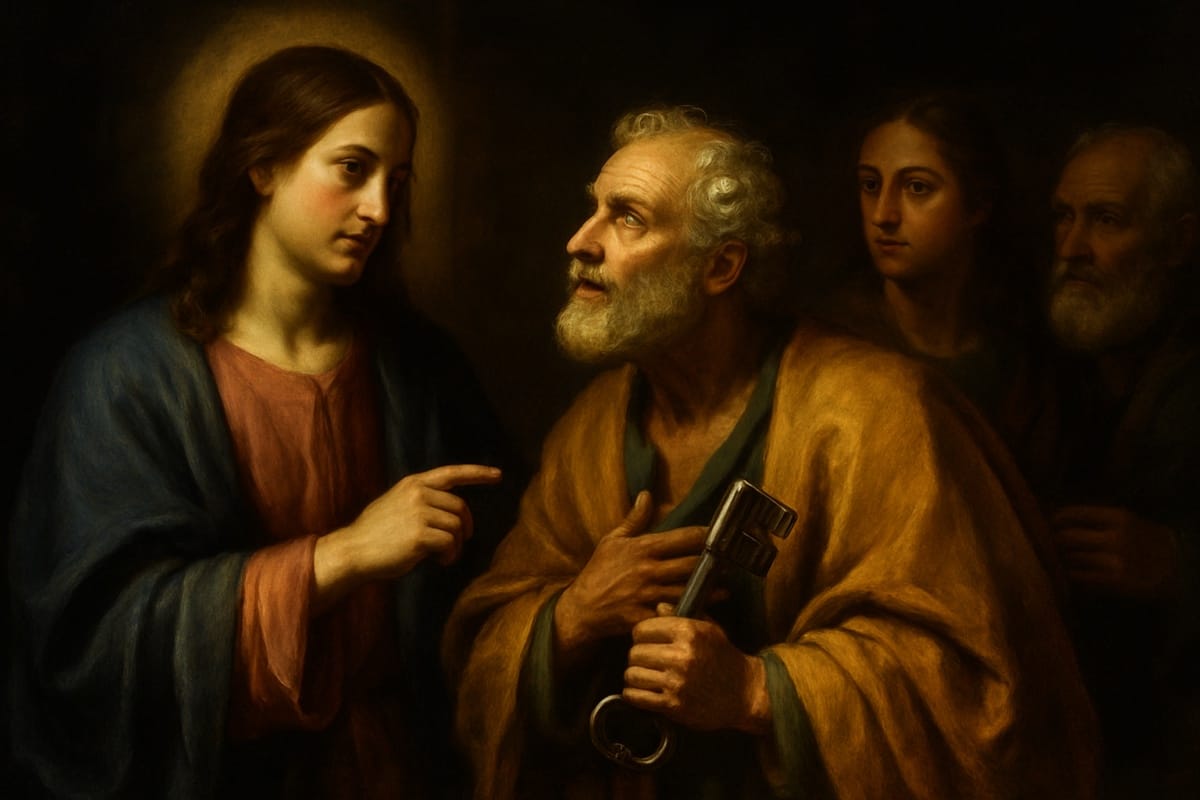
Tu es Petrus, et super hanc petram aedificabo Ecclesiam meam.
Mt 16:18
The Twenty-First Sunday in Ordinary Time, Year A, brings together three texts centered on the authority conferred by God and on the confession of faith that founds the Church. Is 22:19-23 describes the transfer of the key of the house of David: taken from Shebna, it is placed upon the shoulder of Eliakim, with full power to open and to shut. Rom 11:33-36 concludes Paul’s great meditation on Israel and the Gentiles with a doxology: the depth of the wisdom and the knowledge of God is unfathomable. Mt 16:13-20 recounts the confession of Peter at Caesarea Philippi: “You are the Christ, the Son of the living God,” and the answer of Jesus: “You are Peter, and upon this rock I will build my Church.” The three texts converge: God acts in history through choices that exceed human prediction, conferring authority upon those He chooses and founding upon that choice structures that endure.
I. The First Reading: Is 22:19-23
The Lord addresses Shebna, the steward of the royal household: “I will thrust you from your office” (Is 22:19). In his place, Eliakim the son of Hilkiah: “I will place the key of the house of David upon his shoulder. What he opens, no one shall shut. What he shuts, no one shall open” (v. 22). The key upon the shoulder is the symbol of delegated authority: Eliakim does not act by his own right but by commission of the king. And the authority is full: he opens and shuts without possibility of appeal. The replacement of Shebna by Eliakim is not merely an administrative change: it is the sign that God acts in history, removing those who fail and raising up those who serve. The key of the house of David will appear again in the Apocalypse (3:7), applied to Christ Himself, and will resound in the “O Clavis David” of the Advent antiphons.
II. The Second Reading: Rom 11:33-36
Paul ends his meditation on Israel and the Gentiles with a doxology of four verses that is one of the most beautiful texts of the New Testament: “O the depth of the riches, of the wisdom and of the knowledge of God! His judgments are unsearchable and his ways inscrutable! Who has known the mind of the Lord? Or who was his counselor”? (Rom 11:33-34). And the Trinitarian conclusion: “From Him, through Him and for Him are all things. To Him be the glory forever and ever. Amen” (v. 36). The doxology is not an evasion: it is the honest recognition that human thought cannot encompass the ways of God. The three preceding chapters of Rom 9-11, with all their theological complexity concerning election and rejection, end not in a logical conclusion but in an act of adoration. When the intellect has reached its limit, the only fitting act is praise.
III. Evangelium: Mt 16:13-20
At Caesarea Philippi, Jesus questions the disciples: “Who do men say that the Son of Man is”? (Mt 16:13). The answers vary: John the Baptist, Elijah, Jeremiah, one of the prophets. Jesus sharpens the question: “And you, who do you say that I am”? (v. 15). Peter answers: “You are the Christ, the Son of the living God” (v. 16). Jesus declares him blessed: “It was not flesh and blood that revealed this to you, but my Father who is in heaven” (v. 17). And then the founding act: “You are Peter, and upon this rock I will build my Church, and the gates of hell shall not prevail against it. I will give you the keys of the Kingdom of Heaven: whatever you bind on earth shall be bound in heaven, and whatever you loose on earth shall be loosed in heaven” (vv. 18-19). The keys of the Kingdom of Heaven echo the key of the house of David in Is 22: the same structure of delegated authority, the same impossibility of reversal on the human side. The confession of Peter is not a merit of his own: it is a revelation received. The rock upon which the Church is built is not the virtue of Peter but the faith that God worked in him.
IV. Mary and the Key of David
The Advent antiphon “O Clavis David,” based on Is 22:22, is addressed to Christ: “O Key of David, O Scepter of the house of Israel, you who open and no one shuts, you who shut and no one opens: come and lead forth from prison the captive who sits in darkness and in the shadow of death.” The Key of David is Christ. But Mariology has seen in Mary the one who opens the door to the coming of the Son: like Eliakim, who received the delegated key, Mary received the delegated mission of bringing into the world the One who has the power to open and to shut. The doxology of Rom 11:33-36 resounds with the Magnificat: where Paul exclaims “his judgments are unsearchable and his ways inscrutable,” Mary sings “he who is mighty has done great things” (Lk 1:49). Both arrived at the same point: at the limit of what can be understood, and there they adored. Peter and Mary are the two pillars of the Church: Peter with the authority of the keys, Mary with the intercession of a mother’s heart. The confession “You are the Christ, the Son of the living God” was pronounced first by Peter, but lived first by Mary, who bore Him, raised Him, and followed Him to the Cross.
Postgraduate Program in Mariology
Would you like to deepen your formation in Mariology? Discover the Postgraduate Program in Mariology of Locus Mariologicus — an academic formation that unites theological rigor, spiritual life, and the living tradition of the Church.




Responses