Holy Mary, Disciple of the Lord
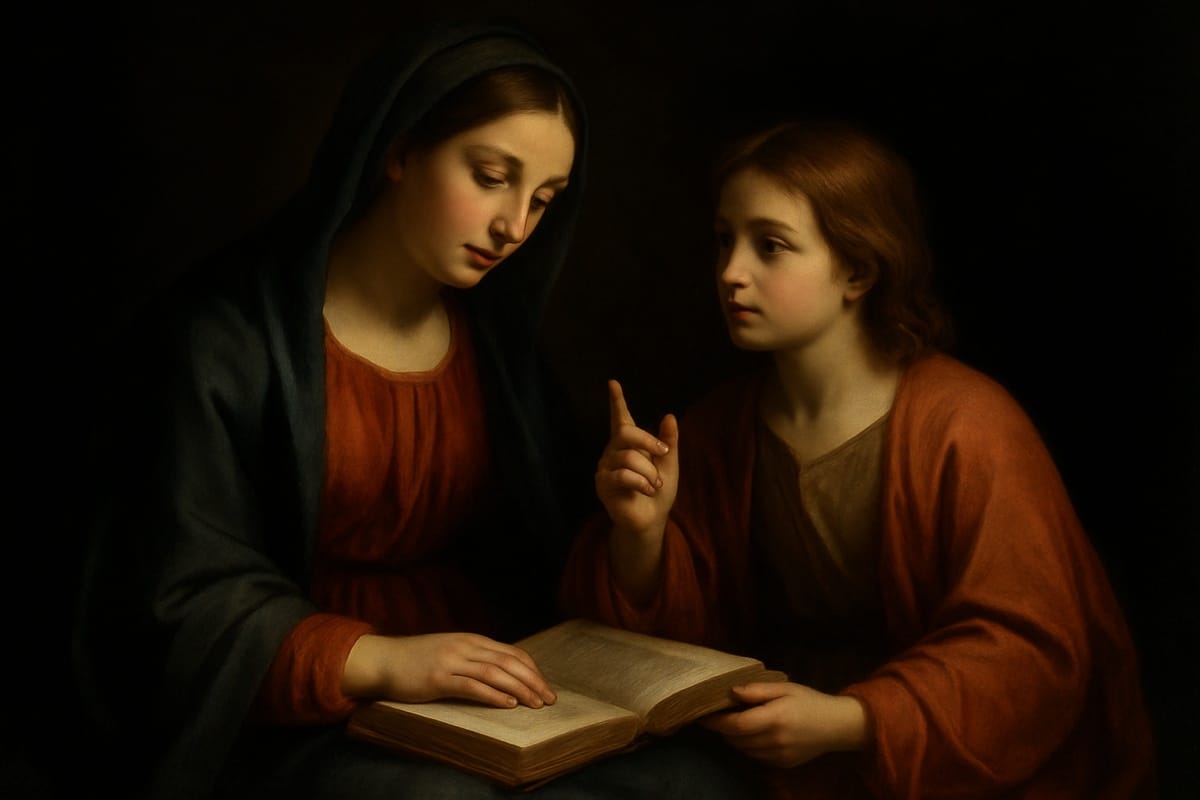
“Beati qui in verbo eius morantur et in iustitia eius meditantur”. “Blessed are those who dwell in his word and meditate on his justice”. (Sir 14:20)
I. The Search for Wisdom: The Spiritual Itinerary of Sirach 51
The final canticle of Sirach, which constitutes the reading of this Mass, is the testimony of a man who found Wisdom after having sought her with all the intensity of which he was capable. “When I was still young, even before I set out on my travels, I sought Wisdom openly in my prayer. Before the temple I asked for her, and I will seek her until the end” (Sir 51:18-19). Ben Sira’s itinerary is the itinerary of every soul that takes the search for God seriously: it begins in youth, it is nourished by prayer, it is oriented toward the temple as the space of the divine-human encounter, and it does not cease as long as life lasts. The persistence of this search is itself a form of love, the love that is not satisfied with what is superficial and that does not give up when the road becomes difficult.
At the end the sage invites the young to come and learn from him: “Come to me, you who have not been instructed, and take your place in the house of teaching” (Sir 51:23). This invitation does not come from a proud master displaying his erudition: it comes from a disciple who has learned and wants to share what he has learned. The wisdom that Ben Sira found is not his own property: it is a good that multiplies as it is handed on, that grows as it is shared, that never diminishes in the one who gives it because it is always greater than any human capacity to contain it. Mary is the most perfect icon of this wise discipleship: she who “kept all these things, pondering them in her heart” (Lk 2:19, 51) is the one who has learned the most and the one who has the most to hand on.
II. From the Sage Who Seeks to the Child Who Teaches
The scene of Jesus in the temple, recounted in the second chapter of Luke, is the only episode of Jesus’ childhood and adolescence that the Gospels have preserved, and its exceptional character makes it all the more significant. The twelve-year-old boy who goes up to Jerusalem for the Passover with His parents is not an ordinary adolescent taking advantage of the journey to explore the city: He is the one in whom “the Wisdom of God” dwells substantially, who goes to the temple not as a tourist but as a son returning to His Father’s house. His remaining among the teachers, listening to them and questioning them, has the structure of discipleship: He listens before speaking, He learns before teaching. But the answers He gives reveal an understanding that no human teacher could have imparted.
Mary and Joseph, who were seeking their lost son with the anguish of the three days of searching, finally find Him in the temple. Mary’s question is the most human and most maternal question one could imagine: “Son, why have you done this to us? See how your father and I were searching for you, full of anguish”! (Lk 2:48). Jesus’ answer, “did you not know that I must be about my Father’s business”? (Lk 2:49), reveals the abyss that at times exists between human perception and the divine perspective, even in the heart of the one who loves most. And the text immediately adds that “they did not understand what he said to them” (Lk 2:50). Mary did not understand. And even so she keeps all these things, because faith can exist where understanding has not yet arrived.
III. The Discipleship of Mary: Hearing, Keeping, Meditating
The portrait of Mary as disciple of the Lord is not a later theological construction: it is inscribed in the very text of Luke’s Gospel which, at two parallel moments (Lk 2:19 and 2:51), describes Mary as the one who “kept all these things in her heart”. The verb to keep, in the biblical context, always carries the connotation of faithful custody: one keeps what is precious, one keeps what one does not want to lose, one keeps what one wants to be able to recover when the moment is right. Mary keeps the mysteries of her Son as a treasure that she knows is worth more than she understands, a treasure whose full riches will be revealed progressively throughout the history of salvation.
Mary’s discipleship is not passivity: it is the most active and most intense form of relationship with the Word of God that a human creature can attain. Jesus will define the authentic relationship of spiritual kinship with Him not by biological blood ties, but by the practice of the Word: “My mother and my brethren are those who hear the Word of God and do it” (Lk 8:21). Mary is the Mother of Jesus both biologically and spiritually: she heard the Word at the moment of the Annunciation, she practiced it throughout her whole life, she kept it in her heart with a fidelity that no incomprehension or suffering was able to break. That is why she is the most perfect model of Christian discipleship.
IV. Mary, Teacher of Discipleship for the Church
The tenth Mass of the Collection, the first for the Season of Lent, proposes Mary as the model of Lenten conversion in its deepest aspect: discipleship of the Word. Lent is the season in which the Church is invited to renew her listening, to deepen her relationship with the Scriptures, to let the Word of God penetrate more deeply and transform more radically. And the model of this transforming listening is Mary, the perfect disciple who heard, kept, and meditated as no other creature did.
Ben Sira invited the young to “take their place in the house of teaching”: Mary took her place in the house of the Son of God from the first moment, and never left it again. Every sentence Jesus spoke, she kept. Every gesture He made, she pondered. Every mystery she did not understand at the time, she preserved like a seed awaiting its season of germination. The Church that celebrates this Mass is invited to learn from Mary what it means to be truly a disciple: not the accumulation of theological knowledge, but persevering listening, faithful keeping, the prayerful meditation of the mysteries of a love that surpasses all understanding.
Postgraduate Program in Mariology
Would you like to deepen your formation in Mariology? Discover the Postgraduate Program in Mariology of Locus Mariologicus – an academic formation that unites theological rigor, spiritual life, and the living tradition of the Church.
Would you like to study Mariology seriously?
This article is born of the works in the library of Locus Mariologicus. The Postgraduate Program in Mariology brings you to the same source, with academic guidance: Scripture, the Fathers of the Church, and the Magisterium, from the first dogma to contemporary questions.





Responses