The Virgin of Advent

Introduction
Advent is a word dear to the Catholic Church, for it powerfully signifies the time of preparation for Christmas, inviting the faithful to remember the birth of Christ not as a mere historical event, but as a decisive experience of faith. Advent is not only the period of the year that precedes December 25, but a time of waiting and, at the same time, of the coming of Jesus Christ, awaited yesterday, today, and always, for He is the One who came, who comes, and who will come. Advent, then, is characterized as a time of waiting that does not disappoint, a time of conversion, of a welcoming readiness that becomes unceasing praise, of a joyful hope that is transformed into love and prayer, of wonder that leads to contemplation. The believer awaits, with vigilance and with the heart of one betrothed, the coming of Christ in the humility of our flesh, and prepares to meet Him in glory.

The liturgy of the Advent season thus celebrates the two comings of Christ the Lord: the first, in humble silence, when the Son of God, in the fullness of time (cf. Gal 4:4), took flesh in the womb of the Virgin Mary. The second, in glory, when, at the end of time, Christ will return to judge the living and the dead and to lead the righteous to the Father’s house, where the Virgin has gone before them and from where she continually intercedes for them. Within this unique perspective, which embraces both the beginning and the fulfillment of salvation history, the Church frequently turns her gaze of faith to Mary, invoking her help on the path of conformity to Christ and in adopting the same attitudes that she lived in the expectation and the coming of Christ the Lord.
Mary in the Advent Liturgy
The lights shed on the mystery of Mary during the Advent season are found in the biblical pages of the Lectionary and in the presidential prayers of the Missal, which introduce, accompany, and conclude each Eucharistic celebration. These prayers include the opening prayer, called the “Collect,” the “Prayer over the Offerings” (or super oblata), and the “prayer of thanksgiving” (or Prayer after Communion). Attention to these prayer texts is, according to liturgists, an essential starting point for a Marian spirituality centered on liturgical prayer. The constant reading and meditation of these prayers, distributed across the various moments of the liturgical celebration, enrich the faithful spiritually, for the features of Mary’s face help to renew the memory of faith and to direct one’s actions in an authentic Christian spirit.
Western Marian euchology is not restricted to the texts of the Eucharistic celebration, but extends to the Liturgy of the Hours, with elements such as psalms interspersed with antiphons, readings followed by responsories, hymns, and intercessory prayers. These texts, handed down since antiquity, give the Virgin a special place and are effective instruments for prayer, for the formulation of the faith, for spiritual deepening, and for the ordering of Christian life. Advent, besides being a celebration of the expectation of the Messiah, is also an opportunity to rediscover Mary as the model of the spirit with which the Church celebrates and lives the divine mysteries (cf. Marialis cultus 16). This season recalls the figure of the Mother of the Messiah, who is progressively revealed in the prophecies, figures, and symbols of the liturgy.
In Advent, significant prophecies about Mary stand out, such as Genesis 3:15 (the Protoevangelium, which mentions the enmity between the woman and the serpent), Isaiah 7:14 (the prophecy of the virgin who will conceive a son called Emmanuel), Isaiah 11:1 (the shoot of the Davidic line), and Micah 5:1-2 (the woman who is to give birth in Bethlehem). In addition to the prophecies, the liturgy presents figures of mothers who prefigure Mary, such as Ruth, the devout Moabite; the wife of Manoah, mother of Samson; Hannah, mother of Samuel; and Elizabeth, mother of John the Baptist. These extraordinary motherhoods, the fruit of divine intervention, foreshadow the even more wondrous motherhood of Mary of Nazareth.
The Advent liturgy also uses symbols to celebrate Mary, such as the earth (the primordial maternal womb from which the Savior springs forth), the gate (which leads to the new condition of salvation), the house (the safe and happy dwelling of the Word for nine months), and the temple (the place of the divine presence, applied to Mary because of the singular presence of the Word within her). The celebration of Advent emphasizes three principal mysteries of Mary’s life: the Immaculate Conception (December 8), the Annunciation (December 20), and the Visitation (December 21). The Solemnity of the Immaculate Conception celebrates God’s singular redemptive act in preserving Mary from every stain of original sin in view of her motherhood. On that same day, the angel’s announcement to Mary is proclaimed (cf. Lk 1:30-31).
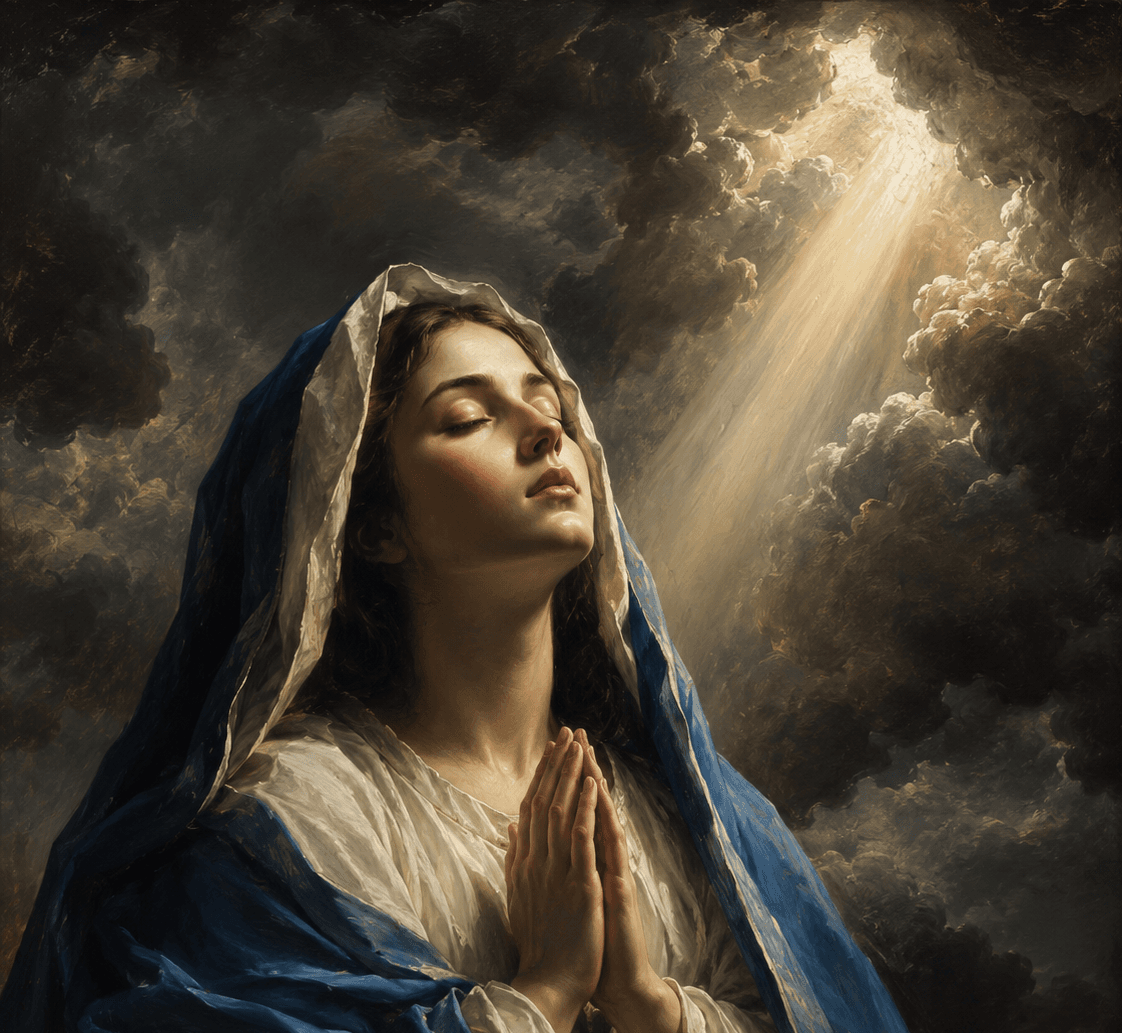
The other events, the Annunciation and the Visitation, are celebrated in Advent (in Years B and C, respectively) and also on specific dates outside this liturgical season (March 25 and May 31). Yet the importance of these celebrations does not lessen the prominence of the mystery of the Incarnation of the Word and of Mary’s visit to Elizabeth in the weeks leading up to Christmas. From First Vespers until Christmas Eve, the Lucan account of the Annunciation gives Advent an incomparable character of expectation, longing, and messianic joy. In this context, the figure of Mary clearly emerges as the Virgin of expectation, the earth pregnant with the seed of the Word, while the liturgy intensifies its cry: “Let the heavens pour down the Just One!” (cf. Is 45:8).
Marian Popular Piety in Advent
Besides the liturgy, forms of popular piety also devote special attention to Mary Most Holy during the season of Advent, as various pious exercises show, especially the novenas of the Immaculate Conception and of Christmas. According to the Directory on Popular Piety and the Liturgy, recommended practices include the Advent wreath, Advent processions, the “Winter Ember Days” (esteemed as moments of supplication and of reflection on human work), the Christmas novena (with the suggestion that Vespers be solemnized with the participation of the faithful), and the Christmas crib. This analysis highlights the Novena of the Immaculate Conception, the Angelus Domini, and the Litanies of Holy Mary of Hope.
Novena of the Immaculate Conception
The Directory (§102) points out that the Solemnity of the Immaculate Conception, deeply rooted in the devotion of the faithful, is an occasion for various popular expressions, such as the traditional offering of flowers made in public squares, especially in the Piazza di Spagna in Rome. Such a gesture, when translated into a proposal for a life according to the Gospel, becomes a beautiful outward sign of true devotion. Mary Immaculate, as a model, inspires the faithful to seek strength in the struggle against evil, with a view to the Kingdom of God. However, the most significant expression is the Novena of the Immaculate Conception, which relates the mystery of Mary’s purity to Advent themes, such as the long messianic expectation and the symbols of the Old Testament.
During the novena, the Christian people praise and thank God for anticipating in Mary the redemptive work of Christ, making her a worthy Mother of the Savior. The Immaculate is celebrated as a reflection of God’s infinite mercy and of the call of all to holiness. This time is not limited to theological discussion, but exalts joy, praise, and the longing for God, inspiring Marian attitudes such as obedience, gratitude, and the way of divine beauty.
Angelus domini
The Angelus Domini is a simple, theologically rich prayer that recalls, three times a day, the Angel’s announcement to Mary and the Incarnation of the Word. This deeply biblical pious exercise highlights Mary’s response to the divine call and rejects any passive or alienating view of her faith. On the contrary, it presents Mary as the woman who proclaims divine justice and defends the humble and the oppressed. In Advent, it is recommended that families recite the Angelus, accompanied by catechesis that helps them deepen this practice of Marian piety. Celebrations of the Word centered on the proclamation of Luke 1:26-38 or on the singing of the Angelus are also strongly encouraged.
Litanies of Holy Mary of Hope
The title “Holy Mary of Hope”, very dear to the Latin American tradition, is inspired by Mary’s life as a model of hope. During Advent, the liturgical season of expectation, Marian devotion finds special expression in the litanies that invoke Mary as “woman faithful in waiting.” Mary awaits with confidence the coming of the Messiah, the manifestation of the Savior, and the fullness of redemption, and she is a symbol of light in the dark moments of Christian life.
The litanies also celebrate Mary as “hope of the poor, the oppressed, and the persecuted,” whom she protects and guides to the heavenly homeland. This role of Mary as a “luminous sign” on the Church’s journey is highlighted as an inspiration for the perseverance of the faithful on the path of salvation.
Recommended reading: Marialis Cultus (Paul VI), an apostolic exhortation on Marian devotion.
Delve deeper into your studies: explore Mariology, Marian Theology, Marian apparitions, and the Postgraduate Program in Mariology.
Conclusion
In this brief period of four weeks, the Roman liturgy and popular piety honor Mary in an exemplary way, recalling her as the one who fully lived the expectation of the birth of Jesus, Emmanuel, “God with us” (cf. Sacrosanctum Concilium 102-103). Mary, a symbol of hope and obedience, guides the Church and the faithful in living the mystery of Advent, showing the way to the coming of the Savior.
The Locus Mariologicus Institute is the global academic reference in Mariology. Discover our resources on Marian Theology, Marian apparitions, and the Postgraduate Program in Mariology.
Postgraduate Program in Mariology
Would you like to deepen your formation in Mariology? Discover the Postgraduate Program in Mariology of Locus Mariologicus, an academic formation that unites theological rigor, spiritual life, and the living tradition of the Church.
Would you like to study Mariology seriously?
This article grows out of the works in the Locus Mariologicus library. The Postgraduate Program in Mariology takes you to the same source, with academic guidance: Scripture, the Fathers of the Church, and the Magisterium, from the first dogma to contemporary questions.



Responses