The Holy Virgin Mary in the Cenacle: A Dogmatic-Liturgical Analysis

Mary in the Cenacle: The Praying Virgin at Pentecost
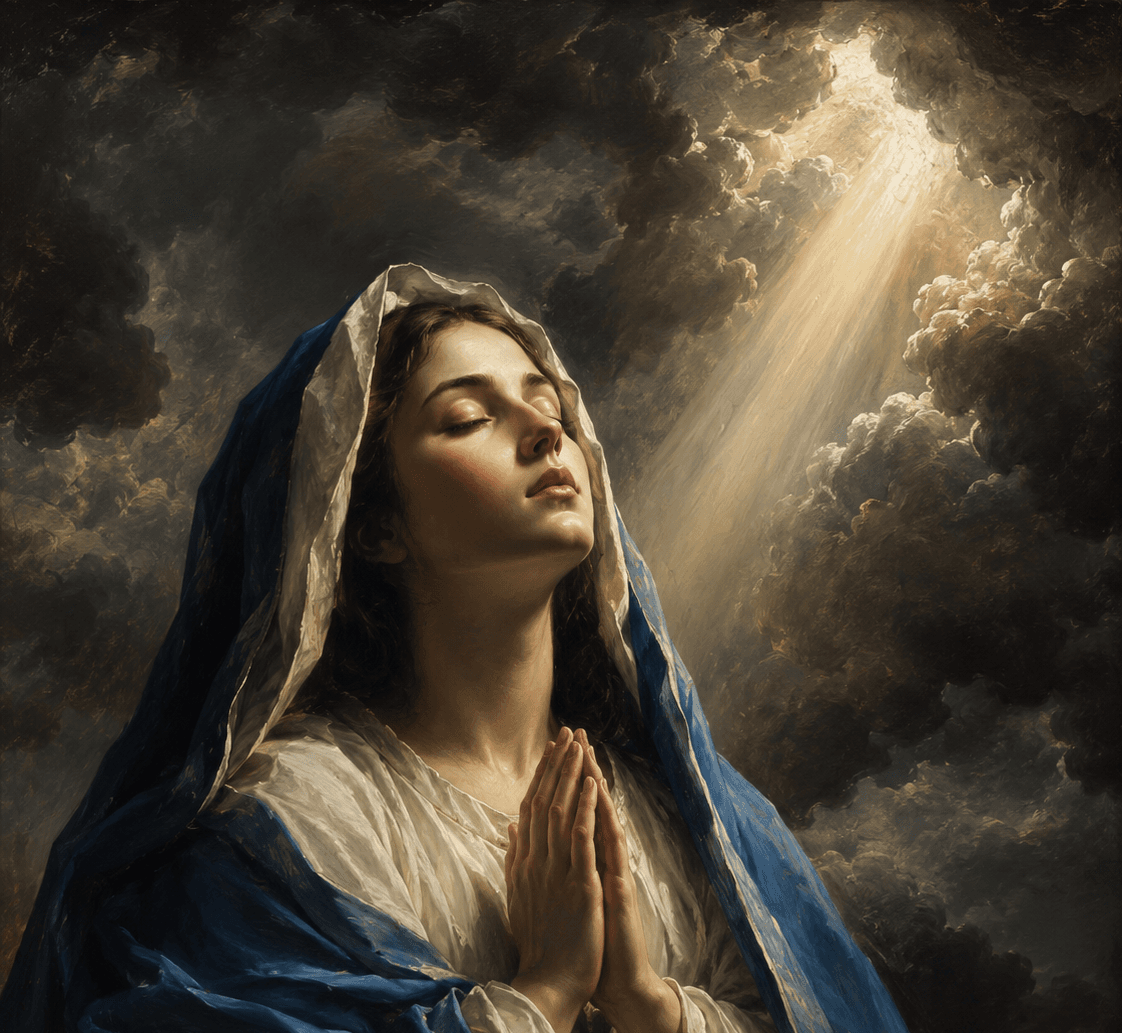
The presence of Mary in the Cenacle is one of the densest texts of biblical Mariology. Luke states that Mary in the Cenacle persevered in prayer with the Apostles (Acts 1:14), which makes her the praying mother of the nascent Church and the model of all ecclesial life.
The Virgin Mary in the Cenacle: A Dogmatic-Liturgical Analysis
In the Cenacle of Pentecost the disciples are filled with the Holy Spirit whom Jesus had promised during the Paschal supper in that same place. In this Mass Mary is celebrated as:
virgin filled with the Spirit.
model of the Church at prayer.
model of harmony, communion, and peace.
docility to the voice of the Spirit.
vigilance in awaiting the Lord’s return.
The very familiar noun “cenacle” is absent from every biblical text. It is bound up with the fundamental event of Jesus’ Paschal supper with the disciples, that supper eaten in the large upper room of a friend’s house, furnished with carpets (Mk 14:15; Lk 22:12). From then on, that spacious room became:
- the secluded refuge of the disciples, where the risen Jesus finds them gathered together (Mk 16:14; Jn 20:19, 26).
- then the common house of the early Church, where its identity and organization gradually matured (Acts 1:3).
- finally, a balcony open to the world, from which the Gospel radiates (Acts 2:14).
In that “cenacle” we find once again those who had been with Jesus from the very first hour: the apostles, named one by one (the unfortunate Judas is missing), some very faithful disciples such as Joseph called Barsabbas and Matthias (Acts 2:23), a group of relatives, some women, and Mary herself, the mother of Jesus. They are the ones who shared with the Lord, in that same venerable place, the Last Supper, hours of life during the “Paschal Lent” (the forty days of encounter with the Risen One), and the bewildering event of His elevation into heaven, where He took His seat at the right hand of God (Mk 16:19; Lk 24:51; Acts 1:9).
In this sort of roll call of the “nascent Church,” the sacred writer highlights the women and the relatives of Jesus, who together with the apostles are indispensable ecclesial presences. Jesus’ relatives had formed differing opinions of Him: some labeled Him an adventurer to be kept at a distance, or someone to distance themselves from; others esteemed Him as a master to be followed (only these followed Him as far as the “cenacle”). The women appeared to be the most constant and faithful: never abandonment or desertion, always helpful and loving. This was the “Church of the Cenacle.”
The Cenacle is the historical space of the early Church and the symbol of the whole ecclesial future. The Cenacle had gathered the followers of Jesus; only Mary had always been with Him, from the conception in Nazareth to the cross on Calvary. Hers was a presence prompted by a natural, spontaneous maternal love, but also by a growing awareness of faith and trust. Jesus widens for our sake the spaces of presence beside Him, spaces that can be inhabited by those who know and live the Word of God. Within the space of this closeness, Mary stands out: she is the mother who welcomes the Word that becomes flesh in her womb; she is the handmaid of the Holy Spirit, ready to fulfill His word. Mary is the model of the Church in the Cenacle.
Mary in the Cenacle takes part in the reconstitution of Jesus’ community: a community united in faith and assiduous in prayer, in which the new Kingdom is constituted. In the Cenacle Jesus is no longer with the disciples:
1. He is in them, so that they may be perfected in unity (Jn 17:20).
2. He is in their midst, because two or three are gathered there in His name (Mt 18:20).
3. He is before them, because they have been taught to await His return (Acts 1:11).
In the Cenacle no one is an isolated protagonist, not even Mary: all share in the fraternity of disciples, each placing his own faith, hope, and charity at the service of the new Kingdom: their Gospel identity, reborn at Pentecost.
What happened then continues and is accomplished for us today.
To deepen your reflection on Mary in the Cenacle and her presence at the birth of the Church, consult the encyclical Redemptoris Mater of John Paul II, which contemplates Mary at prayer in the Cenacle as Mother of the nascent Church.
Delve deeper into your studies: explore Mariology, Marian Theology, Marian apparitions, and the Postgraduate Program in Mariology.
In summary, Mary in the Cenacle remains the hermeneutical key to the Church at prayer and awaiting the Spirit. To delve deeper into Mary in the Cenacle is to contemplate the Virgin as mother of the Church and model of the believer. Read more in the Acts of the Apostles.
Postgraduate Program in Mariology
Would you like to deepen your formation in Mariology? Discover the Postgraduate Program in Mariology of Locus Mariologicus — an academic formation that unites theological rigor, spiritual life, and the living tradition of the Church.
Would you like to study Mariology seriously?
This article grows out of the works in the Locus Mariologicus library. The Postgraduate Program in Mariology takes you to the same source, with academic guidance: Scripture, the Fathers of the Church, and the Magisterium, from the first dogma to contemporary questions.



Responses