Mary and the Risen Christ: Easter Message 2025
Dear brothers and sisters of Locus Mariologicus,

Christ is risen, alleluia! In this holy season of Easter, we are invited to lift up our hearts in praise for Our Lord’s triumph over death. Easter is the center of the Christian proclamation and is always the starting point of Mariological thought. Indeed, in the “hour” of the Passion and Resurrection, the hour of the Son’s glorification, Jesus gives us a precious gift: in offering Himself to the Father on the cross, He leaves us the Holy Spirit and, at the same time, entrusts His own Mother to us. In His last words before He expired, we hear the Lord say: “Behold your Mother” (Jn 19:27). Thus, at the very heart of the paschal mystery, Mary Most Holy is given to the nascent Church, represented by the beloved disciple. From that hour on, Christian history becomes a mutual welcome between the Mother of Jesus and the community of the disciples: Mary welcoming the children of God, and the disciples welcoming Mary as their spiritual Mother.
Mary on Holy Saturday: the silence of the tomb and the faith preserved in the interval between the cross and the Resurrection
Let us contemplate Mary in the sacred silence of Holy Saturday. After Jesus has been laid in the tomb, while the apostles scatter and the disciples of Emmaus give way to discouragement (cf. Lk 24:21), Mary is the one who kept the flame of faith alive. Saint John Paul II teaches that Mary’s waiting on Holy Saturday constitutes one of the highest points of faith, for “in the darkness that envelops the universe, She entrusts herself fully to the God of life, recalling the words of her Son and hoping for the fulfillment of the promises”. Thus, when the dawn of Sunday arrives, Mary’s heart is already prepared to receive the joyful news of the Resurrection.
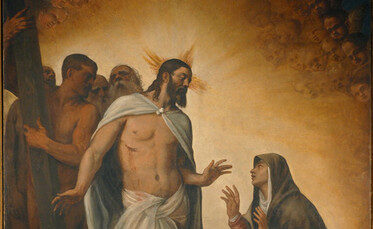
Although the Gospels do not explicitly recount a meeting of the risen Jesus with His Mother, nothing prevents us from contemplating this mystery in the faith of the Church. “How could the Virgin, present in the first community of disciples, have been excluded from the number of those who met her risen Son”?, asks Saint John Paul II. Indeed, it is legitimate to think that Mary was the first person to whom the risen Jesus appeared, for she remained faithful beside the Cross and kept her faith intact through the trial. Her absence among the women who went to the tomb at dawn may be a sign that She had already met Jesus. This ancient pious intuition has been shared by saints and theologians down the centuries.
More important still, Mary took part in a unique way in every moment of the paschal mystery: she stood at the foot of the Cross (cf. Jn 19:25) and persevered in prayer in the Upper Room (cf. Acts 1:14). The Most Holy Virgin was probably a privileged witness of Christ’s Resurrection, thus completing her participation in all the essential moments of the Paschal Mystery. In welcoming the risen Jesus, Mary becomes a sign and an anticipation of the humanity that awaits the final resurrection. In her we already glimpse, by anticipation, the victory of life over death that God promises to us all.
Mary’s paschal joy: from the passion to the Risen One and the witness of the patristic and liturgical tradition
Easter is a time of overflowing joy, and in no heart was that joy as deep as in the heart of Mary. After suffering the sorrows of her Son’s Passion at the foot of the Cross, Mary was filled with “ineffable joy” at the victory of the Resurrection. For this reason, the Church exults and invites her to rejoice: “Rejoice, Virgin Mother”! In the Easter liturgy, we sing of Mary as “Mother of the Light”, for Christ, the Light of the world, rose glorious from the tomb. Echoing the greeting of the Angel at the Annunciation (“Rejoice, full of grace”, Lk 1:28), the paschal “rejoice” gives definitive form to the Kaire of Christ’s conception. That is, the joy of Mary’s fiat at Nazareth reaches its fullness in the paschal joy of the new creation.
In the Regina Coeli, the prayer that replaces the Angelus during the Easter season, the whole Church joins Mary Most Holy in celebrating the Resurrection. “Queen of Heaven, rejoice, Alleluia”, the antiphon prays, “for He whom you were worthy to bear in your womb has risen as He said, Alleluia”. As we intone this song, we recall Mary’s joy at the resurrection of Jesus, prolonging in time the gladness that had been announced to her by the Angel at the Annunciation. Faith tells us that “the Paschal Virgin”, as we may call Mary in this context, experienced the happiness of Easter as no one else did. She who is the cause of our joy (Causa nostræ lætitiæ, we invoke in the Litanies) now shares in the glory of her Son and exults in God her Savior with a new song.
This maternal and divine joy radiates from Mary to the whole Church and to the world. The Resurrection of Christ, the source of true happiness, flooded the Mother’s heart with an inexpressible joy, filled the nascent Church with gladness, and cast a new light upon all creation. “The Lord has truly risen”! This is the good news that transforms hearts. Indeed, “if Christ has not risen from the dead, our faith is in vain”. But He is risen, and in this we find the unshakable certainty of our hope. Christ’s victory over sin and death is also the victory of the Heart of Mary, who trusted fully in God’s promises.
Mary in the Upper Room (Acts 1:14): the mother of Jesus as living memory and praying presence of the nascent Church after Easter
After Easter, Mary remains among the disciples as a loving mother and the living memory of Jesus. The Acts of the Apostles describe her persevering in prayer with the eleven, in the Upper Room, awaiting the Holy Spirit (Acts 1:14). Pope Benedict XVI recalls that Mary was “the humble and discreet protagonist of the first steps of the Christian community”, standing “at the spiritual heart” of the nascent Church. Her simple presence among the disciples was already a sign of the gift of the promised Spirit, for she who had been “the temple of the Spirit” since the Incarnation now enlivens the young Church with her faith and charity. As mother and model of the Church, Mary teaches us to listen to and to keep the Word of God, and to remain united in fraternal communion, awaiting with confidence the fulfillment of Christ’s promises.
In the school of Mary, the perfect disciple of Christ, we learn to experience Easter in depth. Mary “observed first and fully the word of her Son”, Benedict XVI shows us. She loved Jesus not only as a mother, but also as a humble and obedient handmaid. Contemplating her intrepid faith, which did not waver even in the dark night of Holy Saturday, Christians of every age find inspiration to trust in God’s victory. Under Mary’s maternal protection, the Church experiences the presence of the Risen One in her midst: she gathers around the Eucharist, where the living Christ gives Himself, and perseveres united in prayer, certain that the Lord will fulfill His promise to be with us until the end of time.
Today, Mary continues to exercise her maternal role in the Church, guiding the faithful along the path of holiness and always pointing to the center: the living Christ. She who “completes her participation in all the essential moments of the paschal Mystery” invites us too to enter into this mystery. The charism of Locus Mariologicus, “to know Mary better in order to love Mary more”, takes on its full meaning in the paschal light. As we deepen our knowledge of Mary’s privileges, virtues, and mission, we are led to a greater love for her. And by loving her more, we let ourselves be formed by her interior dispositions so as to love Jesus infinitely more. Mary keeps nothing for herself: every true love for Her overflows into love for Christ, for Mary always tells us: “Do whatever He tells you” (Jn 2:5). To know and to love Mary leads us to believe more firmly in the risen Christ and to bear witness to Him before the world with renewed ardor.
The risen Christ walks ahead of us: Easter 2025 and the renewal of the gaze of faith with Mary
Dear family of Locus Mariologicus, this Easter let us renew our gaze of faith: Christ lives and walks ahead of us! United to her glorious Son, Mary Most Holy intercedes for us and accompanies every step of the pilgrim Church. She, the “New Jerusalem” personified, shines with the light of the victorious Lamb and reflects that light upon us, her children. Let us remain close to Mary, above all in this Easter season, letting ourselves be taught by her spirit of contemplation, her adoring silence, and her unbreakable joy. Thus our love for her will grow, and with her we shall proclaim the wonders of the Resurrection.
Finally, gathered in prayer, let us together raise the song of praise: “Let the angelic host exult for joy, let the children of God rejoice”!, for Christ is truly risen! May the joy of the risen Lord flood your souls and your families. In the company of Mary, the Mother of the Risen One, may we all have a Holy and Happy Easter, filled with the peace of Christ and with the hope that does not disappoint.
The Locus Mariologicus Team
April 20, 2025, Easter of the Resurrection of the Lord, Son of Mary.
Mary’s relationship with the paschal mystery of Christ is contemplated in the Encyclical Redemptoris Mater by John Paul II, where Mary’s presence at Easter is presented as the supreme expression of her faith and hope.
Deepen your studies: explore Mariology, Marian Theology, Marian apparitions, and the Postgraduate Program in Mariology.
Formation in Mariology: The Locus Mariologicus Institute offers the Postgraduate Program in Mariology, articles, and academic resources on Mariology, Marian apparitions, and Marian Theology.
Postgraduate Program in Mariology
Would you like to deepen your formation in Mariology? Discover the Postgraduate Program in Mariology of Locus Mariologicus, an academic formation that unites theological rigor, spiritual life, and the living tradition of the Church.
Would you like to study Mariology seriously?
This article is born of the works in the Locus Mariologicus library. The Postgraduate Program in Mariology takes you to the same source, with academic guidance: Scripture, the Fathers of the Church, and the Magisterium, from the first dogma to contemporary questions.




Responses