The Silence of Holy Saturday: the “Hour of the Mother”
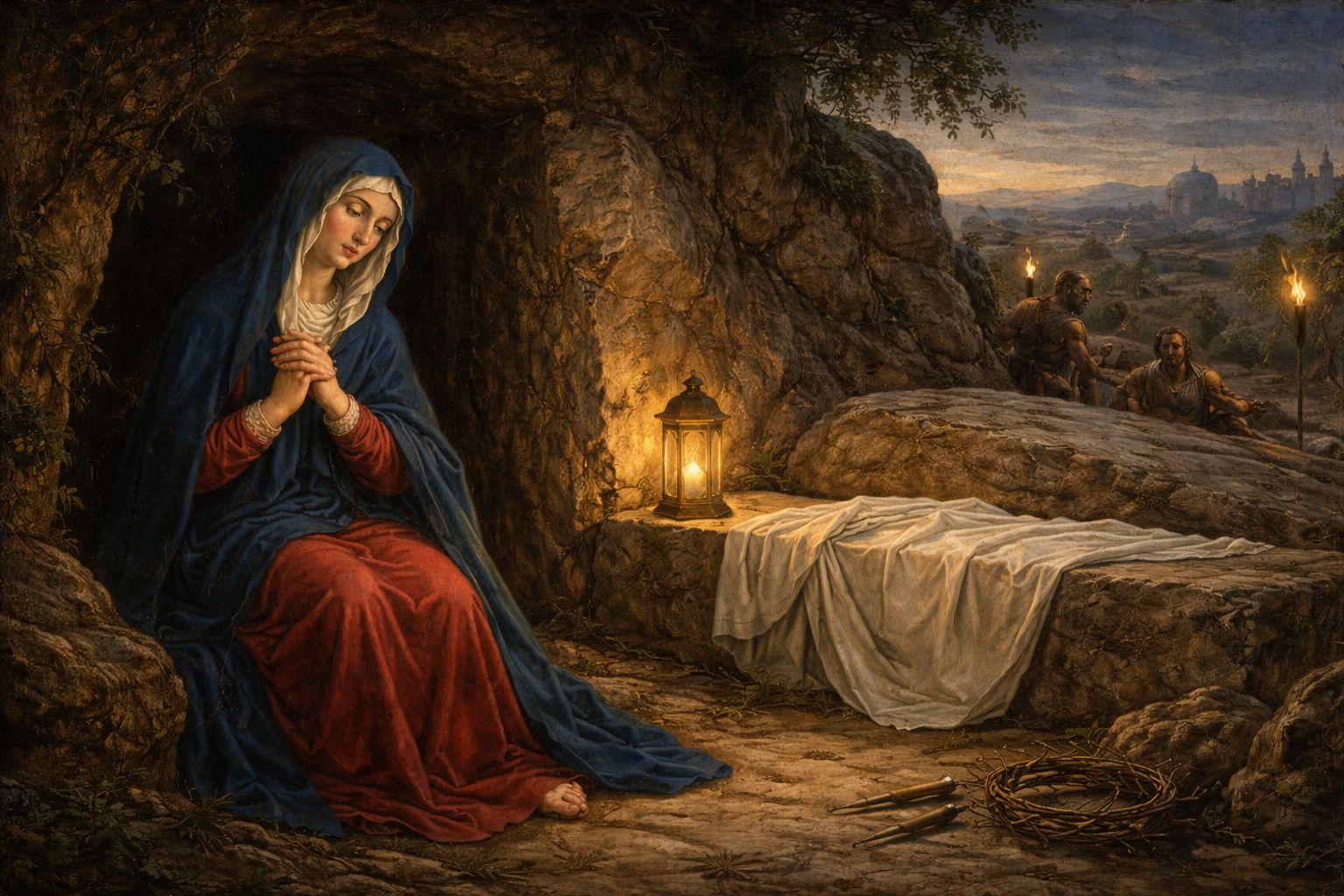
Holy Saturday is the only day of the liturgical year on which the Church administers no sacraments and celebrates no Eucharist. The altars are bare. The tabernacles, open and empty. The liturgical silence is not a forgetting: it is a language.
The Church, as the Roman Missal says, “remains beside the tomb of the Lord, meditating on his Passion and Death, his descent into the realm of the dead, and awaiting in prayer and fasting his Resurrection”. This day without celebration is itself a celebration: that of waiting.
And in this waiting, the Directory on Popular Piety and the Liturgy highlights a figure whom the liturgy does not name but whom tradition has always recognized: “In Mary, according to the teaching of tradition, the whole body of the Church is gathered, she is the universal collection of the faithful. The Virgin Mary who remains beside the tomb of her Son is the image of the Virgin Church keeping watch at the tomb of her Spouse, waiting to celebrate his Resurrection”. Holy Saturday has, in its deepest theological structure, a face: the face of Mary.
I. The liturgy of Holy Saturday: what the Church keeps silent and what it confesses
The liturgical peculiarity of Holy Saturday demands a hermeneutic. There is no Mass because the sacrifice has already been offered, “Consummatum est” (Jn 19:30). There are no sacraments because the sacraments are participation in the paschal mystery, and the paschal mystery is not yet complete: the Risen One has not yet manifested Himself. On this day the Church lives the most delicate time of her entire historical existence: the time between the death of the Spouse and His Resurrection.
This “between” has a theological density that Hans Urs von Balthasar was among the first to explore systematically. In Mysterium Paschale (1969), he showed that Christ’s descent into sheol, the “place of the dead”, is not a passive interval between the Cross and the Resurrection: it is the moment in which the love of God descends to the most radical point of the human condition. Christ descends so that no man may remain definitively excluded from the reach of trinitarian love. The silence of Holy Saturday is the silence of this love at work in the depths.
II. The “hour of the mother”: the pious exercise that the Church recommends
In this context, the Directory on Popular Piety and the Liturgy (n. 156) explicitly recommends the pious exercise of the Hour of the Mother: “while the body of the Son rests in the tomb and his soul has descended to the realm of the dead to announce to his forebears the imminent liberation from the region of shadows, the Virgin, anticipating and personifying the Church, waits full of faith for the victory of her Son over death”. This exercise, which can accompany the Liturgy of the Hours of Holy Saturday, is an ecclesially approved way of living the silence of this day in the company of Mary.
The expression “anticipating and personifying the Church” is theologically precise. Mary does not wait merely as an individual: she waits as figure and head of the whole Church. Her faith on Holy Saturday is the faith of the entire Church, concentrated in a single person. And this faith, which the Western liturgical tradition summed up in the formula “sola remansit fides in Maria” (“faith remained in Mary alone”), is what guarantees the theological continuity between the Cross and the Resurrection. The Church never lost faith on Holy Saturday because Mary never lost it.
III. The ancient homily of Holy Saturday: “What has happened? A great silence”
The Office of Readings of Holy Saturday includes, in the Roman liturgical tradition, an anonymous homily of ancient origin of enormous poetic and theological density. It begins with these words: “Today there is a great silence and solitude on earth. There is a great silence because the King sleeps… God made man has fallen asleep, and he has raised up those who were sleeping from the beginning”. This liturgical text, read in the official celebration of the Church, is the best introduction to the Mariological contemplation of Holy Saturday.
In this silence in which the King sleeps, Mary keeps watch. The ancient homily does not speak of her directly: but Holy Saturday, contemplated in its entirety, is inseparable from her presence. It is she who, among the group of disciples, keeps the memory of what her Son said, “on the third day he will rise” (Mt 16:21), and awaits its fulfillment. Mary’s Holy Saturday is the model of every spiritual silence in which the believer awaits, without proof, the dawn that God has promised.
IV. The Easter vigil: from night to light
Holy Saturday ends, and Sunday begins, with the Easter Vigil: “the mother of all vigils”, in the expression of Saint Augustine. The liturgy begins outside, in the darkness, with the blessing of the new fire and of the paschal candle. The Exsultet, the Easter proclamation, then proclaims: “Exult, my heart, exult, for this Mother of the Church also rejoices, clothed with the splendor of the great light”. The Church, figure of Mary, passes from the night of Holy Saturday into the light of the Risen One. What Mary lived in silence during the day, the Church proclaims in song during the night.
The seven Old Testament readings that the Vigil proposes, from creation (Gen 1:1) to the exodus (Ex 14:15), from the promise of Isaiah (Is 54:5-14; 55:1-11) to the new covenant of Ezekiel (Ezek 36:16-28), are the memory of all the times in which God fulfilled what He had promised. Mary knew these readings. In waiting on Holy Saturday, she aligned her faith with this whole history. The Easter Vigil is the ecclesial confirmation of what Mary lived in silence: that God always fulfills His promises.
On this Holy Saturday of 2026, we invite everyone to enter into the Hour of the Mother. To sit in silence with Mary beside the tomb. To let her silence teach. To await, as she awaited, the dawn that, she knew, was to come. And then, at night, to light the candle from the paschal candle and to sing with the entire Church: “Lumen Christi. Deo gratias”. Read also: the encounter of the Risen One with His Mother, Mary, teacher of paschal hope and the paschal joy of Mary Magdalene. Cf. Paschale Solemnitatis §§ 73,76.
Deepen your studies: explore Mariology, Marian Theology, Marian apparitions and the Postgraduate Program in Mariology.
What is Holy Saturday and what is its Mariological meaning?
Holy Saturday is the only day of the liturgical year on which the Church neither celebrates the Eucharist nor administers sacraments, being the day of silence between the death and the Resurrection. The Mariological tradition calls it the “Hour of the Mother”: while the disciples scattered and Peter denied, Mary remained alone as the guardian of the faith of the Church. John Paul II, in Redemptoris Mater (n. 18), affirms that Mary’s faith on Holy Saturday was the foundation of the hope of the whole Church, which learned from her to await the Resurrection.
Why does tradition call Holy Saturday the “Hour of the Mother”?
The expression “Hour of the Mother” designates the period between the death of Christ on the Cross (Good Friday) and the Resurrection (Easter Sunday). In that interval of silence and apparent defeat, Mary was the only one who maintained unshakable faith. Marian Theology, developed by authors such as Hans Urs von Balthasar in “Mysterium Paschale”, sees in Holy Saturday the synthesis of the Marian vocation: to wait without seeing, to believe without proof, to guard the flame of faith when everything seems extinguished. Mary is thus the icon of the Church in moments of crisis and darkness.
How does Mary’s silence on Holy Saturday teach us to live the faith today?
Mary’s silence on Holy Saturday is a school of faith for the faithful of every age. She did not run to the tomb, she did not demand signs, she did not capitulate to despair: she waited in prayer, meditating on the Word that her Son had entrusted to her. Marian spirituality proposes this “fruitful silence” as a model for moments of spiritual aridity, of suffering or of doubt. Just as the grain buried in the earth seems dead but prepares life (Jn 12:24), Mary teaches us that God’s silence is always the prelude to a new dawn.
To deepen your reflection on Mary at Easter and her role in the history of salvation, consult the Encyclical Redemptoris Mater of Pope John Paul II.
Postgraduate Program in Mariology
Would you like to deepen your formation in Mariology? Discover the Postgraduate Program in Mariology of Locus Mariologicus, an academic formation that unites theological rigor, spiritual life and the living tradition of the Church.





Responses