What is Mary’s role as a woman and a laywoman?

Mary’s role as a woman and a laywoman in the history of salvation
A layperson means a baptized person who is not part of the clergy. This simple definition distinguishes two states of life: the laity and the religious within Christianity. In our time, the laity are valued anew as those responsible for the ecclesial community. It is from this definition that we will speak about Mary’s lay state.
Mary, as the Mother of Jesus, is consecrated in the Spirit and is united to the whole priestly people in the one sacrifice of Christ. However, concerning her lay dimension we must consider three aspects:
- Sociological Sense. Mary is an Israelite woman, and for this reason she could never have exercised any priestly function. Within the home she could, as the educator of her children, transmit the faith until they completed five years of age. After that age the child was initiated into public life, in which the woman could not intervene. In fact, even attendance at the temple took place in a court far from the men’s space of prayer, and even in the school of the scribes feminine participation was forbidden.
- Historical Sense. The priestly character of a man in Israel came from the inheritance of blood. Mary, even though she belonged to a priestly family — in the genealogy of Jesus we find Zadok (Mt 1:14) [Azor begot Zadok. Zadok begot Achim. Achim begot Eliud.] and Levi (Lk 3:29) [son of Joshua, son of Eliezer, son of Jorim, son of Matthat, son of Levi] — was a relative of Elizabeth, who was a descendant of Aaron (Lk 1:5). The possibility of the priesthood would have been for Joseph, because he was a man.
- Gospel Sense. Mary’s religiosity took on traits similar to those of Jesus, as a new way far more existential than ritual. We can even speak of an essential status of the lay life in Luke, when he sets the Annunciation of John the Baptist to Zechariah antithetically over against that of Jesus to Mary. The Angel enters Mary’s house (Lk 1:26) [When Elizabeth was in the sixth month, the angel Gabriel was sent by God to a city of Galilee called Nazareth,] and announces God’s dwelling to a laywoman. This passage ruins the conception of the “temple of stone” and inaugurates the “Church of persons”, for the centuries-old priestly mediation becomes lay, where God’s presence meets the person freely, regardless of their priestly belonging. Instead, the Priest Zechariah remains inside the temple of stone, incredulous and, consequently, mute, while Elizabeth points to the veneration of Mary (Lk 1:42) [With a loud voice, she exclaimed: “Blessed are you among women, and blessed is the fruit of your womb!”]. When we read attentively the description of Elizabeth’s husband, he is a priest who exercises his priesthood in the temple of Jerusalem, the center of Hebrew worship; he was righteous and blameless, he lived according to the law and the customs (Lk 1:6) [Both were righteous before God and faithfully kept all the commandments and precepts of the Lord]. However, Zechariah’s long religious and cultic experience did not spare him doubt about the Angel’s words.
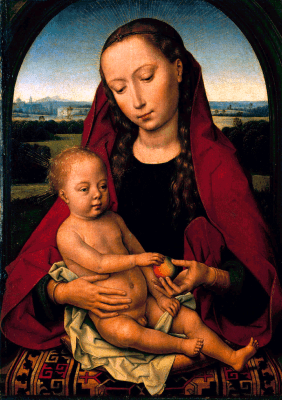
The presence of Mary in the history of salvation transcends the states of wife and mother. For Mariology, all the 153 verses about Mary that have come down to us do not speak of a change in the status of the Mother of Jesus as a laywoman. Mary truly shared in the priestly attitudes and behaviors of Jesus when He offers His life for the remission of the sins of the world. She was aware that her Son had come to save the people from their sins (Mt 1:21) [She will bear a son, and you shall give Him the name Jesus, for He will save His people from their sins”]. The prophecy of Simeon had pointed out to her the tragic death, together with the sword that would pierce her soul. Finally, in the hour of the Cross, we witness the greatest revelation of the Son in relation to the Mother, leaving her as an inheritance to the community of the redeemed as Mother in her union with the redeeming sacrifice of the Son. We can then conclude that Mary’s lay state is based on the response of faith that inaugurates the irruption of God into the world. The woman who lived in a despised province (Jn 7:41) [“Truly, he is the prophet”! Others said: “He is the Christ”! But others disagreed: “Can the Christ come from Galilee?”], coming from a disparaged village (Jn 1:46) [Nathanael asked: “Can anything good come out of Nazareth”? Philip answered: “Come and see”!], is exalted for her faith, for she gave her consent (Lk 1:38) [Jesus turned around and, seeing that they were following Him, asked them: “What are you looking for”? They answered: “Rabbi (which means Master), where are you staying”?]. As Mother of the Son of God, her attitudes are listening to the Word of God, keeping and carrying out in daily life what we call the Gospel (Lk 8:19-21) [His mother and His brothers came to Him, but they could not reach Him because of the crowd. Someone told Him: “Your mother and your brothers are outside and want to see you”. He answered: “My mother and my brothers are these: those who hear the Word of God and put it into practice”] (Lk 11:27-28) [While Jesus was speaking in this way, a woman raised her voice in the midst of the crowd and said to Him: “Blessed is the womb that bore you and the breasts that nursed you”. He answered: “Blessed, above all, are those who hear the Word of God and put it into practice”]. Mary is the one who puts the Word of God into practice and teaches us, in every state and form of life, whether lay or not, to take up God’s call and, with courage, to proclaim “the great deeds” of the Lord wherever we may be.
Reader, where have you been proclaiming “the wonders” that the Lord has done? Comment below on how you have put your lay state into practice.
To deepen the theology of Mary as woman and disciple, consult the encyclical of John Paul II: Redemptoris Mater on Mary in the pilgrimage of faith.
Deepen your studies: explore Mariology, Marian Theology, Marian apparitions, and the Postgraduate Program in Mariology.
Postgraduate Program in Mariology
Would you like to deepen your formation in Mariology? Discover the Postgraduate Program in Mariology of Locus Mariologicus, an academic formation that unites theological rigor, spiritual life, and the living tradition of the Church.
Would you like to study Mariology seriously?
This article arises from the works of the library of Locus Mariologicus. The Postgraduate Program in Mariology takes you to the same source, with academic guidance: Scripture, the Fathers of the Church, and the Magisterium, from the first dogma to contemporary questions.



Responses