Holy Week: Mary, Disciple of the Lord

Mary, Disciple of the Lord in Holy Week
Mary in the Paschal Cycle
The paschal cycle unfolds over about three months and is centered on the celebrations of the sacred Triduum. It is the core around which the life of ecclesial communities revolves, as they relive the perennial penitential experience of the exodus and the liberating realization of the Pasch in the lives of individuals.
It is the period in which the decisive events of salvation take place: Christ is on His way to fulfilling the will of the Father in the supreme sacrifice, in His Passover from this world to the Father. But it is also the period in which, after the days of the blessed Passion, the Church experiences the presence and action of the Risen One, who completes His mission with the gift of the Spirit.
In such an eventful phase, the Virgin is present, and not in a secondary role. The contemplative testimony of the Mother’s presence beside the Son is given to us by the Gospel of John.
The twofold character of Lent, baptismal and penitential, is meant to dispose the faithful each year to celebrate Easter, above all through more frequent listening to the word of God and more intense prayer (Sacrosanctum Concilium 109).
The intense commitment demanded by the Lenten journey draws the believer’s attention to his sequela Christi, that is, to the way in which he has accepted the proclamation of the faith and follows it in the footsteps of Christ, along the liberating way of the cross. The disciple, who each year retraces this journey with an ever-renewed spirit, finds in the person of the Virgin the concrete example of how the Word of God is to be received and of how one must respond to Christ on the way to Calvary.
At the end of the sacrament of the forty days, when the Church contemplates the central moment of the Father’s saving plan, we look once again to Mary who, as the new woman, stands beneath the tree from which life sprang forth, beside Christ, the new man. From the Son’s testament of love, by which she is entrusted to the disciple, Mary appears as the spiritual mother of all who turn the gaze of faith toward the cross.
Mary, Disciple of the Lord
Following Christ on the way of the cross entails taking on the attitude of the disciple who walks in the footsteps of the Master. They are footsteps that lead to the cross, and the Virgin Mary walked in them.
Everything becomes understandable when one agrees to enter into the mystery of the Father’s will, by accepting His will: this is what true discipleship consists in. The two Gospel pericopes proposed as alternatives emphasize this dimension: the ecclesial reading of Lk 2:41-52, recalling how Jesus was lost in the temple and His reply, directs our gaze to the Mother of Jesus, who kept these things in her heart. The passage from Mt 12:46-50, for its part, reminds us that whoever does the will of the Father who is in heaven belongs to Jesus’ family.
The secret of the disciple therefore consists in treasuring the divine Word: in this lies that wisdom which can gladden the heart (Sir 51:18-24, 27-30). And the assembly sings of this reality: your words, Lord, are spirit and life, and recognizes the Virgin as blessed because she kept the word of God, pondering it in her heart.
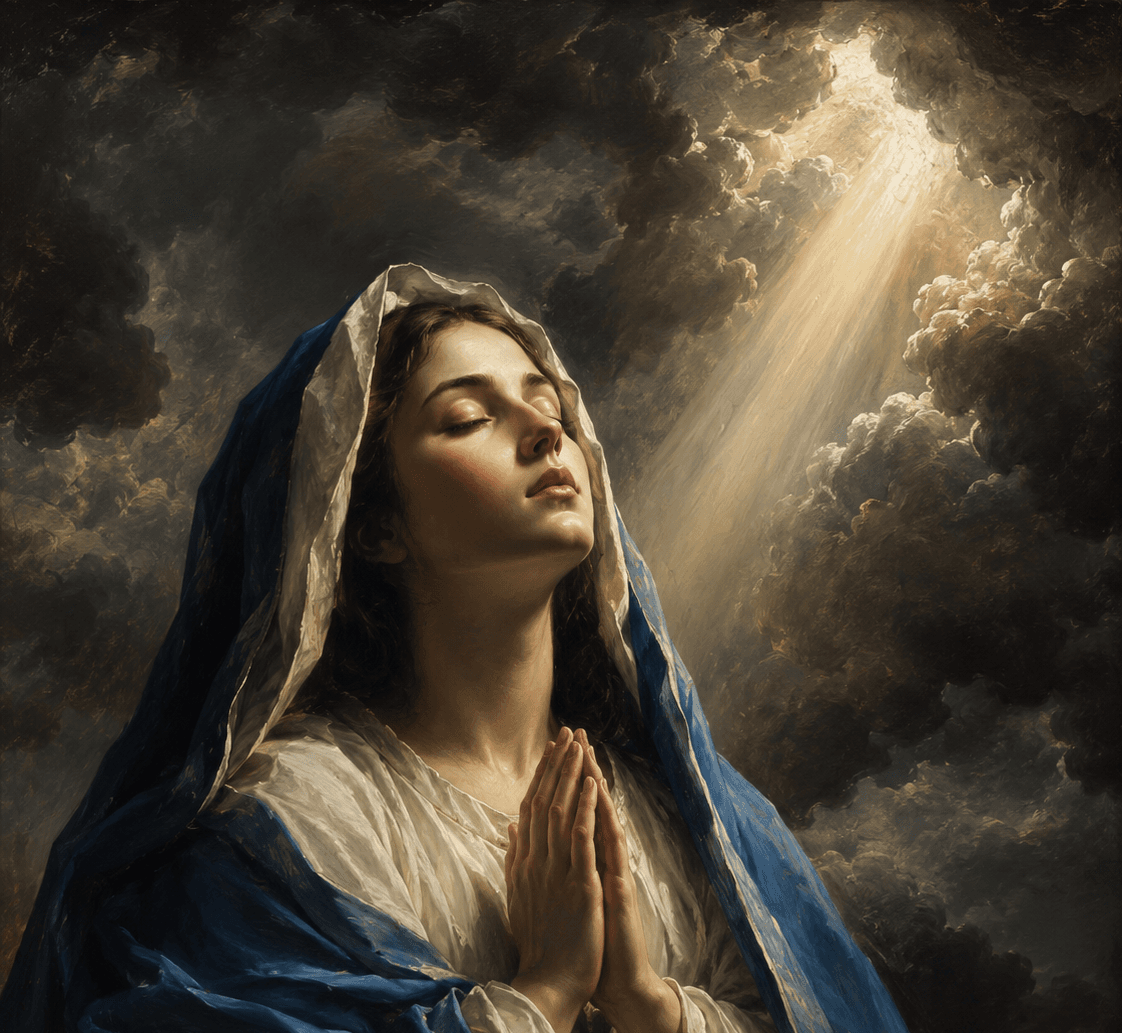
Mary was a faithful disciple of the Word made flesh: indeed, she is the model of those who welcome the Word.
A similar acknowledgment, already suggested in Marialis Cultus 35, where Mary is described as the “first and perfect disciple,” on the one hand recalls how essential readiness for the Word is in order to walk the way of the cross, and on the other highlights the attitude and the role of Mary.
This attitude of full and unconditional readiness emphasizes above all the role that the Virgin plays in the Church, when the faithful and the community undertake this plan of salvation on their own. Indeed, in keeping with the Gospel beatitude, “blessed are those who hear the word of God and keep it” (Lk 11:27-28), faithfully reflected in Mary, “mother and disciple of the Son,” the Church invites us to imitate her attitude with hearts open “to the beatitude of listening.” With life choices that make each believer a “holy place where the word of salvation is fulfilled today.” And through the gift of that “wisdom and grace” which is obtained not “by our own strength alone,” but through participation in the holy mysteries.
On the one hand, the Virgin’s exemplarity emerges clearly; on the other, it challenges the faithful who travel the same path of faith. Being faithful disciples of Christ, like Mary, entails placing ourselves in the “school of the Virgin Mary.” This requires, first, a constant search for the Father’s will and its faithful fulfillment, carried out “with love,” and second, attentiveness to the word of Christ and a consequent fidelity “to his commandments.”
Deepen your studies: explore Mariology, Marian Theology, Marian apparitions, and the Postgraduate Program in Mariology.
To delve deeper into the role of Mary in the Passion and Resurrection of Christ, consult the Encyclical Redemptoris Mater of Saint John Paul II.
Postgraduate Program in Mariology
Would you like to deepen your formation in Mariology? Discover the Postgraduate Program in Mariology of Locus Mariologicus, an academic formation that unites theological rigor, spiritual life, and the living tradition of the Church.
Would you like to study Mariology seriously?
This article grows out of the works in the Locus Mariologicus library. The Postgraduate Program in Mariology takes you to the same source, with academic guidance: Scripture, the Fathers of the Church, and the Magisterium, from the first dogma to contemporary questions.



Responses