Sign of the prophet Jonah: the sign of Jonah and Mary, the gate of the Savior
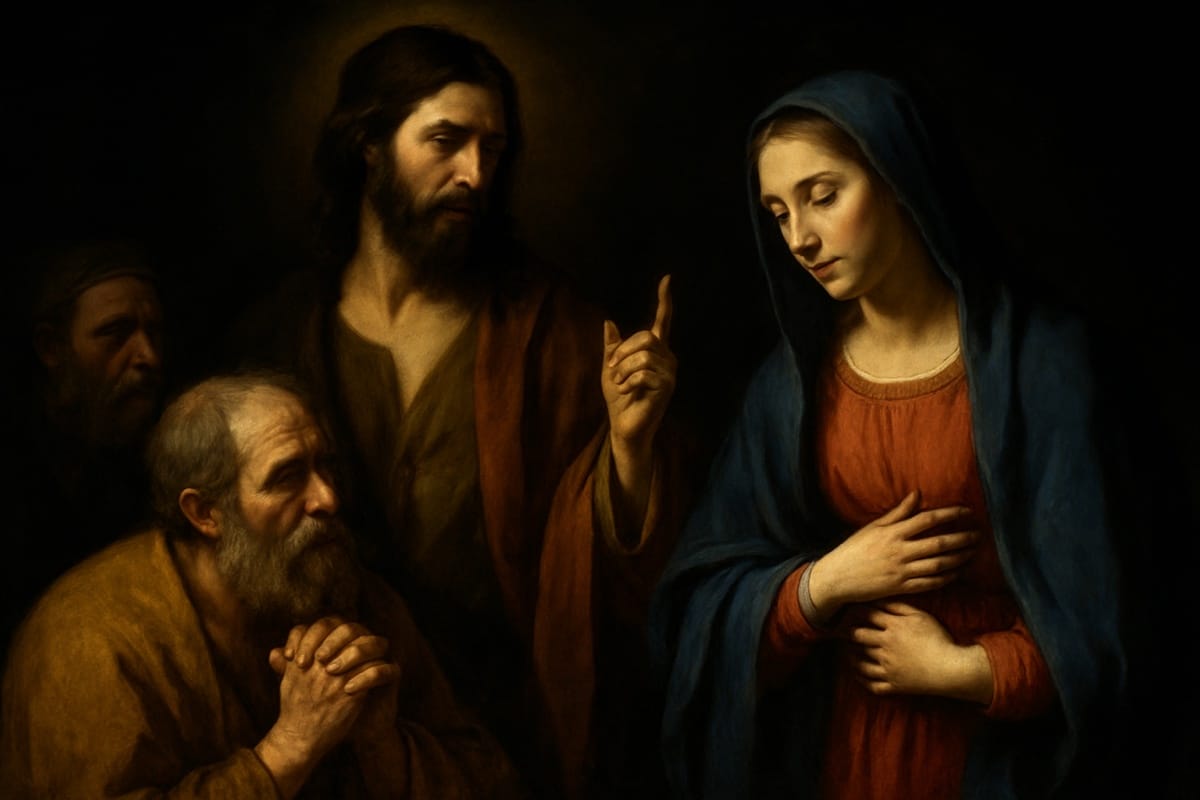
Generatio mala et adultera signum quaerit, et signum non dabitur ei nisi signum Ionae prophetae.
Mt 12:39
Mt 12:38-42 presents one of the most enigmatic of Jesus’ answers: the scribes and Pharisees ask for a “sign”, a miraculous proof of Jesus’ divine authority, and Jesus refuses to give any sign except the “sign of Jonah”. The refusal is surprising given the immediate context: Jesus has just worked numerous miracles (healings, exorcisms) which the Pharisees attributed to Beelzebul (Mt 12:24). The miracles have already been done and were not acknowledged. To ask for an additional “sign” is, for Jesus, the symptom of a generation that does not want to acknowledge what it has already seen, “an evil and adulterous generation” (Mt 12:39).
The “sign of Jonah” that Jesus announces is presented with a twofold interpretation: Jonah in the belly of the fish for three days and three nights as a prefiguration of the Son of Man’s remaining “in the heart of the earth” (Mt 12:40), that is, the death and resurrection, and the repentance of the Ninevites at Jonah’s preaching as a judgment upon the generation that heard Someone “greater than Jonah” (Mt 12:41) and was not converted. The only “sign” that Jesus will give is the paschal mystery itself, the death and the resurrection, which are at once the greatest of signs and the most incomprehensible for those who look for spectacular signs.
I. “Asks for a sign”: the logic of the demand for proof
“An evil and adulterous generation asks for a sign” (Mt 12:39). Jesus’ diagnosis of the generation that asks for signs is twofold: “evil” (πονηρά, malicious, inclined to evil) and “adulterous” (μοιχαλίς, in the biblical sense of infidelity to the covenant, cf. Hos 1-3; Jer 3). The demand for “a sign” is not innocent intellectual curiosity; it is the expression of the refusal to believe without a proof that would overcome every objection. The “sign” asked for is the sign that would eliminate the freedom of faith: a proof so irresistible that it would make belief obligatory.
Jesus refuses to give this kind of sign because it contradicts the logic of revelation: God does not impose Himself, He invites. The sign that Jesus will give, the death and the resurrection, is the most radical “sign” possible and, at the same time, the most ambiguous for anyone who does not want to believe: the empty tomb can be explained by the theft of the body (Mt 28:13), the appearances of the Risen One can be explained by hallucinations. The “sign of Jonah” does not eliminate the possibility of refusal; it is an invitation to a faith that remains free.
The theology of the “sign of Jonah” has implications for Christian apologetics: faith is not born of irresistible signs but of the conversion of heart that the “Ninevites” carried out at Jonah’s preaching. Preaching, not miraculous spectacle, is the ordinary means by which faith is born. The Ninevites saw no miracles: they heard Jonah’s preaching (“yet forty days, and Nineveh shall be destroyed”, Jon 3:4) and were converted. The conversion that Jesus expects does not require extraordinary signs; it requires openness to the ordinary sign of the word proclaimed.
The “adulterous generation” that asks for signs is implicitly contrasted with Mary: where the generation of Pharisees and scribes demands proofs before believing, Mary believed without demanding additional proofs. The “fiat” of the Annunciation was given with no signs beyond the word of the angel, and even the “sign” that the angel offered unprompted (Elizabeth’s pregnancy as a confirmation) was offered on divine initiative, not demanded by Mary. The Mother of the “Sign of Jonah” was the first to accept it without demanding other proofs.
II. “Jonah was three days in the belly of the fish”: the sign of death and of the Resurrection
“So will the Son of Man be three days and three nights in the heart of the earth” (Mt 12:40): the Jonah/Jesus typology is one of the oldest in the patristic tradition. Jonah is the “figure” (τύπος) of Christ dead and risen. The “belly of the great fish” (Jon 2:1) is a figure of the tomb. Jonah’s “coming out” on the third day is a figure of the Resurrection. The typology is not a forced allegory; it is affirmed by Jesus Himself as the interpretive key to His death and resurrection.
The “heart of the earth” (καρδία τῆς γῆς), where the Son of Man will be “three days and three nights”, is an expression that evokes not only the physical tomb but also the descensus ad inferos, the “descent into hades” mentioned in the Apostles’ Creed. Jesus goes to the deepest place of human existence, death, and returns. The “sign of Jonah” is the sign of the victory over death from within death: not the victory that avoids the tomb, but the one that passes through it.
The Resurrection as the “sign of Jonah” has a Mariological dimension that tradition has not always explored: Mary was the first to “keep the sign”, the one who, on Holy Saturday, awaited Jonah’s coming out of the belly of the fish when all the others had given up. The “keeping of the sign of Jonah” during Holy Saturday is the Marian form of paschal faith: to believe that the “sign” Jesus promised will be fulfilled, even when everything seems to indicate the contrary.
III. “Here there is something greater than Jonah”: Mary and the one greater than Jonah
“Here there is something greater than Jonah” (Mt 12:41): the comparison is Christological. Jesus is greater than Jonah because Jonah was only the human prophet who proclaimed the destruction of Nineveh, whereas Jesus is the Son of God who proclaims not destruction but salvation. The Ninevites “will rise” at the judgment and will condemn the generation of Jesus because they were converted at the preaching of Jonah, and this generation was not converted at the preaching of Someone infinitely greater.
Jesus’ “a fortiori” argument (if the Ninevites were converted by Jonah, how much more should this generation be converted by Someone greater) applies also to Mariology: if the Ninevites were converted by the preaching of a prophet who came from outside their city, how much more should those be converted who have received, through Mary’s motherhood, the very Son of God. Mary is the “gate” through which the “one greater than Jonah” entered the world, the human mediation through which the eternal Word assumed flesh.
The expression “gate of the Savior” is not a canonical Loretan title, but it expresses a theological dimension present in tradition: Mary as the “ostium” (gate) of salvation, the one who opened access to the Savior by saying “fiat”. This dimension is parallel to the “sign of Jonah”: as Jonah came out of the belly of the fish to proclaim salvation to Nineveh, Jesus came forth from the womb of Mary to proclaim universal salvation. The womb of Mary is the “belly of the fish” in which the Sign took human form before being proclaimed to the world.
IV. “The Queen of the South will rise at the judgment”: the wisdom that sought the greater one
“The Queen of the South will rise at the judgment with this generation and will condemn it. For she came from the ends of the earth to hear the wisdom of Solomon, and here there is something greater than Solomon” (Mt 12:42): the “Queen of the South” (the Queen of Sheba of 1 Kgs 10:1-13) is the second typological figure of Mt 12:41-42. The pagan queen who made a long journey to hear the wisdom of Solomon is a figure of those who actively seek divine wisdom, in contrast with those who have Wisdom present among them and reject it.
The “Queen of the South/Mary” typology has a history in tradition: the queen who sought the wisdom of Solomon by traveling “from the ends of the earth” is contrasted with Mary, who received incarnate Wisdom with no need to travel, because Wisdom came to her. Mary’s “fiat” is the answer of the “Queen of the South” who does not need to go to the ends of the earth because the Wisdom she sought came to meet her. Mary did not seek Wisdom; Wisdom sought her.
The “Queen of the South” who “will rise at the judgment” to condemn those who did not respond to the “sign of Jonah” is, in this parallel, an anticipation of the “Queen of Heaven” who intercedes for those who, unlike the Pharisees, received the sign. Mary as Queen is not the judge (that role belongs to the Son) but the Advocate, the one who intercedes for those who responded to the “sign of Jonah” with the “fiat” of faith. The “Queen of the South” who sought wisdom prefigures the “Regina Caeli” who intercedes for the faith of those who still seek it.
Postgraduate Program in Mariology
Would you like to deepen your formation in Mariology? Discover the Postgraduate Program in Mariology of Locus Mariologicus – an academic formation that unites theological rigor, spiritual life, and the living tradition of the Church.
Would you like to study Mariology seriously?
This article is born from the works in the Locus Mariologicus library. The Postgraduate Program in Mariology takes you to the same source, with academic guidance: Scripture, the Fathers of the Church, and the Magisterium, from the first dogma to contemporary questions.


Responses