Super mare ambulans: Mary and the peace of Christ in the storm
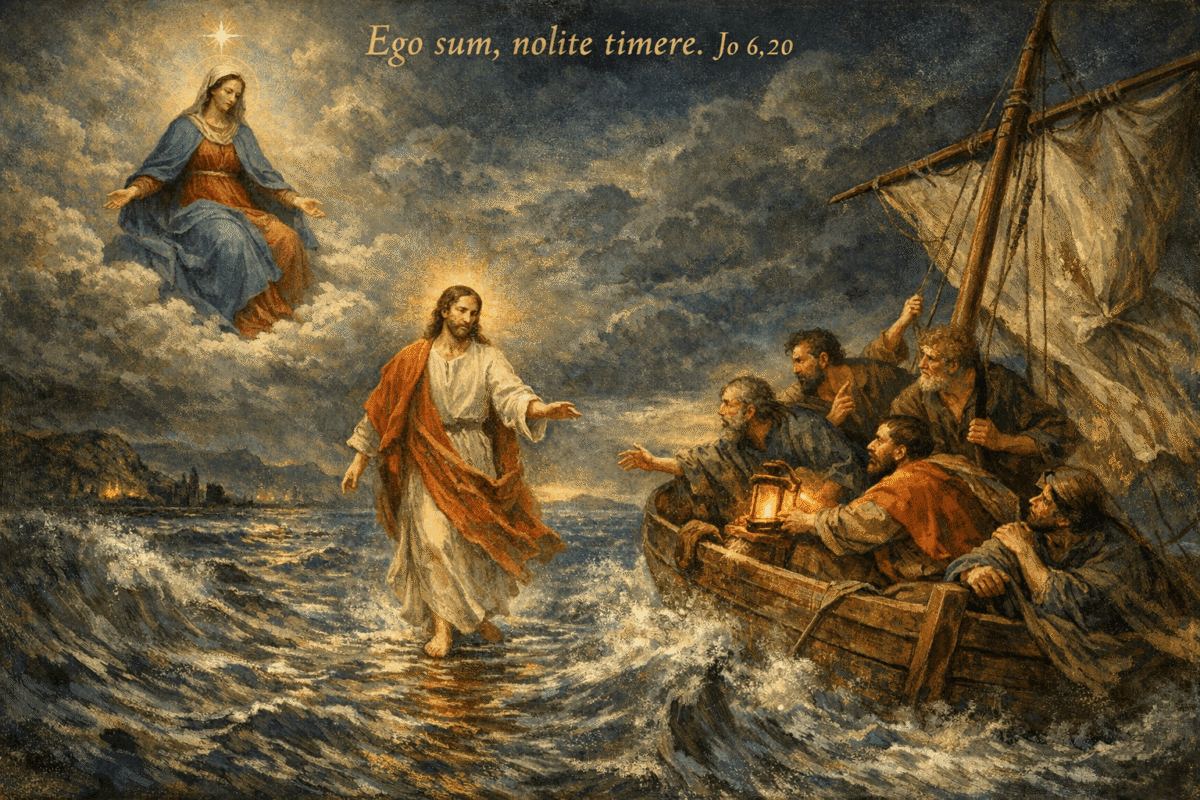
Ego sum, nolite timere.
Jn 6:20
After the sign of the loaves, the disciples cross the sea by night, shaken by the storm, and catch sight of Jesus walking on the waters. Fear takes hold of them, until the voice of Jesus reaches them: “It is I; do not be afraid”. This pericope, which might seem to be merely an account of a miracle, contains a profound theology of faith in tribulation and illumines, from an unexpected angle, the figure of Mary as the model of the faith that perseveres when the night is dark and the sea is rough. The “do not be afraid” addressed to the disciples in the Gospel of John echoes the “do not be afraid, Mary”, with which the angel inaugurated her vocation (Lk 1:30).
I. The sea, the night and chaos
In biblical and patristic cosmology, the sea represents chaos, threat, the power of forces that escape human control. The Psalter sings: “Those who go down to the sea in ships… saw the works of the Lord and His wonders in the deep” (Ps 107:23-24). The book of Job describes the sea as the domain of Leviathan, the creature that only divine power can control (Job 41). And the Apocalypse will anticipate the eschatological moment by saying that “the sea will be no more” (Rev 21:1); the symbol of chaos will be definitively eliminated. Jesus’ walking on the waters is therefore not a simple portent of nature: it is a theophania, a manifestation of the divine power over chaos that only the Creator can exercise.
The night, “it was already dark and Jesus had not yet come to them” (Jn 6:17), reinforces the symbolic dimension of the scene. In the Fourth Gospel, night is always the time of absence and of temptation: Nicodemus comes to Jesus “by night” (Jn 3:2). Judas leaves the Upper Room and “it was night” (Jn 13:30). Mary Magdalene goes to the tomb “while it was still dark” (Jn 20:1). Night is the time when faith is put to the test, when there is no direct vision, when the presence of Christ is not perceptible to the senses, when the boat seems adrift without the Master on board.
Mary knew this “night of faith” more deeply than any other disciple. Her longest and darkest night was Holy Saturday, the day between the Cross and the Resurrection, when the Son was in the tomb and everything seemed definitively lost. The Gospels do not describe for us what Mary did on that day. But the theology of Holy Saturday, explored by Hans Urs von Balthasar in Mysterium Paschale, presents Mary as the only creature who kept faith alive in that total “night”: she who had kept the Word in her heart (Lk 2:51) did not lose it even when the Bearer of the Word lay dead in a tomb of stone.
The Christian spiritual tradition, from Bernard of Clairvaux to John of the Cross, identified in the night of faith one of the most fruitful moments of the spiritual life. It is in the “dark night” that faith is purified of everything that was attachment to sensible consolation and becomes pure adherence to the Word of God. Mary, who passed through Holy Saturday without any external consolation, is the model of this purified faith, the faith that remains when everything that sustained it externally has disappeared.
II. “It is I, do not be afraid”: the paschal Epiphany
“It is I”, Egō eimi, is one of the most theologically charged formulas of the Fourth Gospel. In the discourses with a predicate (“I am the light of the world”, “I am the door”, “I am the Good Shepherd”), the formula reveals the identity of the Son. But there are also absolute uses, without a predicate, in which the formula echoes the divine Name of Ex 3:14: “I am who I am”. Jn 6:20 is one of those absolute uses: Jesus walks on the waters and says “It is I”, an affirmation that is not only one of personal identity, but of divine identity. He who masters the sea is the Creator of the sea. He who walks on the waters is the Lord of the waters.
Do not be afraid, nolite timere / mē phobeisthe, is, in the New Testament, a formula of epiphany: it is what the angels say when they appear (Lk 1:13; 1:30; 2:10), it is what Jesus says when He rises (Mt 28:10), and it is what the Risen One says to John in the Apocalypse (Rev 1:17). It is not a simple word of psychological comfort: it is the proclamation that the presence of God dissolves fear because it is more real than any threat. The fear of the disciples on the sea is real. But the presence of Christ is more real still, and His voice is enough to turn the storm into tranquility.
Mary was the first human creature to receive this do not be afraid in its most direct version: Do not be afraid, Mary, for you have found grace before God (Lk 1:30). The angel does not deny Mary’s disquiet; the text says that she was perplexed (dietarachthē) by the greeting, but he proclaims that the presence of God, which precedes her and enfolds her, is stronger than any cause of fear. This was the inaugural lesson of Mary’s life: Christian faith is not the absence of fear, but the confidence that the presence of God is always stronger than whatever frightens us. A lesson that she would have to relearn, in progressively more demanding versions, throughout her whole life.
In the paschal context, the It is I, do not be afraid acquires its fullest resonance. The Risen One who appears in the Upper Room with His words of peace, Peace be with you (Jn 20:19; 21:21), is the same who walked on the waters. The paschal peace is the realization of what the episode on the sea anticipated: the presence of the Risen One turns fear into peace, the storm into tranquility, the night into dawn. Mary, who was in the Upper Room when the Risen One appeared (cf. Acts 1:14; and, implicitly, Jn 20:19), received this peace as the definitive confirmation of the do not be afraid that had inaugurated her vocation some thirty-odd years earlier.
III. The stella maris and the faith that guides
The Marian tradition, above all in medieval liturgical poetry, identified Mary with the stella maris, the star of the sea, precisely because she is the point of orientation for those who sail through the storms of existence. The title, popularized by Isidore of Seville and made famous by the medieval hymn Ave Maris Stella, expresses Mary’s maternal function: she does not calm the sea by herself, but points to Him who masters it. When the boat inspires fear, when the storm seems overwhelming, Mary does not say “fear nothing”. She says, as at Cana: “do whatever He tells you” (Jn 2:5), directing us to the Son, who alone can walk on the waters and say “It is I”.
The hymn Ave Maris Stella, probably composed in the ninth century, is one of the most beautiful of the Marian liturgy. It invokes Mary as a “sure guide” (monstra te esse matrem) and asks her to “show the way” to the Son. This function of guiding does not replace the presence of Christ: it leads toward Him. Mary, who knows the Son better than any other human being, knows where He is even when the night is darkest. And her intercession is the star that shines when the guidance of the other heavenly bodies is lost in the storm. In theological terms, the stella maris is an expression of Mary’s subordinate mediation: she who is always with the Son directs those who seek Him to where He is.
The nautical spirituality of this image has deep resonances for the life of faith. To sail implies accepting the unpredictability of the sea. To trust the star implies having a stable point of reference even when the horizon closes in. Mary as stella maris is the stability that persists when everything is shaking: the faith that remained on Holy Saturday when all the others had lost their bearings is the same faith that, in moments of crisis, continues to point to the risen Son as the only safe harbor.
The history of Marian devotion in contexts of shipwreck and danger at sea, from the ancient invocations of Mediterranean sailors to the promises of the Portuguese navigators of the fifteenth and sixteenth centuries, reflects a concrete spiritual experience: in times of crisis, when what is human does not suffice, Mary is invoked as the one who knows where the Son is and who can present their need to the only one who can walk on the waters. This devotional experience has a solid theological foundation in the episode of Jn 6:16-21: where fear paralyzes the disciples, the voice of Christ, to whom Mary always points, dissolves fear by His simple presence.
IV. Receptive faith as an ecclesial model
In the Johannine version of the episode, Peter does not leave the boat, unlike Mt 14:28-31, where Peter’s attempt and his near-fall are the narrative center. In John, the disciples welcome Jesus into the boat and immediately reach the shore. The faith that Jn recounts is the faith that welcomes, not the faith that challenges or tests. This receptive faith, which receives the Master into the boat and discovers that it has already arrived at its destination, is Marian faith par excellence: not the spectacular faith that asks to walk on the waters, but the silent faith that receives the Lord and lets itself be brought by Him to harbor.
This distinction between receptive faith and “heroic” faith has important ecclesial implications. The temptation of the Church is often to want to “walk on the waters” by herself, to try to solve her problems by human capacities, without waiting for Christ to enter the boat. Marian faith, on the contrary, consists in recognizing one’s own insufficiency and receiving the Lord when He draws near. “They took Him into the boat”: this active welcome is the correct response to the epiphany of the “It is I”.
The ecclesiology of the Second Vatican Council developed this intuition by describing the Church as the “People of God on pilgrimage”, a community that journeys toward its destination, not by its own strength, but by the presence of the risen Lord who accompanies it. Mary, “type of the Church” (Lumen Gentium, n. 63), is the model of this receptive and pilgrim faith: she did not arrive at the destination by her own merit, but by having welcomed into her boat, into her heart and into her womb, Him who said “It is I, do not be afraid”.
The paschal context confirms this reading: the Risen One who appears several times to the disciples over the course of the forty days is not a spectacular apparition demanding from them a heroic response. It is a presence that offers itself to be welcomed, as He offered Himself to the welcome of Mary at the Annunciation. Paschal faith is essentially a welcoming of the Risen One who gives Himself. And Mary, who first welcomed Him in the Incarnation, is the permanent model of this paschal welcome that the Church is called to repeat in every generation.
May the Stella Maris guide us in the storms of faith and of life, always pointing to Him who walks on the waters and says: “It is I, do not be afraid”.
Postgraduate Program in Mariology
Would you like to deepen your formation in Mariology? Discover the Postgraduate Program in Mariology from Locus Mariologicus – an academic formation that unites theological rigor, spiritual life and the living tradition of the Church.
Would you like to study Mariology seriously?
This article is born from the works in the library of Locus Mariologicus. The Postgraduate Program in Mariology takes you to the same source, with academic guidance: Scripture, the Fathers of the Church and the Magisterium, from the first dogma to contemporary questions.





Responses