Trinity and Mary: Trinitarian Mariology
It appears that the provided text contains placeholders or markers for a content management system (possibly related to “BSF” – Bible Study Tools Foundation) but does not contain any actual content to translate. If you provide a meaningful text in Portuguese, I will be happy to translate it into English according to the given rules.
Trinity and Mary, Trinitarian Mariology
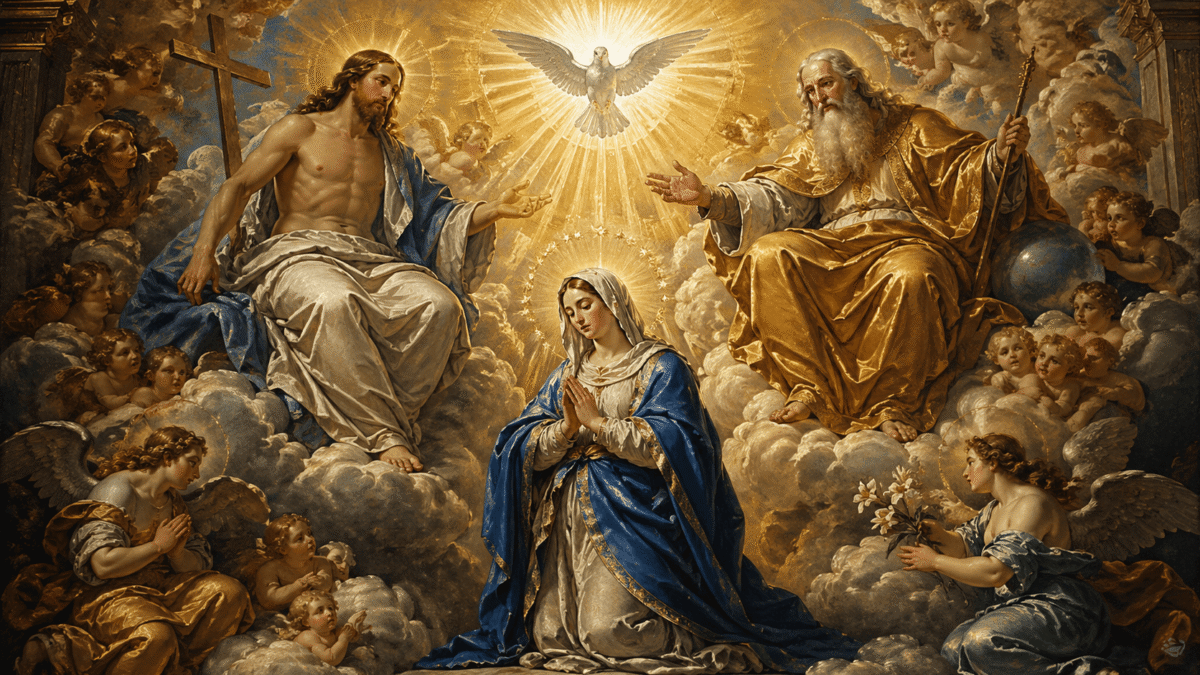
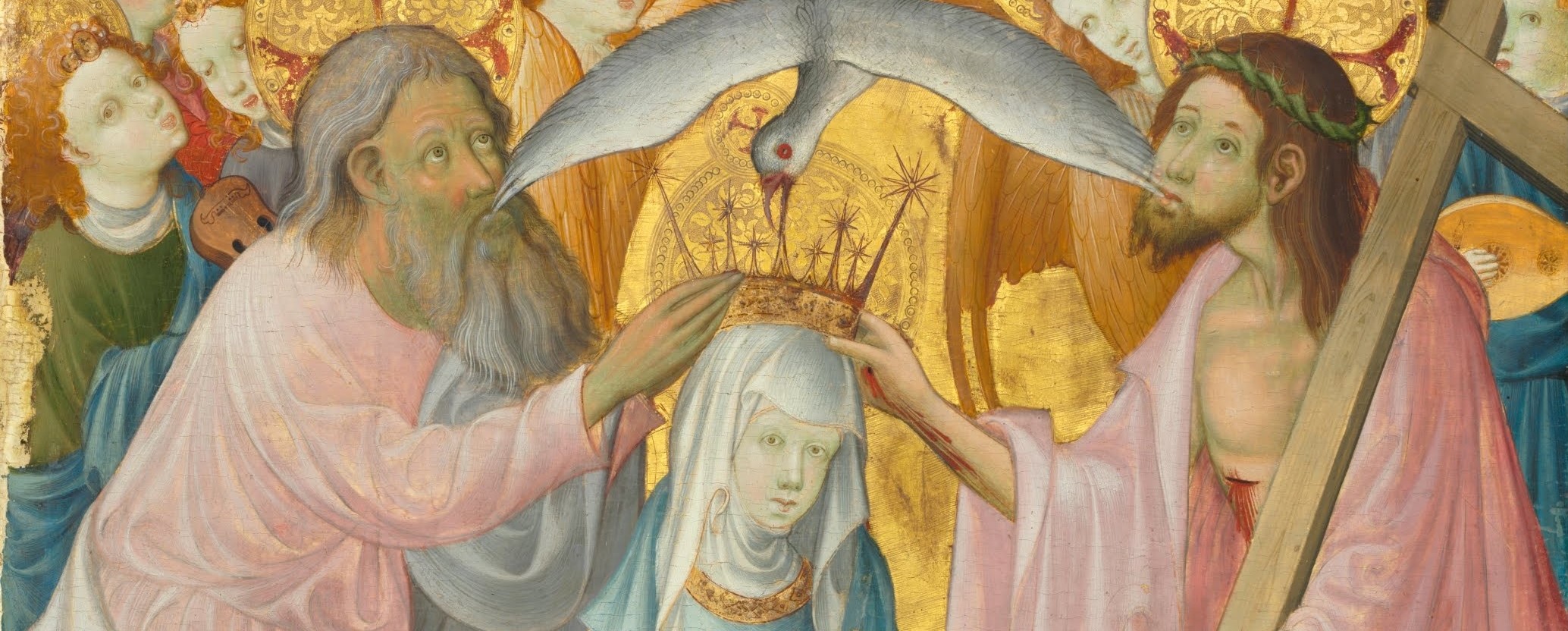
“A” (no translation needed, as it is a single character) Trinity This is the most comprehensive theological framework for Mariology. Mary is the creature who, in a unique way, stands in a personal relationship with the Three Divine Persons: she received maternal fertility from the Father, generated the incarnate Son, and welcomed the Holy Spirit as the power of the Most High. For a complete article: Mariology“Mariology, angelology, demonology, josephology”
Two theological modalities
Western trinitarian theology divides into two “modalities”: the Western-Latinwhich part of the divine essence as a prior reality to Persons, and Greco-patristicWhich part of the Persons serves as the reference point for all reflection. The first leads to the use of “appropriations,” attributing to a Person what is common to the three. The second allows for a more personalist and relational theology. For Mariology, the Greco-patristic modality is more fruitful: it allows consideration of Mary’s relations with each of the divine Persons in their own terms and not merely “appropriated.”
The French school of spirituality
Cardinal Peter of Bérulle (1575-1629) inaugurates a trinitarian mariology of great richness. For Bérulle, Mary’s divine maternity “imitates” the Father’s paternity and “participates” temporally in the fertility of the First Person. His continuers, Condren, Gibieuf, Olier, Saint John Eudes, develop these intuitions. Gibieuf writes: “God, having planned from all eternity to proceed from Himself on the path of love, chose first a wife and an aid that would be like Him. And He thought of Mary.” Saint Louis Marie Grignion de Montfort summarizes the tradition: “God the Father communicated to Mary His own fertility, to the extent that a simple creature is capable, to give her the power to generate His Son.”
Systematic elaborationTrinitarian mariology proposes an analogy of supernatural being based on the Trinity. The “maternal being” of Mary occupies a unique and irreducible place in this analogy: it is not a grace of filiation (proper to adopted sons) nor a grace of hypostatic union (exclusive to Christ), but a proper grace that makes her a “partner” of the Father in the temporal generation of the Son. Spiritual motherhood of Mary It must also be framed trinitarily: it is fertile regarding the Father, who communicates to her the ability to generate also the sons of adoption. The Holy Spirit dwells in Mary actively, diffusing in the hearts of the faithful the spirit of filiation.
Trinitarian-Marian TitlesThe patristic tradition invoked Mary with titles reflecting her relations to the Three Persons: “daughter of the Father,” in the sense of a partner in His paternal fertility, “comparter of the Father” (Dionysius Cartusian). “Mother of the Son,” the central and most stringent title, foundation of all, Mariology“Spouse of the Holy Spirit,” a title in modern theology referring to the creative action of the Third Person in the work of salvation. Virgin ConceptionContemporary theological reflection insists on using these titles with soberness, giving primacy to real relations over nominal appropriations.
Trinitarian-Marian spiritualityThe Apostolic Exhortation Marialis Cultus (Paul VI, 1974) proposes a trinitarian note as an essential characteristic of Marian worship “It is first and foremost necessary that the acts of piety towards the Virgin Mary clearly express the trinitarian and christological note” (n. 25). The same document calls for giving “due emphasis to the person and work of the Holy Spirit” in Marian devotion (n. 26). The presence of the three Persons in Mary, association with the fertility of the Father, motherhood in relation to the Son, active habitation of the Spirit, forms the basis of a Marian spirituality Deeply contemplative and ecumenical.
Deepen your studies Explore (no translation needed, keep as is) Mariology“Short title/phrase – translate without context or additional information.” Marian theology“Short title/phrase – translate without context or additional information.” Mother of God “And (she) said” Postgraduate Program in Mariology“Mariology, angelology, demonology, josephology”
Beata Virgo Maria ab aeterno a Patre electa, Spiritu Sancto obumbrata ut Filium conciperet: tota eius vita ad Trinitatem refertur et in ea comprehenditur.
Vatican Council II, Dogmatic Constitution Light of the Peoples, number 56
Book “Tradução literal” translates to “Literal translation” in English. The Blessed Virgin Mary was chosen by the Father from eternity, covered with the shadow of the Holy Spirit to conceive the Son: all her life refers to the Trinity and is comprehended within it.
Filha electissima Patris et sacrarium Spiritus Sancti, dono sublimis gratiae prae ceteris creaturis, Filium Dei carne induit.
Vatican Council II, Dogmatic Constitution Light of the Peoples, number 53
Book “Tradução literal” translates to “Literal translation” in English. Daughter beloved of the Father and sanctuary of the Holy Spirit, by a sublime grace above all creatures, she enveloped the Son of God in flesh.
Postgraduate Program in Mariology
Would you like to deepen your formation in Mariology? Get to know the Postgraduate Program in Mariology from Locus Mariologicus, an academic formation that combines theological rigor, spiritual life, and the living tradition of the Church.
Learn what the Church teaches about Mary, Mediator of all Graces.
Desire to study Mariology seriously? This article arises from the works in the Locus Mariologicus library. The Postgraduate Program in Mariology takes you to the same source, with academic guidance: Scripture, the Fathers of the Church, and the Magisterium, from the first dogma to contemporary issues.
To learn more, visit: Postgraduate Program in Mariology




Responses