The Visitation of the Blessed Virgin Mary
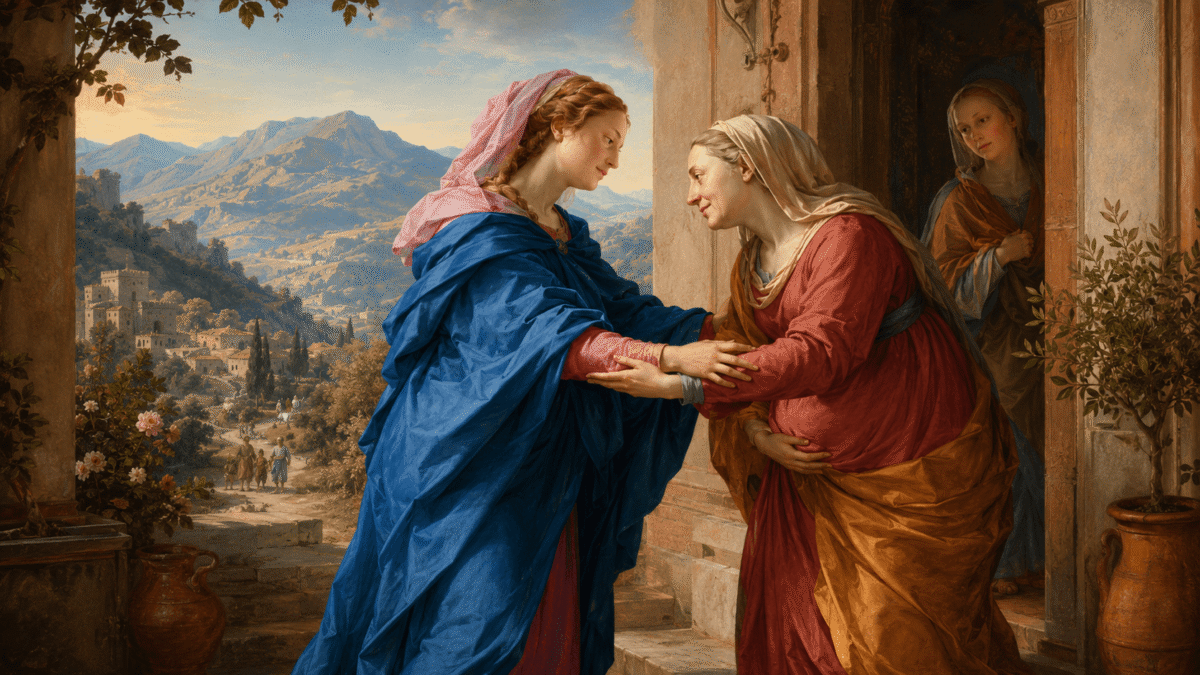
The Visitation of Mary to Elizabeth (Lk 1:39-56) constitutes one of the central moments of biblical Mariology. The Visitation of Mary reveals the mystery of the divine presence anticipated by the Holy Spirit. In the Visitation of Mary, the Mother of the Savior becomes the bearer of the messianic joy announced by the prophets.
“Exulta et lauda, filia Sion, quoniam magnus in medio tui Sanctus Israel”. “Exult and sing for joy, daughter of Zion, for great in your midst is the Holy One of Israel”. (Is 12:6)
I. The joy that bursts forth from the presence of God
The canticle of the prophet Zephaniah, which opens the reading of this Mass, is one of the most luminous pages of Old Testament prophecy. “Sing, daughter of Zion, exult, Israel! Be glad and rejoice with all your heart, daughter of Jerusalem!” (Zeph 3:14). The invitation to joy does not spring from a humanly favorable situation: Zephaniah prophesied in a period of infidelity and threat. The joy he announces is not the result of favorable external conditions, but the consequence of an interior presence: “The Lord, your God, is in your midst as a victorious hero. He exults with joy over you, he renews his love, he dances with jubilation for you” (Zeph 3:17). The reversal is surprising: it is not only Israel that rejoices in God, but God who rejoices in Israel. The relationship between God and His people is presented here in its most intimate and most impassioned dimension: a love that dances, a love that sings, a love that does not hold itself back before the beloved creature.
This joy that Zephaniah announces to the daughter of Zion finds its most perfect realization in the Visitation. Mary is the Daughter of Zion par excellence: in her God dwells in a unique way, in her the promise of presence becomes flesh. When Mary enters the house of Elizabeth, the joy that Zephaniah had prophesied bursts forth physically: John the Baptist himself, still in his mother’s womb, leaps for joy on sensing the nearness of the Lord whom Mary brings with her. The liturgy of this Mass unites the two texts in a single contemplation: the messianic joy that the prophet had promised to Zion is the joy that Mary pours out in every house she visits, because she bears within herself Emmanuel Himself.
II. The haste of charity and the logic of the gift
The Lucan account of the Visitation begins with a detail that the spiritual tradition has never ceased to contemplate: “In those days Mary arose and went with haste into the hill country, to a town of Judah” (Lk 1:39). Mary’s haste is neither nervousness nor anxiety: it is the outward expression of a charity that bears no delay when there is service to be given. As soon as she has received the angelic announcement with the news of Elizabeth’s pregnancy, Mary sets out. She does not wait for the moment to be convenient, she does not calculate the costs of the journey, she does not weigh whether it is prudent to travel alone through the hill country. The grace received is immediately transformed into service offered. This dynamism is constitutive of Marian spirituality: Mary does not keep for herself the gifts she receives, but lets them pour out upon others.
Mary’s visit to Elizabeth is at once an act of human charity, a prophetic gesture, and a sacrament of the divine presence. It is human charity because Mary goes to help an elderly cousin in her unexpected pregnancy. It is a prophetic gesture because Mary’s arrival immediately provokes the manifestation of the Holy Spirit. It is a sacrament of the divine presence because, in Mary, Christ Himself reaches the house of Elizabeth before being born. The Visitation thus anticipates the sacramental logic of the Church: the presence of Christ made effective through human and concrete mediations.
III. The Magnificat: the canticle of the messianic reversal
Elizabeth’s greeting to Mary is one of the most beautiful mariological confessions in all of Scripture: “Blessed are you among women, and blessed is the fruit of your womb! How have I deserved that the mother of my Lord should come to visit me?” (Lk 1:42-43). Elizabeth, moved by the Holy Spirit, recognizes in Mary the Mother of the Lord before any human explanation. Mary’s divine motherhood, which the Council of Ephesus would solemnly define in 431, is already present in this confession of the woman pregnant with John in the mountains of Judea. Elizabeth proclaims Mary’s beatitude not for her physical motherhood alone, but for her faith: “Blessed is she who believed, for what the Lord said to her will be fulfilled” (Lk 1:45). Mary’s faith is, in the order of beatitude, prior to her physical motherhood, because it is by faith that Mary welcomed the divine motherhood as gift and mission.
In response to Elizabeth’s proclamation, Mary intones the Magnificat, one of the grandest of biblical poems. “My soul magnifies the Lord, and my spirit rejoices in God my Savior, because he has looked upon the lowliness of his handmaid” (Lk 1:46-48). Mary’s canticle is a rereading of the whole history of salvation from the perspective of the little ones: God casts down the mighty from their thrones and exalts the humble, fills the hungry with good things and sends the rich away empty-handed (cf. Lk 1:52-53). This reversal is not social revenge: it is the revelation of the logic of the Kingdom, where the divine criteria of greatness contradict human criteria. Mary is the first icon of this reversal: the “handmaid” (Lk 1:38, 48) who becomes the Mother of God, the “lowly one” who is called blessed by all generations.
IV. Mary, bearer of Christ and model of ecclesial service
The third Mass of the Collection of Masses of the Blessed Virgin Mary celebrates in the Visitation the mystery of Mary as the bearer of Christ to the world. The Christophora, she who bears Christ, is not merely a pious designation: it is one of the most expressive designations of Mary’s mission in the economy of salvation. Mary does not bear the Son of God only in her maternal womb for nine months: she bears Him to the world in every gesture of service, in every visit that transforms, in every encounter where the presence of Christ bursts into the lives of others through her mediation.
The Church contemplates in the Visitation the model of her own being and acting. Just as Mary brought Christ to the house of Elizabeth and carried with her joy, liberation, and the Holy Spirit, so the Church is called to be the bearer of Christ in every age and in every culture. Mary’s service to Elizabeth is the archetype of ecclesial service: gratuitous, urgent, concrete, capable of awakening in others the recognition of the divine presence. The Magnificat that Mary sings in the house of Elizabeth is the canticle that the Church prolongs at every Vespers, because the messianic joy that the Visitation inaugurated has not ceased: it continues to travel the world whenever someone, moved by the Spirit, arises with haste to go and meet a brother in need.
Postgraduate Program in Mariology
Would you like to deepen your formation in Mariology? Discover the Postgraduate Program in Mariology of Locus Mariologicus – an academic formation that unites theological rigor, spiritual life, and the living tradition of the Church.
Would you like to study Mariology seriously?
This article is born of the works in the library of Locus Mariologicus. The Postgraduate Program in Mariology brings you to the same source, with academic guidance: Scripture, the Fathers of the Church, and the Magisterium, from the first dogma to contemporary questions.





Responses