The Mother of God and her gaze of tenderness

The Mother of God: Mary’s altar of tenderness over humanity
We begin with an edifying narrative from the Churches of the East: it is said that God was deeply grieved by the fact that His only-begotten Son had been rejected by men in the world. However, God the Father did not want the world to be lost, and so He decided to send the Mother of Jesus, so that her tenderness might draw everyone and no one could reject salvation.
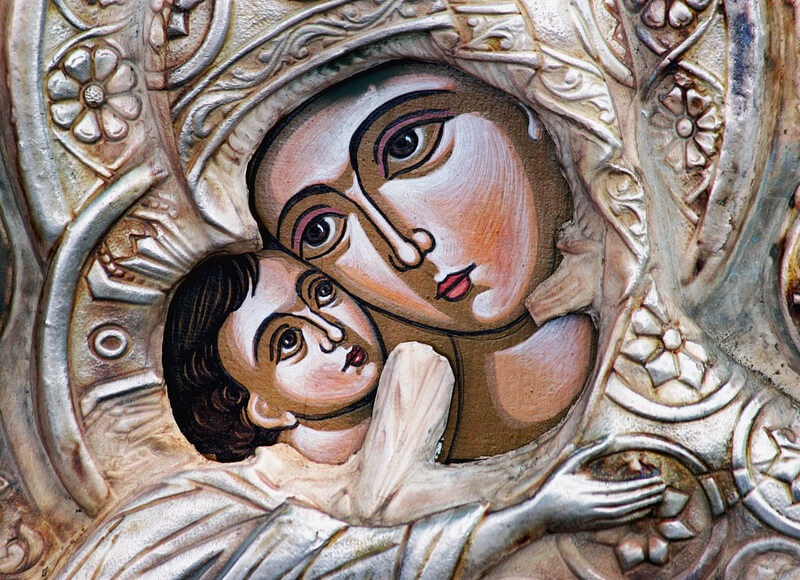
This narrative, however simple, does not fail to contain an important anthropological truth: to be welcomed with tenderness is not outside God’s horizon. If it is true that the world of the industrial age is coming to an end as the age of information opens up, one problem remains: the technology and structures of work that do not humanize. In this sense the value of the tenderness of welcome balances the frenetic life of metropolitan man, solitude, aggressive competition, the invasive harassment of the web world, the eternal discovery of unforeseen things, good and bad. All this is part of Mary’s great emblem: to welcome with tenderness the unforeseeable, the wholly other.
Mary welcomed the Son of God in her heart and in her body. Unlike the scribes and Pharisees who were hostile to Jesus, Mary is welcoming in everything. In her radical poverty she opened herself to God and saw His presence. For this very reason the iconography of Mary, unlike the emperors who are represented in profile on coins, presents Mary frontally, in the light of God, where she welcomes and points out to the pilgrims of the Church the life of Christ.
Mary’s tender welcome goes beyond the horizon of the world we know because it opens itself to a personal hospitality, beyond the local one, for it welcomes the God who comes. This welcome of the Mother of Jesus is feminine but it is also the work of the Holy Spirit. It reflects the fatherhood of God, becoming the ‘maternal face of God’, an expression of tenderness that evokes the mercy of the Father and that in the Latin tradition we express as Mother of Mercy. In this way Mary responds to two cries of our humanity: the need for tenderness and the valuing of women. The ‘reinforced concrete’ of the metropolises houses but does not welcome, people communicate but without compassion in the harshness of the days. Mary, on the contrary, welcomed with tenderness the Child, the Crucified One, the Risen One, and the children in the Son who abandoned Him on the cross. From the feminine point of view Mary nourishes, defends, and welcomes the life of all the crucified of all times. We cannot think of Mary without thinking of the women to whom She entrusts her treasures in every consecrated virginity or spousal motherhood.
If we think of the atheism of the contemporary age, we see this contempt for the Virgin Mother and for the women who safeguard the humanizing moral values capable of balancing materialist structures.
Pavel Evdokimov (a Russian theologian) said: “Now, if Christ saves the world, it is the Theotokos who protects it and introduces into its humanity the attentiveness that becomes sensitive to grace. The maternal tenderness that is bound to the cult of the Theotokos infuses into Christian humanism an absolutely particular note of sweetness”.
The world and the Church can only gain from the encounter with Mary, for in the concrete reality of our days she signifies the paradigm of divine compassion and of the welcome of the other, placing no obstacles, prejudices, judgments, or conditions upon her maternal tenderness. We leave you with the words of the Holy Father Pope Francis when he met the Bishops of Mexico in 2016:
“I know that in looking into the eyes of the Virgin I reach the gaze of your people, who in her learned to express themselves. I know that no other voice can speak so deeply to the Mexican heart as the voice of the Virgin. She protects their highest desires, their hidden hopes. She gathers up their joys and their tears. She understands their many languages and answers them with a Mother’s tenderness, because they are her children. As Saint Juan Diego did, and as successive generations of the children of the Guadalupana have done, the Pope too has for some time now had the desire to see her. Even more, I myself wanted to be reached by her maternal gaze. I have reflected much on the mystery of this gaze, and I ask you: welcome what comes forth from my Pastor’s heart at this moment. Above all, the Virgin Morenita teaches us that the only force capable of conquering hearts is the tenderness of God. That which enchants and attracts, that which convinces and conquers, that which opens and breaks the chains is not the force of instruments or the harshness of the law, but rather the omnipotent weakness of divine love, which is the irresistible force of its sweetness and the irreversible promise of its mercy”.
Invited by the Tenderness of the Virgin, we also propose to every scholar of Mariology the practice of the “revolution of tenderness”. Here is a day to act concretely in the family, at home, with your own, or perhaps with those who for so long have been waiting for a practice of tenderness from you. Perhaps a telephone call to someone who is waiting for you, a thank-you to the loved one who has taken care of your house, of your things. Perhaps a message of affection, an embrace, a well-spoken “I love you”. The Holy Spirit will inspire you this day to concrete acts of tenderness.
Afterwards we want you to share with us here how your concrete act went!
To deepen the theology of Mary as Mother of God, consult the encyclical of John Paul II: Redemptoris Mater on Mary Mother of the Redeemer in the faith of the Church.
Deepen your studies: explore Mariology, Marian Theology, Marian apparitions, and the Postgraduate Program in Mariology.
Postgraduate Program in Mariology
Would you like to deepen your formation in Mariology? Discover the Postgraduate Program in Mariology of Locus Mariologicus, an academic formation that unites theological rigor, spiritual life, and the living tradition of the Church.
Would you like to study Mariology seriously?
This article arises from the works of the library of Locus Mariologicus. The Postgraduate Program in Mariology takes you to the same source, with academic guidance: Scripture, the Fathers of the Church, and the Magisterium, from the first dogma to contemporary questions.



Responses