Mary in Gil Vicente, the Father of Portuguese Theater (1465-1536)

Gil Vicente (1465-1536) and Marian theater: the autos of devotion and the presence of Our Lady
The Auto da Sibila Cassandra: the polyphonic exaltation of the Virgin and the original Mariological argument
He is considered the founder of Portuguese theater and one of the richest poets and personalities of the Renaissance period. His output includes works of a religious character, comedies, criticism of manners, a vast, lively, and colorful gallery of characters who emerge from every quarter, from the mythological, chivalric, courtly, religious, and angelic world, and who move through settings of great environmental and psychological variety, and through a satirical and humorous vein that spares no one. Throughout the autos, Gil Vicente maintains a good level of theology sustained by a sincere feeling of piety.
What is an auto?
A form of theater that arose in the Middle Ages, composed of a single act that moves between the religious and the profane, and whose characters are allegorical, for they symbolize the virtues, the sins, angels, and demons.
In his work the presence of Our Lady is constant. She appears in her beauty and sublimity as Mother of God and in her goodness toward sinners.
The Auto da Sibila Cassandra is an entire polyphonic exaltation of the Virgin.
What is a Sibyl?
She is a woman recognized as having the ability to foretell the future.
The argument is original: the Sibyl Cassandra believes she is the virgin from whom the Lord was to be born, and so she renounces marriage. When she understands her mistake, she does not hesitate to invoke and exalt the true Mother of God. Among the characters who come into action are also Isaiah, Abraham, and Moses.
We present here some excerpts from the ending.
All the characters of the Auto reveal who the true Mother of God is.
Hail, star of the morning
Isaiah (to Cassandra). Be quiet, poor fool. For such a mother much more is required, and much more was prophesied. As for you, you are her opposite: vain, arrogant, and presumptuous. That incomparable mother has humility as her characteristic. The rivers and the fields sing her beauty, the snow her immaculate purity, virtues not found in creatures. The flowers of creation are inspired by her, and among the stars of heaven there is no more radiant star. Conceived without sin, chosen as queen before she was born, chosen from eternity, loved by God and chosen by him as mother. By virtue she is a luminous and generous queen, by grace an empress, by humility a great lady, so that the world has never seen so sublime a creature. Her name is Mary, and this unmasks your presumptions. Her son Emmanuel, according to my prophecy, will eat butter and honey.
ABRAHAM (to Isaiah). A thousand times you pointed out and announced the Messiah of God; I swear to you: you did not lie.
MOSES (to Solomon). You too, Solomon, in your songs set forth prophecies and said of her: formosa mea, columba mea, who delights in your glory and at the sight of you fills the soul with joy, despite the hardness of life.
ABRAHAM. Were one to manifest what was predestined for her, no one could imagine it, because the infinite escapes our mind. Everything was prophesied by the will of God.
CASSANDRA. O Lord, I am so lost and contrite that I do not dare to ask anything. I did not know wisdom and prudence. I did not deserve to live. Virgin and Mother of God, I come to you, flower of women. By the seven gifts that God granted you, pray for the wicked world.
CIMMERIA. Mirror of the generations and of the nations, daughter of God, mother and spouse, exalted, glorious, queen, summit of perfections, way of the pilgrims who weep, advocate of the people, I deliver myself into your hands.
PERESICA. Sole good, planet of our glory, certainty of victory, our banner of laurels.
ERUÉIA. Hail, star of the morning, so divine. Hail, rose, white flower. You gave birth to the Redeemer, and your beauty after the birth became finer.
(thus their praise ends; the characters go on to sing the following song, composed and set to music by the author)
ALL. The maiden is very lovely, very lovely. Tell her, sailor who lives on the sea, whether the ship or the sail or the star is as beautiful.
Tell her, knight, locked in your armor, whether the horse or the arms or the war is as beautiful.
Tell her, O shepherdess, who keep your flock, whether he or the valleys or the meadows are as beautiful.
(Auto da Sibila Cassandra)
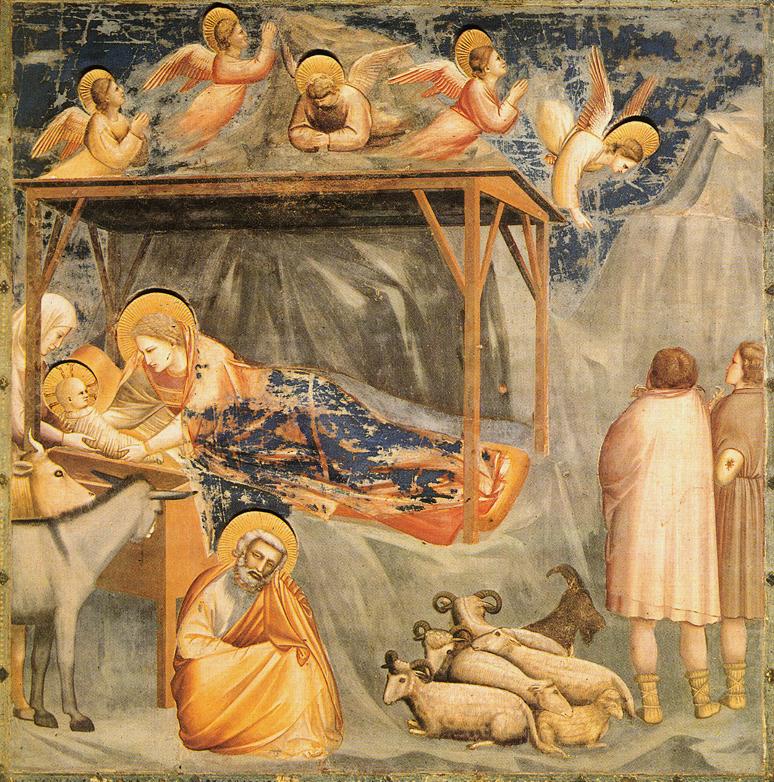
The birth of Jesus
It seems to me, my Lady,
that in this darkness
no lights are needed,
because the Lord, who is now born,
he himself is the true light.
Do not trouble yourself
with preparing the food.
He himself is abundance,
his name is bread of life.
Therefore, nothing else is lacking to us.
If he chose
so poor a dwelling in which to be born,
do not be distressed by that.
Wherever he comes to be found,
there is his heavenly court.
If you should lack small cloths,
there will be no great misfortune.
He will have something to cover himself with,
He who all things, heaven and earth,
clothed with great beauty.
The presence of Mary in art and in literature as an expression of popular faith is valued by Paul VI in the apostolic exhortation Marialis Cultus, which recognizes in the artistic and literary works dedicated to Mary a legitimate and precious form of transmission of the Marian faith through the centuries.
Deepen your studies: explore Mariology, Marian Theology, Marian apparitions, and the Postgraduate Program in Mariology.
Postgraduate Program in Mariology
Would you like to deepen your formation in Mariology? Discover the Postgraduate Program in Mariology of Locus Mariologicus, an academic formation that unites theological rigor, spiritual life, and the living tradition of the Church.
Would you like to study Mariology seriously?
This article is born from the works in the library of Locus Mariologicus. The Postgraduate Program in Mariology takes you to the same source, with academic guidance: Scripture, the Fathers of the Church, and the Magisterium, from the first dogma to contemporary questions.



Responses