The Eucharistic Memory of Mary

From the Annunciation to the Eucharist
The mystery of the Annunciation can be summed up in a “yes” to the saving plan of the Father: “Behold, you will conceive a son, you will give birth to him and you will call him Jesus… Here I am, I am the handmaid of the Lord; let it be done to me according to your word” (Lk 1:31, 38). Mary shows a remarkable capacity for listening and, consequently, for responding: she listens (Lk 1:29), marvels (Lk 2:33), contemplates (Lk 2:19, 51), and plays an intercessory and silent role in the self-giving (Jn 2:5; 19:25).
The saving plan of the Father transcends the limits of time and space. God had already expressed himself in many ways throughout the history of humanity and, especially, in the history of Israel, but “in these days, He has spoken to us through the Son, whom He appointed heir of all things and through whom He also created the world” (Heb 1:2). Mary welcomed Jesus, the incarnate Word: “In Him the Father spoke the definitive word about man and his history” (Tertio Millennio Adveniente 5).
The angel announced to her that Jesus was “the Son of the Most High” (Lk 1:32), for “the one who is to be born will therefore be holy and will be called the Son of God” (Lk 1:35). This plan of the Father, communicated to Mary at the Annunciation, is God’s mercy “from generation to generation” (Lk 1:50). The saving plan of the Father becomes a mission for Mary. Thus she will proclaim the saving message in the house of Elizabeth, who was carrying the precursor in her womb (Lk 1:44), and will show Jesus to the shepherds and to the magi (Lk 2:16; Mt 2:11).
Mary’s faith will help to discover the meaning of the signs of Jesus, through which “his disciples believed in him” and followed him “with his mother” (Jn 2:11-12). Mary’s virginal conception took place “in the fullness of time“, when “God sent his Son, born of a woman… to redeem those who were under the law, so that we might receive adoption as sons” (Gal 4:4-5). This conception will lead Mary to remain steadfastly “at the foot of the cross“, in order to hear anew the saving and missionary plan of the Father accomplished by Jesus: “Woman, behold your son!” (Jn 19:26).
From the Annunciation to the cross, Mary listens, marvels, contemplates, intercedes, gives herself… The words of the angel and the words of Jesus reveal the saving plan of the Father. For Mary, the words “behold your son” meant seeing in every human being a “living Jesus” who must be born. She could recall the prayer of Jesus at the Last Supper: “Father… you have loved them as you have loved me… that the love with which you have loved me may be in them, and I in them” (Jn 17:23-26).
Mary enters into the mystery of universal salvation: “Behold your son… then you will love them as you have loved me… because I am in each one of them… Mary, from the Annunciation on, becomes the Mother of the “bread of life”, for she receives Jesus in order to communicate him to all. Indeed, “the Virgin was called to offer all her humanity and femininity so that the Word of God might become incarnate and become one of us… Mary, in giving her consent to the message of Gabriel, lost nothing of her true humanity and freedom” (Saint John Paul II, Fides et Ratio n. 108).
The ecclesial community always celebrates the Eucharist remembering Mary, in whose womb the bread of life was formed and whose presence is related to Christ sacrificed. The “memory” of Mary, “Theotokos“, helps the ecclesial community to deepen the Eucharistic “memory“, as presence, sacrifice, communion, special action of the Spirit, mission and eschatology. Mary is the “model of the spiritual attitude with which the Church celebrates and lives the divine mysteries” (Paul VI, Marialis cultus n. 16).
The Eucharistic-Marian Spirituality of the Church
Santa Maria ad Praesepe, or Saint Mary Major, where the Salus populi romani is preserved, is called “the Bethlehem of Rome”, because it preserves, according to an ancient tradition going back to the sixth century, the crib or cradle of Jesus. According to the Gospel of Luke, the encounter of the shepherds took place in this way: “They found Mary and Joseph, and the child lying in the manger” (Lk 2:16).
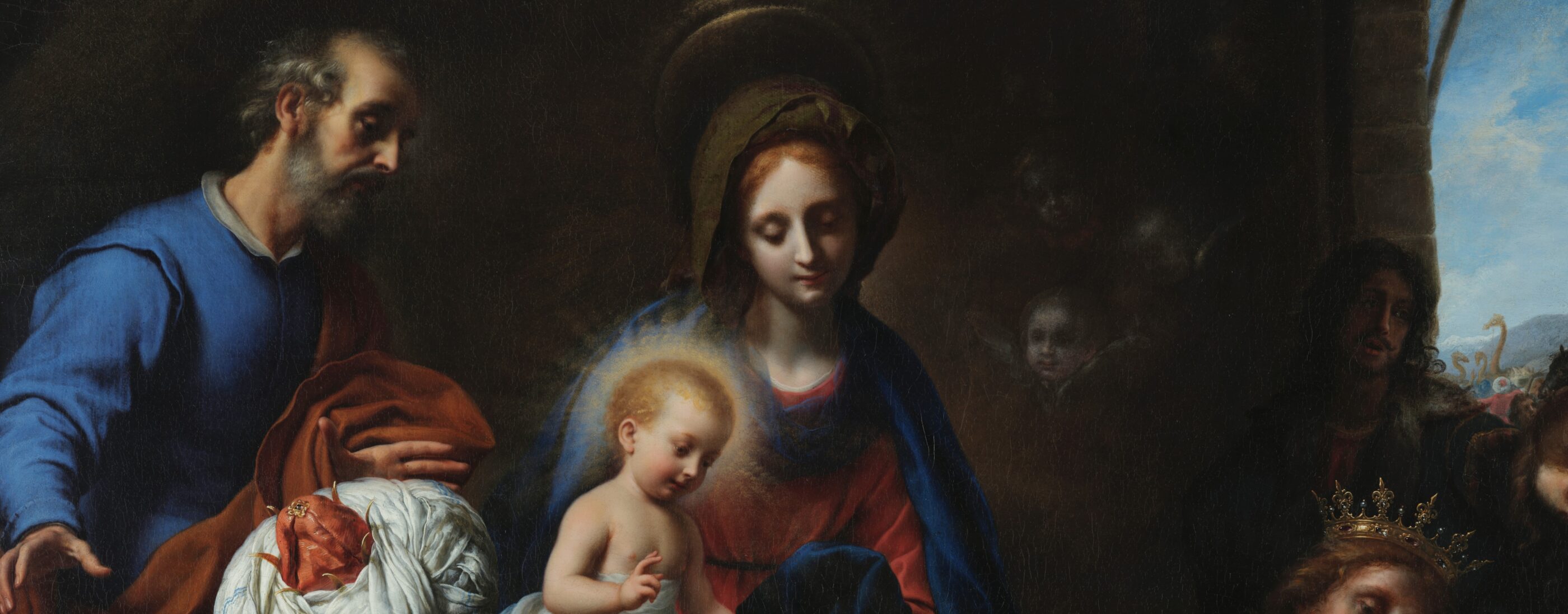
After the birth of the Lord in Bethlehem, Matthew recounts the arrival of the Magi from the East. The encounter with the newborn child is described in the following way: “Entering the house, they saw the child with Mary his mother, and falling down, they worshiped him. Then they opened their treasures and offered him gold, frankincense and myrrh” (Mt 2:11). In “Bethlehem“, which according to popular etymology means “house of bread“, “the days for her to give birth” were fulfilled for Mary (Lk 2:6). Mary offers the bread of life, laid in the manger, to the shepherds and the magi (Lk 2:7, 12, 16; cf. Mt 2:11).
Matthew speaks rather of “house“. Mary is the house where the bread of life is found. Matthew’s biblical context, in this case, holds all the richness of the Old Testament texts about the new Jerusalem, full of light, mother of the peoples. Luke will give us, in the presentation of Jesus in the temple, a hint of connection with this same context of Matthew: Jesus is the “light of the peoples” (Lk 2:32). Matthew’s account of the Magi, who come from other peoples, follow the star and find the Messiah (cf. Mt 2:1-11), seems to draw its inspiration from Is 60:1-6, in describing Jerusalem as the mother of all the peoples: “Arise, be clothed in light, for your light is coming, and the glory of the Lord is rising upon you… A multitude of camels will cover you, dromedaries of Midian and Ephah. All of them will come from Sheba, bringing gold and frankincense and proclaiming the praises of the Lord” (Is 60:1-6; cf. Is 11; 49; 56; 66; Zech 2:14-15; Ps 72:10-11).
The new Jerusalem, our mother (Gal 4:26), is prefigured in Mary, the “woman“, who comes forth from the man-Adam (cf. Gen 2:23) and who becomes the figure of the new community (the Church), which comes forth from the open side of Christ. The Church makes “memory” of this Marian reality in the Eucharistic celebration, where the redeeming mystery of Christ is made present in all its aspects. The centrality of the Eucharist in Christian life reinforces the Marian dimension of spirituality, as it is lived in the Marian shrines. Christian spirituality is always “life according to the Spirit“, “life in Christ“, and therefore life according to the model of Mary, faithful to the Spirit, associated with Christ present in the Church and, in a special way, in the Eucharist.
“Spirituality” means “walking according to the Spirit” (Rom 8:4, 9), that is, “walking in love” (Eph 5:1), “living” in the Spirit (cf. Gal 5:25). Marian spirituality follows these same lines of generous fidelity to the Spirit in order to be able to serve the designs of the Father in Christ. It is always a Trinitarian, Christological, Eucharistic, pneumatological, ecclesial spirituality. Marian spirituality and Eucharistic spirituality are analogous terms, for it is a question of the one Christian spirituality.
With the model of Mary and with her help, the believer lives the Eucharistic mystery as presence, sacrifice and communion of Christ. To deepen the Eucharistic mystery in these three aspects means to rediscover Mary’s relationship with the sacrificial and communal presence of Christ in the Eucharist.
The Active Presence of Mary in the Community That Celebrates the Eucharist
A Marian shrine is always centered on the Eucharistic celebration. ‘Saint Mary of the Crib‘ (Sancta Maria ad Praesepe) is the mother of the ‘bread of life‘, born in Bethlehem (‘house of bread‘), who is offered to all. Mary’s presence in the community leads to the listening to the Word and to association with Christ the Redeemer, whose sacrifice is made present in the Eucharist.
From the beginning of Christianity, in the Eucharistic celebration, Mary is the ‘memory‘ of a Church that, like her, wants to ponder the Word of God in its heart (cf. Lk 2:19, 51), and also wants to be spousally associated with Christ the Redeemer (Jn 19:25-27). The Church follows the attitude of gathering, as in the Upper Room, ‘with Mary, the Mother of Jesus‘ (Acts 1:14). Today, as in the primitive ecclesial community, Mary is present at the celebration of the ‘breaking of the bread‘ (Acts 2:42).
This Eucharistic-Marian reality is manifested in a special way in the Marian shrines, where the faithful come to listen to the Word of God and to be associated with Christ, present in the Eucharist, under the guidance of Mary, associated with Christ the Redeemer. If we look for the theological foundation of this Eucharistic and Marian attitude of the Church, we must draw inspiration from the harmony of revelation and from the contents of the faith. When Jesus said ‘this is my body‘ (‘my flesh‘), ‘this is my blood‘ (Lk 22:19-20), it is a question of the ‘flesh of the Son of Man‘ (Jn 6:53). Whoever eats his flesh and drinks his blood shares in his very life: ‘Whoever eats my flesh and drinks my blood abides in me and I in him… whoever feeds on me will live because of me‘ (Jn 6:56-57).
The Church is aware of the echo of these words in the heart of Mary, who sees Jesus alive in every Christian who takes part in the Eucharist. Now the same body born of Mary is glorified and present in the Eucharistic sacrament. The Church professes this faith through the Eucharistic hymn: ‘Hail, true body born of the Virgin Mary… Jesus, son of Mary‘ (fourteenth-century text). By its nature, the Church is Eucharistic and Marian. The glorified and Eucharistic flesh of Jesus, virginally conceived by Mary, is flesh like ours, but in relation to glorification and to the new world restored by Christ. ‘Flesh‘, in the Semitic mentality, means the living (human) being in its totality: the whole person in his dimension of limitation.
But now, this glorified flesh is ‘flesh for the life of the world‘ (Jn 6:51). When Jesus says ‘I am the bread of life‘ (Jn 6:48), he means that, by offering his ‘flesh‘, he communicates his very life. The Eucharist is the banquet offered freely (Is 55:1-3), prepared for all peoples (Is 25:6-9). Mary, figure of the Church, welcomes all peoples into her womb, in order to communicate to them the bread of life. This happens through the Church: ‘The words that Jesus utters from the cross signify that the motherhood of the one who bore him finds a “new” continuation in the Church and through the Church, symbolized and represented by John‘ (Saint John Paul II, Redemptoris Mater 24). ‘Mary embraces, with her new motherhood in the Spirit, each and every one in the Church and… through the Church‘ (Redemptoris Mater 47).
From this Marian-ecclesial perspective we can better understand the relationship between the wedding at Cana (Jn 2), the announcement of the bread of life (Jn 6), the manifestation of Mary as Mother and the open side of Christ (Jn 19). Mary is the ‘woman‘, Mother and figure of the community that nourishes us with the bread of life. Cana is the beginning of the sacramental signs, summed up in water, wine, bread, blood. The Church springs from the open side of Christ, like the blood and the water that symbolize the sacraments.
Jesus hands over to the Church: his mother, the gifts of the Spirit and the sacramental signs, among which the Eucharist stands out. This is why the Christian people live the spiritual motherhood of Mary in relation to the Eucharist. Mary always leads to the sacred Banquet, as the privileged and central sign of the ecclesial mystery. As Saint John Paul II teaches us
“This motherhood of hers is particularly felt and lived by the Christian people in the sacred Banquet, the liturgical celebration of the mystery of the redemption, in which Christ is made present, his true body born of the Virgin Mary. Rightly, the piety of the Christian people has always recognized a profound bond between devotion to the Blessed Virgin and the worship of the Eucharist: it is a fact observable in the liturgy of both West and East, in the tradition of the religious Families, in the spirituality of contemporary movements, including those of young people, and in the pastoral care of the Marian shrines. Mary guides the faithful to the sacred Banquet”
(Redemptoris Mater 44)
The reality of Mary, who gave Christ flesh and blood, is in some way made present in the Eucharistic celebration and in the whole ecclesial mystery. The mystery of the Incarnation is in some way prolonged in the Eucharistic celebration. “The Virgin was called to offer all her humanity and femininity so that the Word of God might take flesh and become one of us… begetting the Truth and keeping it in her heart, she shared it with the whole of humanity forever” (Saint John Paul II, Fides et Ratio 108).
The relationship between Mary and the Eucharist is deepened in the encyclical Redemptoris Mater of John Paul II, which presents Mary as the Eucharistic woman, whose fiat inaugurates the path of oblation that culminates in the Eucharist.
Deepen your studies: explore Mariology, Marian Theology, Marian apparitions and the Postgraduate Program in Mariology.
Postgraduate Program in Mariology
Would you like to deepen your formation in Mariology? Discover the Postgraduate Program in Mariology of Locus Mariologicus, an academic formation that unites theological rigor, spiritual life and the living tradition of the Church.
Would you like to study Mariology seriously?
This article is born from the works in the library of Locus Mariologicus. The Postgraduate Program in Mariology takes you to the same source, with academic guidance: Scripture, the Fathers of the Church and the Magisterium, from the first dogma to contemporary questions.




Responses