Christian Hope in the Third Century
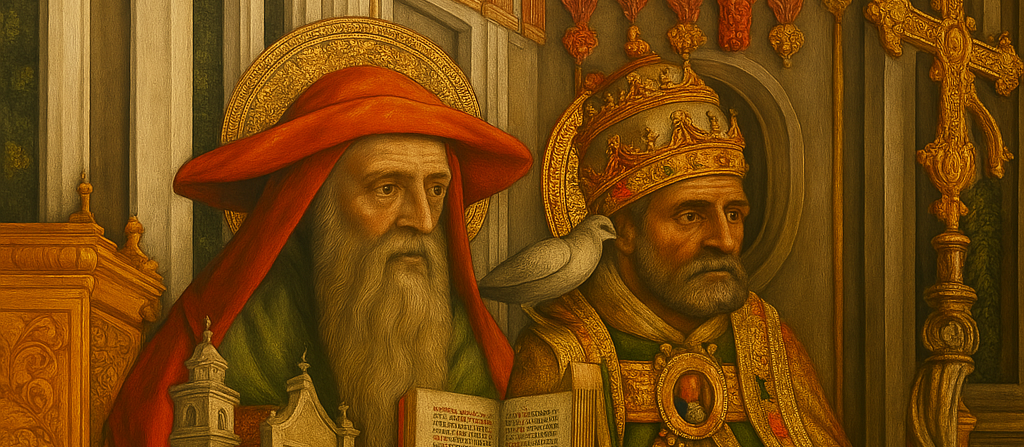
In the third century, Christian theology passes through a period of intense development amid challenges such as increasingly severe persecutions and the clash with Gnostic heresies. In Alexandria, Clement and Origen emerge as key figures, dialoguing with Hellenistic culture and deepening the understanding of hope (spes). This virtue, which establishes itself as an indispensable force for sustaining faith in difficult times, is manifested both in the defense of the resurrection and in the affirmation of a spiritual life directed toward ascending progress.
The Alexandrian context of the third century
Alexandrian theology flourishes in an intellectual environment marked by Greek philosophy and by the meticulous study of the Scriptures. Both Clement of Alexandria and Origen made use of exegetical methods and Hellenistic philosophical conceptions in order to interpret the biblical texts on hope:
Clement of Alexandria, Stromata 2, 134
“It is now important for the true gnostic to understand the transition from visible things to spiritual realities, for hope in what is transcendent raises us above the provisional”.
Clement of Alexandria, Stromata 3, 48
“If we strive to learn all the sciences, how much more fitting it is for us to devote the mind to the divine promises, which are the basis of our hope”.
Origen, for his part, develops the idea of spiritual progression in works such as Peri Archon (De Principiis 1, 7, 5) and in his commentary on Romans, maintaining that the Christian advances from the provisional to the definitive, in search of the “higher realities”.
Origen, De Principiis 1, 7, 5
“Just as the sun gradually rises to illuminate all things, the soul, guided by grace, ascends to higher truths, nourishing itself on the hope of the full vision of God”.
The third century is also marked by controversies with Gnostics who denied the resurrection, diminishing the importance of the bodily element in salvation. Clement and Origen responded directly to these objections:
Clement of Alexandria, Stromata 3, 48
“Some, who call themselves knowers, reject the hope of seeing the body clothed with incorruptibility. It is necessary to demonstrate to them that the same God who created everything out of nothing can restore what He Himself formed”.
Origen, Contra Celsum 5, 17-24
“I refuted Celsus in his attack against Christian doctrine, showing that the hope of the faithful is not based on fables, but on the unequivocal promise of the Scriptures concerning the resurrection”.
The persecutions and the pastoral force of hope
The third century was a period of intense persecutions. Ecclesiastical leaders such as Clement and Origen understood that these adversities could strengthen the faith of afflicted Christians:
Clement of Alexandria, Stromata 4, 13/88
“Their sufferings are transitory, but the crown they hope for is eternal. Christian hope arises as a shield against present anguish”.
In the midst of this climate, various authors recognize that Christian hope functioned as a spiritual force for confronting the widespread fear:
Origen, Exhortatio ad Martyrium
“Whoever perseveres in hope does not bend before earthly threats, for he clings to the promise of Christ, who will sustain him even in the face of death”.
The theme of spes paenitentiae (hope in conversion) also gains prominence. Clement, for example, emphasizes the possibility of reconciliation:
Clement of Alexandria, Quem Dives Salvetur 38, 5-39, 6. 42, 16
“The door of repentance is never closed to those who turn to God. Hope is the bridge by which we return to the merciful Father”.
Clement of Alexandria, Paidagogos 1, 10, 91, 2
“The divine Pedagogue invites the sinner to leave ignorance behind and to tread the path of light, for even though guilt accuses us, the hope of conversion lifts us up”.
Origen also addresses trust in the mercy of God:
Origen, Contra Celsum 5, 65
“If the Lord is truly good, then we cannot forget that His call extends to those who repent. The very history of Israel confirms it: where there is sincere contrition, new hope springs forth”.
Origen, Homily on Jeremiah (20, 9, GCS Orig. 3, 191f)
“In this oracle, Jeremiah presents the sin of Israel, but also announces forgiveness. So too we, though guilty, can hasten to the Lord who awaits our return”.
The influence of philosophy and pastoral necessity
The development of Christian hope in the third century resulted from two principal axes:
- Interaction with Hellenistic philosophy: In dialoguing with Platonism and other Greek currents, the Alexandrian theologians constructed a theology of progress, seeing the spiritual journey as a gradual ascent toward the transcendent.
- Pastoral necessity: Amid persecutions, Gnostic heresies and collective fears, hope becomes a key element for encouraging the faithful, strengthening ecclesial cohesion and offering a consoling vision of human history.
This synthesis between philosophy and pastoral practice marks Alexandrian Theology, ensuring that hope was not merely an abstract concept, but a living force, capable of sustaining hearts in the midst of crises.
Conclusion
In the third century, the doctrine of hope (spes) experienced a notable deepening in the Alexandrian school, where Clement of Alexandria and Origen took on a leading role. The dialogue with Hellenistic culture, the theological struggle against Gnosticism and the climate of persecutions shaped the content and the pastoral function of hope.
- Against Gnosticism: They reaffirmed the resurrection of the body and the goodness of creation, arguing on the basis of the omnipotence and the faithfulness of God.
- In the face of persecutions: Hope became an instrument of courage, inviting the faithful to see beyond the suffering of the present, upheld by the divine promises.
- In conversion: Reconciliation with God remains open. The hope of forgiveness and renewal (spes paenitentiae) reveals the merciful face of the Father.
Thus, the Alexandrian Theology of the third century not only preserved the tradition of the earlier Fathers, but refined the reflection on hope, making it a pillar of the Christian spiritual path, a continuous progress toward the heights of communion with God. Hope, open to divine mercy, raises up the sinner and animates the martyr. It illuminates the wise and reveals to the world that Christian faith is not confined only to visible realities, but anticipates the final victory of God in human history.
Christian hope of the third century, marked by the persecutions and by the witness of the martyrs, is studied in the context of the tradition presented in Spe Salvi by Benedict XVI, which follows the development of Christian hope up to the modern era.
Deepen your studies: explore Mariology, Marian Theology, Marian apparitions and the Postgraduate Program in Mariology.
The Locus Mariologicus Institute is the world’s leading academic center in Mariology. Explore our Marian Theology, the studies on Marian apparitions and the Postgraduate Program in Mariology.
To deepen the theology of Marian hope, consult the Encyclical Redemptoris Mater by Pope John Paul II.
Postgraduate Program in Mariology
Would you like to deepen your formation in Mariology? Discover the Postgraduate Program in Mariology of Locus Mariologicus – an academic formation that unites theological rigor, spiritual life and the living tradition of the Church.




Responses