The Adoration of the Cross and the Sorrowful Virgin:
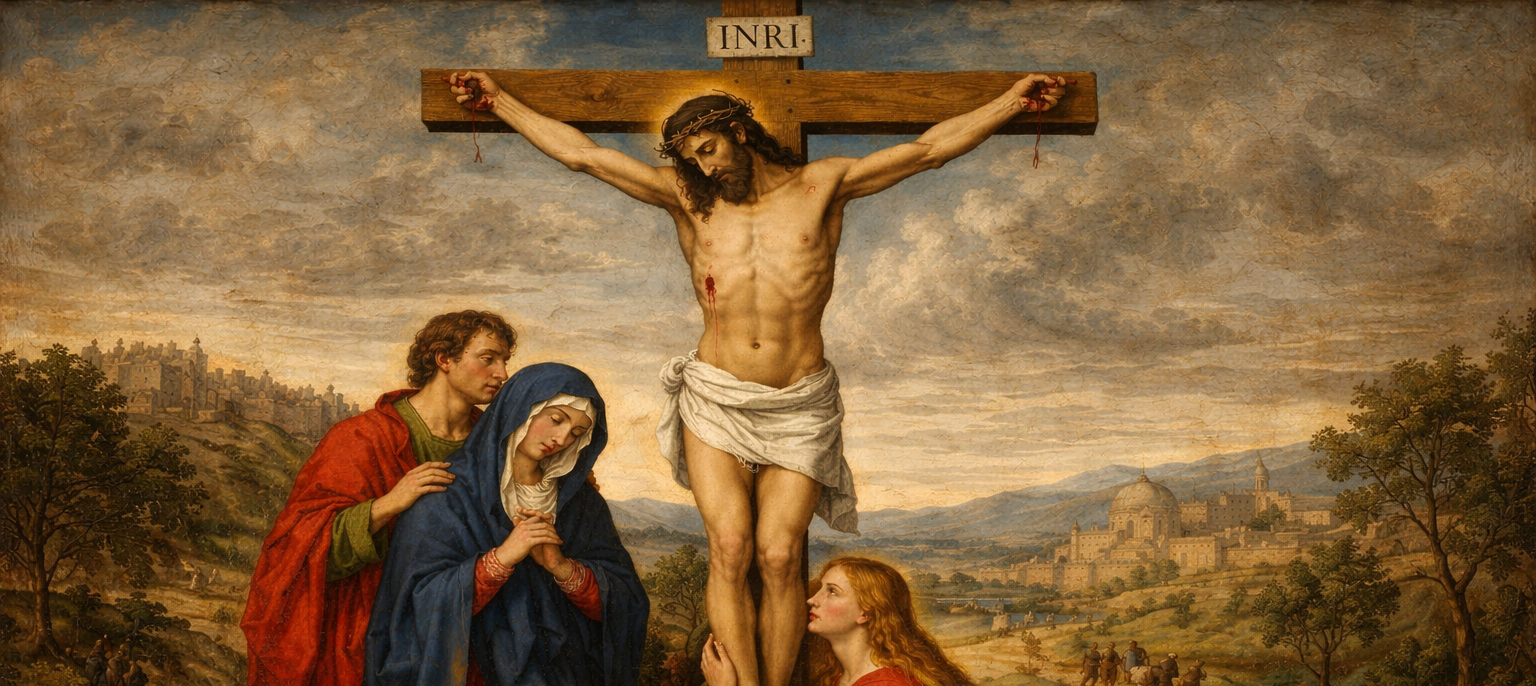
Good Friday has no Mass. It has a Liturgical Action. This distinction is not a matter of protocol: it is theological. Good Friday is the only day of the year on which the Eucharist is neither celebrated nor consecrated, because the Cross is the altar, the priest, and the victim. The Roman liturgy articulates this singular celebration in three articulated moments:
- the Liturgy of the Word,
- the Adoration of the Holy Cross,
- the Communion with the species consecrated on Thursday.
In each of these moments, the person of Mary of Nazareth emerges with a role that is not decorative: it is structural. The Sorrowful Virgin is precisely this structural figure of the liturgy of the Passion.
On this Good Friday of 2026 we propose a reading of the liturgical action of the Passion from its Mariological core: the stabat of the Sorrowful Virgin beside the Cross, her association with the sacrifice of the Son, and the pious exercises that the Church recommends, the Via Matris, the Hour of the Desolate Mother and the contemplation of the Pietà as legitimate and recommended ways of participating in the mystery that the Sorrowful Virgin lived beside the Cross. Read also: the silence of Holy Saturday, the encounter of the Risen One with His Mother and Mary, teacher of paschal hope. Cf. Redemptoris Mater § 18.
I. The first reading: Is 52:13-53:12 and the “suffering servant” whom Mary knew
The liturgical action of Good Friday opens with the fourth Song of the Servant of the Lord (Is 52:13-53:12): “He had no form or beauty to attract us. His appearance inspired no desire. He was despised and forsaken by men, a man of sorrows, acquainted with suffering” (Is 53:2-3). This text, which the Christian tradition has always read as a prophecy of the Passion of Christ, has a Marian dimension that is rarely made explicit: Mary of Nazareth knew these pages. She grew up with them. She kept them in her heart. This is the Sorrowful Virgin who dwelt in the Scriptures before dwelling at the Cross.
When the mother of the Lord remains standing beside the Cross, “stabat autem iuxta crucem Iesu mater eius” (Jn 19:25), she is not witnessing an incomprehensible catastrophe. She recognizes, in the flesh of her Son, the words of the prophet: “As many were horrified at the sight of him, so disfigured was his appearance” (Is 52:14). Mary’s stabat is not merely affective fidelity: it is prophetic recognition. It is the faith of the daughter of Zion who identifies in the Crucified One the Servant who was announced and believes, against all visible evidence, that “by his suffering he shall justify many and shall take upon himself their iniquities” (Is 53:11).
II. The second reading: Heb 4:14-16; 5:7-9 and Mary as the “victim united to the high priest”
The second reading is taken from the Letter to the Hebrews: “We have a High Priest who was tempted in every way as we are, yet without committing sin” (Heb 4:15). The priestly Christology of this letter, which presents Christ as the High Priest who offers Himself in sacrifice, has a Mariological resonance that the patristic tradition did not ignore. If Christ is the High Priest, Mary is the victim united to the sacrifice: not in an equality of titles, but in subordinate participation, living in her own soul what the Son offers in His own body. The Sorrowful Virgin is thus united to the sacrifice of the High Priest.
The text of Hebrews specifies: “in the days of his mortal life, Jesus offered up prayers and supplications, with loud cries and tears, to God who was able to save him from death” (Heb 5:7). The tears of Jesus are also the tears of Mary. The tradition of the Planctus Mariae, the liturgical-dramatic lament of the Mother beside the Cross, cultivated in the Church since the Early Middle Ages, is not a sentimental invention: it is the liturgical and ecclesial expression of this participation of Mary in the sacrifice of the Son. The Church, in recommending this pious exercise, recognizes that Mary’s tears have a theological value. After all, from the crystallization of Mary’s tears the Church was born! The Sorrowful Virgin is the Mother of the Church born from the Cross.
III. Evangelium: Jn 18-19 and the “Stabat mater” as a liturgical act
The Gospel of the Passion according to John (Jn 18-19) is the axis of the liturgical action. John is the only evangelist who places Mary explicitly beneath the Cross: “Standing by the cross of Jesus were his mother, his mother’s sister, Mary the wife of Clopas, and Mary Magdalene” (Jn 19:25). The verb John uses, histémi [ἵστημι], “to stand”, is the same one that describes the servants of God in their cultic attitude before God in the LXX. Mary’s stabat is, in John’s theological grammar, a liturgical posture: she “stands” before the altar of the Cross as the unique cooperator of the One High Priest, associated with His oblation in sorrow. Here John portrays the Sorrowful Virgin in the fullness of her Mariological dignity.
This stabat is also the foundation of the paschal testament: “Jesus, seeing his mother and beside her the disciple whom he loved, says to his mother: ‘Woman, behold [see] your son.’ Then he says to the disciple: ‘Behold [see] your mother.’” (Jn 19:26-27). Mary’s spiritual motherhood is born precisely from this liturgical-sacrificial moment. It is not a domestic episode: it is a constitutive act of the Church, pronounced by the High Priest at the moment of His oblation. In declaring John the “son” of Mary, Christ does what the liturgy does: He institutes, He effects, He sanctifies.
IV. The adoration of the cross: the Sorrowful Virgin and the “via matris”
The second moment of the liturgical action is the Adoration of the Holy Cross, with the antiphon that resounds in the churches: “Ecce lignum Crucis, in quo salus mundi pependit. Venite, adoremus”, “Behold the wood of the Cross, on which hung the Savior of the world. Come, let us adore”. In this gesture of adoration, the faithful do what Mary did: they draw near to the Crucified One, they bow, they touch. The Via Matris, approved by the Apostolic See, is the Marian complement of this adoration: it proposes to the faithful the contemplation of the Passion of Christ through the eyes of the Mother, who “met him and followed him. She was with him when he was taken down from the Cross and laid in the tomb”. This is the itinerary of the Sorrowful Virgin, which popular piety contemplates on Good Friday.
The Hour of the Desolate Mother, another pious exercise recommended by the Church, is the communal form of this contemplation: the faithful “keep company” with the Mother of the Lord, immersed in profound sorrow after the death of her Son. It is not a dramatization: it is a participation. It is in this participation that the faithful are united to the Sorrowful Virgin in her sanctifying sorrow.
The Pietà, the image of Mary with her dead Son in her lap, is the iconographic synthesis of this mystery: “in Mary is concentrated the sorrow of the universe for the death of Christ. In her we see the personification of all the mothers who, throughout history, have wept for the death of a child”.
Good Friday invites us, in 2026, to remain where Mary remained: standing. To adore the Cross that she did not abandon. To let ourselves be taught by the Mother who knew that, from the wood on which her Son hung, the salvation of the world was springing forth. Venite, adoremus.
Deepen your studies: explore Mariology, Marian Theology, Marian apparitions and the Postgraduate Program in Mariology.
What is the Sorrowful Virgin and what is her theological meaning?
The Sorrowful Virgin (Mater Dolorosa) is one of the oldest and most profound representations of Mary in the Catholic tradition: the Mother who stands beside the Cross of her Son, suffering with Him. Her theological meaning is rooted in the prophecy of Simeon, “a sword will pierce your own soul” (Lk 2:35), and in Mary’s presence at Calvary (Jn 19:25). Mariology sees in this suffering not only maternal sorrow, but co-redemption: Mary unites her “fiat” to the sacrifice of her Son, becoming, in the expression of John Paul II (Salvifici Doloris), a model of how human suffering can be redemptive when united to that of Christ.
Why does Good Friday have no Mass, only a liturgical action?
Good Friday is the only day of the year (together with Holy Saturday) on which the Church does not celebrate the Eucharist. This absence is theologically eloquent: when the Sacrifice is being offered on the Cross, its sacramental representation is suspended to make room for the direct contemplation of the mystery. The Liturgical Action of Good Friday, with the Adoration of the Cross, the Liturgy of the Word and Communion, places the faithful before the Cross with Mary, teaching them to be present to the mystery, not merely to remember it.
How does devotion to the Sorrowful Virgin help us to understand suffering?
Devotion to the Sorrowful Virgin, celebrated in the liturgical feast of September 15, offers the Church a model of how to inhabit suffering with faith and dignity. Mary did not flee from the Cross, she did not protest, she did not rebel: she remained standing (Stabat Mater) beside her Son, uniting her suffering to His. Mariology proposes this attitude as the highest Christian response to sorrow: not its denial, but its integration into the paschal mystery, knowing that every Cross precedes a Resurrection. Our Lady of Sorrows is the teacher of spiritual resilience.
Postgraduate Program in Mariology
Would you like to deepen your formation in Mariology? Discover the Postgraduate Program in Mariology of Locus Mariologicus – an academic formation that unites theological rigor, spiritual life and the living tradition of the Church.
Deepen your knowledge of the Perpetual Virginity of Mary.
Would you like to study Mariology seriously?
This article is born from the works in the library of Locus Mariologicus. The Postgraduate Program in Mariology takes you to the same source, with academic guidance: Scripture, the Fathers of the Church and the Magisterium, from the first dogma to contemporary questions.




Responses