Queen: the queenship of Mary in the Christian tradition
Queen: the queenship of Mary in the Christian tradition
The title of Queen (Regina) has been attributed to Mary by the Christian tradition at least since the fourth century, becoming an expression both of liturgical worship (Salve Regina, Regina Caeli, Ave Regina Coelorum) and of popular piety (the Litany of Loreto, the fifth glorious mystery of the Rosary). In 1954, Pius XII stated that “this is not a new truth proposed to the Christian people” when he instituted the liturgical feast of Mary Queen and published the encyclical Ad caeli Reginam (October 11, 1954), the major document of the Magisterium on the subject.
Biblical foundations: the gəbîrāh and the Lucan texts
The biblical Mariology of the queenship rests on two pillars. The first is the institution of the gəbîrāh (queen mother) in the Old Testament: in the tradition of the Davidic dynasty, only the king’s mother holds an official role with special dignity and powers. The paradigmatic case is that of Bathsheba: as David’s favorite wife, she would prostrate herself before him. But when she presents herself to Solomon as his mother, it is the king himself who rises to receive her, prostrates himself before her, and has her seated on a throne at his right hand (1 Kgs 2:12-20). Mary is the gəbîrāh of the Messiah-King, present beside the Son from the Annunciation to Calvary. The second pillar is the Lucan texts: the angel Gabriel reveals the royal mission of the son Mary is about to conceive, “the Lord God will give Him the throne of David His father, and He will reign forever over the house of Jacob” (Lk 1:32-33). And Elizabeth greets Mary as “the mother of my Lord” (Lk 1:43), a royal title derived from Ps 110:1, with eschatological-messianic resonances.
Theological reasons according to ad caeli reginam
Pius XII sets forth two theological foundations. The first is divine motherhood: “the principal argument on which Mary’s royal dignity is founded is, without any doubt, her divine motherhood. Of the Son who would be born of the Virgin it is affirmed that ‘He will be called Son of the Most High’ … Hence it follows that she herself is queen, having given birth to a Son who, from the moment of conception, was King and Lord of all things, by the hypostatic union of the human nature with the Word.” The second is her condition as associate of the Redeemer: “the most blessed Virgin is to be proclaimed queen not only because of her divine motherhood, but also because of the singular part that, by God’s will, she had in the work of our eternal salvation,” associated with the new Adam as the New Eve present at the Cross, offering the Son to the eternal Father.
Assumption and queenship: coronation in glory
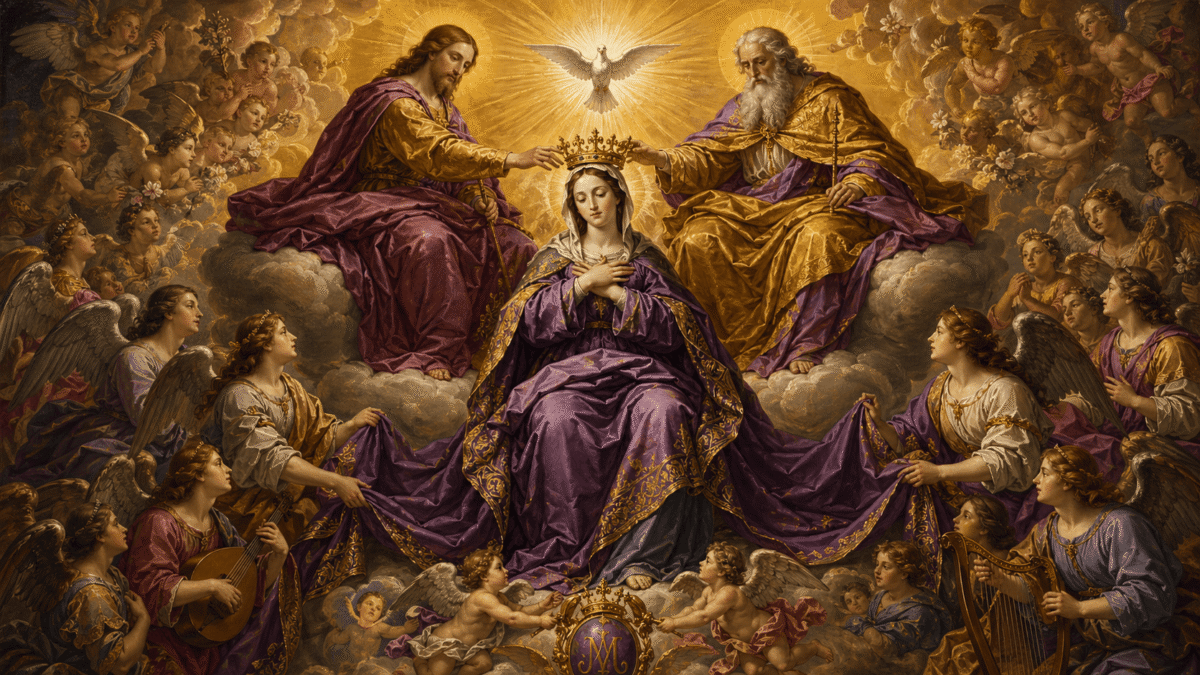
Just as Jesus, through the Resurrection, was enthroned at the Father’s right hand as messianic king (Acts 2:33-36), so Mary, assumed into heavenly glory, is seated as queen beside the Son. Ps 44:10, “at Your right hand stands the queen in gold of Ophir,” is read by the tradition as a figure of Mary’s Assumption and coronation. Christ promised to associate His disciples with His kingship (2 Tim 2:11-12, Rev 3:21). All the more must this be understood of the Mother. The Assumption inaugurates for Mary the full and effective exercise of her royal function: the Virgin’s humanity is fully pervaded by the glory of the risen Son.
Mary Queen in a Gospel sense: the queenship of service
Post-conciliar theology insists that Mary’s queenship must be understood in a Gospel key. “Mary is queen because she is a handmaid”: her greatness is not that of worldly power, but that of total self-giving to the divine design, “Behold, the handmaid of the Lord” (Lk 1:38). The Magnificat (Lk 1:46-55) is the “magna carta” of this inverted queenship: God “has cast down the mighty from their thrones and has exalted the lowly.” Mary reigns “by accepting the kingdom of God,” “by mastering the forces of evil” through humility and faith, and “by reigning crowned with glory” not in order to be served, but to intercede maternally for the children of the Son (LG 62). The opposition between a “Mariology of privileges” and a “Mariology of service” is resolved: Mary’s queenship is real precisely because it is service, a “leader” toward salvific fullness, not domineering.
The liturgical memorial
The feast of Mary Queen was instituted by Pius XII in 1954 and set on August 22 (the octave of the Assumption) by the reformed Missal of Paul VI. The antiphon Regina Caeli (twelfth-thirteenth centuries) is sung during the Easter season in place of the Salve Regina. Over the centuries the Litany of Loreto has accumulated Mary’s royal titles: Queen of Angels, Queen of Patriarchs, Queen of Apostles, Queen of All Saints, Queen conceived without original sin, Queen assumed into heaven, Queen of the Rosary, Queen of Peace.
Deepen your studies: explore Mariology, Marian Theology, Marian dogmas, and the Postgraduate Program in Mariology.
Magisterium of the Church
Mariam Virginem in altissimum caelestis regni fastigium evectam esse credimus, et Reginam regum ac Dominum dominantium honorandam esse cognoscimus.
Pius XII, Enc. Ad Caeli Reginam (11 octobris 1954)
📚 Literal translation: We believe that the Virgin Mary was raised to the highest degree of the heavenly kingdom and we acknowledge that she is to be honored as Queen of kings and Lady of lords.
Postgraduate Program in Mariology
Would you like to deepen your formation in Mariology? Discover the Postgraduate Program in Mariology of Locus Mariologicus, an academic formation that unites theological rigor, spiritual life, and the living tradition of the Church.
Learn what the Church teaches about Mary, Mediatrix of All Graces.
Would you like to study Mariology seriously?
This article arises from the works in the library of Locus Mariologicus. The Postgraduate Program in Mariology takes you to that same source, with academic guidance: Scripture, the Fathers of the Church, and the Magisterium, from the first dogma to contemporary questions.





Responses