The Redemption of Mary and the Immaculate Conception (1854): demonic testimony as theological confirmation
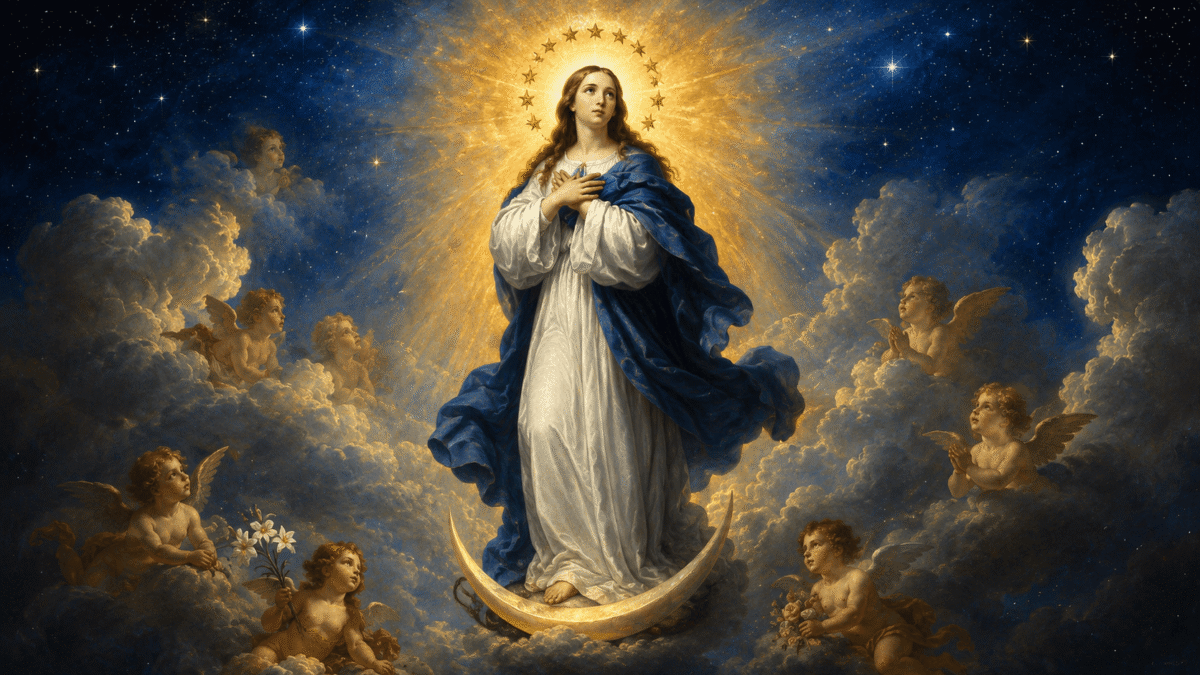
The doctrine of the redemption of Mary constitutes one of the most delicate and precise chapters of dogmatic Mariology. The question is not whether Mary was redeemed, but in what manner: not by extraction from original sin after it had contaminated her nature, as happens with all the other members of the human species, but by anticipated preservation, in virtue of the merits of Christ applied in a singular and pre-emptive way to her conception.
This specific form of redemption, technically designated preservative redemption, is the core of the dogma of the Immaculate Conception defined by Pius IX in 1854 and constitutes, at the same time, the theological foundation of a pastoral and apologetic datum of considerable scope: the documented experience of exorcisms, in which demonic entities are constrained to confirm, in the negative, Mary’s singular position in the economy of salvation.

I. Preservative redemption: dogmatic structure and theological distinction
The distinction between liberative redemption and preservative redemption is technically fundamental for understanding Mary’s position in the order of salvation. Liberative redemption, common to all human beings, presupposes the fall: Christ ransoms the sinner from a state of sin already contracted. Preservative redemption, exclusive to Mary, anticipates the application of the merits of Christ to the moment of conception, in such a way that the stain of original sin never came to touch Mary’s nature.
The bull Ineffabilis Deus of Pius IX formulates this distinction with irreproachable precision when it affirms that Mary was preserved “in view of the merits of Jesus Christ, Savior of the human race”: the initiative is Christ’s, the preservation is the effect, and Mary is the singular beneficiary of a grace that exceeds in modality, without exceeding in foundation, the grace conferred on all the other redeemed.
This theological datum has a precise ontological consequence: Mary does not share the common condition of a humanity wounded by original sin. Her nature, through the preventive action of grace, corresponds to what humanity would have been without the fall. In this strictly ontological sense, Mary represents not only the supreme beneficiary of the redemption, but the paradigm of the human creature as God conceived her in His original intention, before Adam’s disobedience introduced the rupture. The redemption of Mary is therefore at once a singular redemptive act and a restoration of the original order of creation.
II. The Immaculate Conception as the ontological opposite of sin and evil
The tradition of documented exorcisms offers an unusual perspective on the meaning of the redemption of Mary. In exorcism contexts submitted to ecclesial discernment, demonic entities have been constrained to formulate, against their own nature, affirmations about Mary that coincide with the dogmatic definitions of the Church. Among the declarations most cited by the pastoral tradition of exorcisms is the one that formulates the relation between the Immaculate Conception and the devil in terms of a radical ontological opposition: “The Immaculate Conception is my opposite”. This affirmation, wrested from the enemy by the authority of the exorcist, is not a devotional declaration but a theological proposition of high density.
The foundation of this opposition is precisely preservative redemption. Original sin is the territory of the devil: it is the wound he introduced into humanity and which constitutes the point of entry for his action upon creatures. Mary, preserved from this sin before she had even contracted it, stands outside the territory that the devil claims as his own.
The Immaculate Conception is not merely the absence of original sin: it is the full presence of original grace, the state of absolute integrity that original sin compromises in all others. In this sense, the demonic affirmation that the Immaculate Conception is his opposite is theologically exact: where the Immaculate Conception exists, original sin does not exist, and where original sin does not exist, the devil loses the ontological foundation of his action.
III. The efficacy of Marian invocation in the demonological context
The demonological testimonies documented in exorcism contexts converge on a pastoral datum of great relevance: the invocation of Mary as the Immaculate One has a specific effect, recognized by the adversary himself. The declarations obtained in exorcisms record the demonic response to the invocation “Mary conceived without sin, pray for us who have recourse to thee” with the affirmation that such an invocation is “too powerful”. This datum is not an anecdotal curiosity: it has a precise theological foundation that Mariology makes it possible to identify with rigor.
The efficacy of Marian invocation in the demonological context does not derive from a magical property of the formula, nor from a warlike or combative quality attributed to Mary. The logic is deeper and more theological: the invocation of Mary as the Immaculate One introduces into the situation the ontological reality that is the opposite of the condition the devil exploits. When the Immaculate One is invoked, the grace of preservation that she embodies becomes actively present in the situation.
The expansion of the Kingdom of God, of which the Immaculate Conception is the most perfect human paradigm after Christ, is inversely proportional to the presence of the adversary. It is not Mary who fights the devil in the proper sense: it is Christ who fought and conquered, and Mary is the most complete expression of this victory applied to human nature.
IV. The redemption of Mary and the Incarnation: the fundamental theological nexus
The redemption of Mary is not an isolated privilege: it is a condition structurally bound to the Incarnation of the Son of God. The classic argument of scholastic Mariology, taken up by the pontifical Magisterium, formulates this nexus with the utmost precision: the infinite dignity of the Son of God requires that the vessel of the Incarnation be worthy to receive Him. A mother stained by original sin would be an ontological contradiction in the logic of the Incarnation: the eternal Son, who exists from before all time in the fullness of divinity, could not assume a human flesh deriving from a nature compromised by the enemy without this constituting a disorder in the order of the divine dignity.
The patristic tradition, from Irenaeus of Lyons to John Damascene, perceived this connection before scholastic theology formalized it. The argument from fittingness, the potuit, decuit, ergo fecit, sums up this intuition: God could preserve Mary, it was fitting that He should do so in view of the Incarnation, and therefore He did so.
The redemption of Mary is, in this framework, not only the privilege of the worthiest creature, but the condition of possibility of an Incarnation that is truly worthy of the divine majesty. When the devil is forced to recognize the Immaculate Conception as his ontological opposite, he recognizes, involuntarily, the perfection of God’s redemptive plan, which was accomplished first in Mary and through Mary in all humanity.
V. The theological legacy of the preservative redemption of Mary
The doctrine of the redemption of Mary in its preservative form illuminates an aspect of Mariology that is frequently underestimated: Mary’s position is not only that of the supreme beneficiary of the grace of Christ, but that of the eschatological paradigm of the redeemed human creature. What Mary is by preservative grace, the redeemed will be by restorative grace in the final state of salvation. Mary’s glory in the Assumption, body and soul in God, is the anticipation of the destiny of all redeemed humanity: the glorious body that Mary already possesses is what awaits all those who, redeemed by the same Christ, will come to the fullness of their redemption at the end of time.
This eschatological perspective is fundamental for avoiding a merely individual or devotional reading of the Immaculate Conception. Mary’s preservation from original sin is not merely a personal favor: it is the sign of the possibility of the total and full redemption of human nature. What the devil recognizes as his opposite is not only the person of Mary, but God’s plan for humanity that Mary embodies in a paradigmatic way.
The demonological testimony concerning the Immaculate Conception is, in this framework, an involuntary testimony to the fullness of God’s redemptive plan that Mariology confesses and celebrates. Ineffabilis Deus (Pius IX, 1854) and Lumen Gentium, no. 56. The in-depth study of the redemption of Mary and of dogmatic Mariology is part of the curriculum of the Postgraduate Program in Mariology at Locus Mariologicus.
Postgraduate Program in Mariology
Would you like to deepen your formation in Mariology? Discover the Postgraduate Program in Mariology at Locus Mariologicus – an academic formation that unites theological rigor, spiritual life and the living tradition of the Church.
Learn more about the Immaculate Conception.
Would you like to study angelology and demonology in depth?
This article comes from the Locus Mariologicus library. The postgraduate specialisation in Angelology and Demonology (360 hours, fully online) studies angels and demons in Scripture, the Fathers and the Magisterium, with a whole area on practical demonology, exorcism and deliverance prayer. The new class begins on 18 January 2027. Classes are taught in Portuguese.




Responses